











 Secure payments
Standard refund policy
Trade Assurance
Secure payments
Standard refund policy
Trade Assurance
| Product Type | Memory Module |
|---|---|
| Memory Capacity | 4 GB |
| Memory Technology | DDR3 |
| Product Voltage | 1.5V |
| RAM Speed | 1333MHz |
| RAM Standard | DDR3-1333/PC3-10600 |
| Error Identifying | ECC |
| Signal Type | Registered |
| Column Access Strobe (CAS) | CL9 |
| Rank | Dual Rank x4 |
| Quantity of Pins | 240-pin |
| RAM Genre | RDIMM |
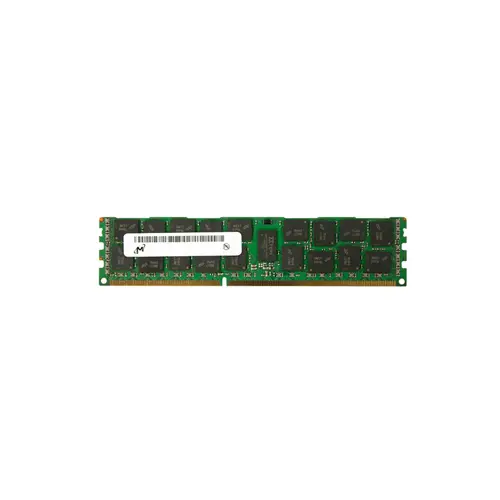
This DDR3-1333 Registered ECC memory module is engineered for legacy server platforms requiring uncompromising data integrity, making it an ideal fit for virtualization hosts and memory-intensive database applications where silent data corruption is unacceptable. Its Dual Rank x4 configuration and Registered signal type enhance signal integrity and permit higher memory population densities, while the CL9 latency provides a responsive balance for enterprise workloads.
1. ECC error correction silently detects and fixes single-bit memory faults, upholding transactional data integrity essential for financial processing and database servers.
2. The registered buffer redrives address and command signals, stabilizing multi-DIMM setups and allowing higher memory capacity per server node without signal degradation.
3. Dual Rank x4 organization interleaves requests across multiple internal banks, maximizing effective bandwidth under heavy virtual machine consolidation workloads.
4. This capacity tier provides just enough headroom for dedicated lightweight server roles like web serving and edge caching, optimizing power and cost per instance.
5. The rated transfer frequency maintains steady and predictable main-memory bandwidth, preventing bottlenecks in latency-sensitive, always-on service applications.
The MT36JSZF51272PZ-1G4F is a server-grade DDR3 Registered DIMM engineered for data centers and enterprise workloads where stability and data integrity directly impact the bottom line. Its ECC capability silently detects and corrects single-bit errors caused by cosmic radiation or electrical noise, which in a virtualized cluster could mean the difference between seamless hypervisor operation and a corrupt transaction that cascades through your entire tenant VMs. The registered buffer retransmits address and command signals cleanly across high-density memory channels, enabling you to fully populate all slots without signal degradation—a critical factor when scaling to 256GB or more for in-memory databases or dense container environments. The dual-rank x4 organization further accelerates performance by interleaving access across two internal ranks, delivering higher sustained bandwidth for memory-bound applications like Redis, SAP HANA, or heavy OLAP queries where every microsecond counts. Operating at 1333MHz with a CAS latency of 9 at 1.5V, this module balances responsive throughput with predictable thermals, helping maintain consistent energy profiles across 24/7 racks. For IT managers, these characteristics combine to deliver hardware-enforced fault tolerance, preventing silent data corruption and minimizing costly downtime in business-critical operations.
General Virtualization
This 4 GB DDR3-1333 RDIMM provides essential ECC reliability for small-scale hypervisor hosts. Build a balanced foundation by installing a minimum of six to eight identical modules for 24–32 GB, ensuring enough headroom for several lightweight VMs. Favor symmetrical channel population across all memory channels to maximize bandwidth under constant, moderate load.
In-Memory Database
In-memory databases demand both capacity and data integrity, making registered ECC a strict requirement. Populate all available DIMM slots with these 4 GB modules to reach 64 GB or higher on dual-socket servers, allowing larger datasets to reside entirely in RAM. Keep CAS latency low (CL9) to reduce query response times while the dual-rank design improves bank-level parallelism for transactional workloads.
High-Performance Computing
HPC clusters benefit from the stability of registered ECC memory during long-running parallel jobs. Deploy multiple nodes with fully populated memory channels—often twelve modules per server (48 GB)—to sustain memory bandwidth for MPI workloads. The 1.5 V operating voltage helps control thermals in dense rack environments, and keeping all DIMMs identical eliminates rank-mixing penalties that could degrade tightly synchronized computation.
Rigorously tested DDR3 server memory, compatible with Dell PowerEdge R710/R610, HP ProLiant DL380 G7, IBM System x3650 M3, and others.
Q: Can I mix this MT36JSZF51272PZ-1G4F with other memory modules of different brands or speeds?
A: Mixing is not recommended. Servers demand identical modules for stable operation. Mixing brands, speeds, or ranks may cause POST failures, signal integrity issues, or memory errors in mission-critical environments.
Q: Is this memory compatible with my system?
A: This 4GB DDR3-1333 Registered ECC RDIMM is designed for server platforms. It supports Intel Xeon 5500/5600 series and AMD Opteron 6100/6200 systems using comparable chipsets with 240-pin RDIMM slots.
Q: What is the recommended DIMM population order for optimal performance?
A: Populate identical DIMMs per channel for balanced memory bandwidth. For dual-processor servers, install matching kits symmetrically across both memory banks. Always refer to the server board’s population guide for specific slot sequences.
Q: Does this module support overclocking or XMP profiles?
A: No. Server-grade Registered ECC memory operates at strict JEDEC standard timings. Overclocking and XMP are not supported, as they compromise data integrity and system stability, which are critical in enterprise environments.
Q: What warranty and typical failure rate can I expect?
A: This module includes a 1-year warranty. Enterprise RDIMMs like Micron’s exhibit very low annualized failure rates (typically <0.5%) when operated within specified voltage, thermal, and workload parameters.