











 Secure payments
Standard refund policy
Trade Assurance
Secure payments
Standard refund policy
Trade Assurance
| Product Type | Memory Module |
|---|---|
| Memory Capacity | 4 GB |
| Memory Technology | DDR3 |
| Product Voltage | 1.5V |
| RAM Speed | 1333MHz |
| RAM Standard | DDR3-1333/PC3-10600 |
| Error Identifying | ECC |
| Signal Type | Registered |
| Column Access Strobe (CAS) | CL9 |
| Rank | Dual Rank x8 |
| Quantity of Pins | 240-pin |
| RAM Genre | RDIMM |
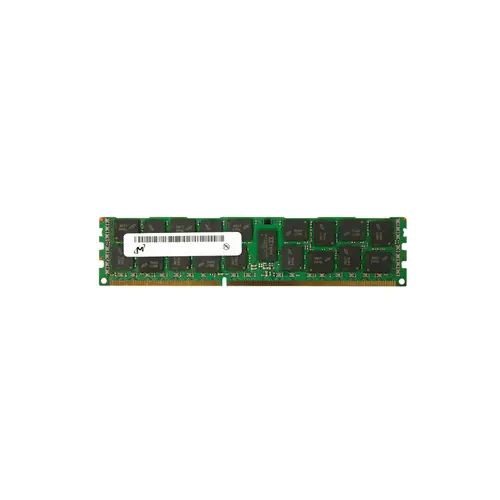
Designed for server and workstation platforms, this 4GB DDR3-1333 RDIMM with ECC and registered signal buffering ensures robust data integrity in virtualization clusters and memory-intensive database applications. Its dual-rank x8 organization improves interleaving efficiency to sustain steady bandwidth under heavy, multi-threaded loads while the CL9 latency offers responsive access in demanding enterprise environments.
1. ECC error correction silently detects and fixes single-bit memory faults, preserving data integrity for mission-critical database and financial transaction servers.
2. Registered DIMM buffering decouples the electrical load from the memory controller, ensuring rock-solid signal integrity when populating all channels for maximum virtualization density.
3. Dual Rank x8 organization enables rank interleaving that keeps the data pipeline saturated, delivering higher effective bandwidth under concurrent multi-tenant workloads.
4. A 4 GB module capacity provides granular provisioning granularity, making it cost-efficient for lightweight hypervisor hosts or dedicated network appliance roles.
5. 1333 MT/s throughput sustains a stable 10.6 GB/s per channel, guaranteeing predictable response times for steady-state enterprise applications where consistency outweighs peak bursts.
The Micron MT18JSF51272PDZ-1G4D1BB is an RDIMM engineered for servers, where downtime is not an option and every bit of data matters. Its ECC technology actively corrects single-bit memory errors caused by background radiation, preventing silent data corruption in financial transaction logs or real-time analytics databases where even one flipped bit can cascade into costly miscalculations. The registered buffer isolates the memory controller from the electrical load of multiple DIMMs, enabling you to populate all memory channels with stability. This means a virtualization cluster can confidently run dozens of VMs on a single node without signal integrity failures during peak consolidation workloads. The dual-rank x8 organization interleaves access across two internal rank groups, effectively doubling command bandwidth. For an in-memory database like Redis or SAP HANA, this translates directly into lower latency on random read-heavy operations and smoother throughput when responding to thousands of concurrent queries. Operating at 1333MHz with a CL9 latency and a dependable 1.5V profile, this module balances responsive performance with the thermal consistency required for 24/7 rack environments where cooling and uptime are paramount.
General Virtualization
For a virtualization host, populate all memory channels symmetrically to maximize bandwidth. Using this 4 GB RDIMM, install at least twelve modules across a dual-socket platform to achieve a 48 GB pool suitable for a moderate number of lightweight VMs. Avoid mixing single and dual-rank DIMMs within the same channel to prevent performance penalties.
In-Memory Database
In-memory databases demand capacity and low latency rather than sheer throughput. Deploy multiple 4 GB RDIMMs to reach higher capacities, but be mindful that dual-rank x8 DIMMs can stress the memory controller when fully loaded. Target a balanced configuration of six or twelve modules per CPU to maintain stable CL9 timing under sustained write-intensive loads.
High Performance Computing
HPC workloads benefit from peak memory bandwidth, so populate at least one DIMM per channel per socket. This 4 GB RDIMM, operating at 1333 MHz, is best deployed in fully populated banks to enable channel interleaving. For compute-bound clusters using registered DDR3, uniformity is critical—standardize on identical 240-pin RDIMMs across all nodes to ensure predictable NUMA behavior and reduce job scheduling variance.
Rigorously tested server memory, compatible with Dell PowerEdge R710/R720, HP DL380 G7/Gen8, and more.
Q: Can I mix this MT18JSF51272PDZ-1G4D1BB with other memory modules of different brands or speeds?
A: Mixing RDIMMs is not recommended for server environments. Different brands or speeds may cause signal integrity issues, BIOS errors, or system instability. Always populate with identical, validated modules to ensure mission-critical reliability.
Q: Is this memory compatible with my Intel or AMD server platform?
A: This DDR3-1333 Registered ECC module is compatible with servers using Intel Xeon 5500/5600 series or AMD Opteron 6100/6200 series platforms that support 1.5V RDIMMs. Please confirm your motherboard's qualified vendor list.
Q: What is the recommended DIMM population order for optimal performance?
A: For dual-socket servers, populate identical DIMMs in matching blue or black slots per channel, typically starting with slot 1 in each memory channel. Refer to your system’s manual for balanced configurations, using equal ranks across channels.
Q: Does this module support overclocking or XMP profiles?
A: No. This is a JEDEC-standard Registered ECC server DIMM operating at fixed 1333MHz CL9 timings. It does not support overclocking or Intel XMP profiles, as server platforms prioritize data integrity and stability over frequency tuning.
Q: What warranty and typical failure rate can I expect?
A: This module carries a 1-year warranty. With enterprise-grade 1.5V components and stringent testing, its annualized failure rate (AFR) is typically below 0.5%, ensuring dependable long-term operation in 24/7 server environments.