











 Secure payments
Standard refund policy
Trade Assurance
Secure payments
Standard refund policy
Trade Assurance
| Model | MT36JDZS51272PZ-1G4F1 |
|---|---|
| Product Type | Memory Module |
| Compliance Standards | RoHS |
| Memory Capacity | 4 GB |
| Memory Technology | DDR3 |
| Product Voltage | 1.5V |
| RAM Speed | 1333MHz |
| RAM Standard | DDR3-1333/PC3-10600 |
| Error Identifying | ECC |
| Signal Type | Registered |
| Column Access Strobe (CAS) | CL9 |
| Rank | Dual Rank x4 |
| Quantity of Pins | 240-pin |
| RAM Genre | VLP RDIMM |
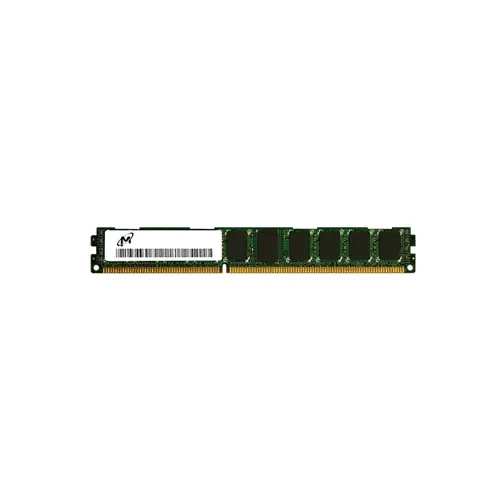
Designed as a Very Low Profile (VLP) registered DDR3 module with ECC, this 4GB dual-rank x4 DIMM is ideal for dense server deployments and virtualization workloads where data integrity and thermal clearance are critical. Its registered signal architecture ensures stable operation across high-capacity memory configurations, while ECC and a CL9 CAS latency provide reliable error correction and responsive access for memory-centric applications like in-memory databases.
1. ECC detection and correction guards against silent data corruption, preserving transactional accuracy in financial and database server operations.
2. Registered signal buffering stabilizes command and address lines across fully populated channels, ensuring reliable scaling to higher memory capacities.
3. Very low profile RDIMM design fits seamlessly into space-constrained blade and 1U server chassis, improving airflow and sustaining thermal margins under continuous load.
4. Dual rank x4 organization interleaves internal banks to deliver higher sustained bandwidth, directly benefiting virtualization density and concurrent workload throughput.
5. DDR3-1333 speed tier supplies ample per-channel throughput for legacy server roles, keeping memory-bound batch processing and web serving responsive without overprovisioning.
The Micron MT36JDZS51272PZ-1G4F1 is a VLP Registered DDR3-1333 RDIMM engineered specifically for server environments, where data integrity and unwavering uptime are non-negotiable. Its ECC technology actively detects and corrects single-bit memory errors caused by cosmic radiation or electrical interference, preventing silent data corruption that could silently cascade through virtualized clusters or corrupt financial records. The registered signal buffer stabilizes command and address lines across densely populated motherboards, allowing you to confidently scale to large memory capacities without signal degradation—critical when consolidating multiple VMs on a single host. In a memory-intensive database engine like SAP HANA or a transactional SQL environment, the dual-rank x4 organization optimizes bank-level parallelism, boosting bandwidth efficiency under heavy concurrent query loads. A real-world example: in a VMware vSphere cluster running live migration, ECC safeguards in-flight VM state from bit flips, while the RDIMM’s buffered design maintains signal clarity across all populated channels, avoiding silent failures during high-stakes vMotion operations. For a Redis or Memcached in-memory store, the balanced rank architecture reduces latency spikes during cache eviction storms, ensuring consistent response times. With a low 1.5V operating voltage and VLP form factor, it also eases thermal constraints in blade servers where every millimeter and watt counts. This memory transforms raw server hardware into a trusted foundation for mission-critical workloads, where the cost of a single uncorrected error far outweighs the investment in reliable infrastructure.
General Virtualization
This 4GB VLP RDIMM is a Registered ECC DDR3-1333 module designed for server platforms. For a lightweight virtualization host running 5–8 low‑resource VMs, install six to eight identical modules across three channels per CPU (triple‑channel architecture) to reach 24–32GB, ensuring memory bandwidth and basic fault tolerance. Always populate ranks symmetrically to maintain interleaving and balanced NUMA access.
In‑Memory Database
In‑memory databases demand high capacity and reliability, but a single 4GB DIMM is too small for standalone use. Combine twelve or more of these RDIMMs in a dual‑socket server to achieve 48–96GB, dedicating capacity to a Redis or Memcached instance handling moderate datasets. Rely on ECC protection to guard against bit‑flip errors that corrupt cached records, and set conservative overcommit rules to avoid swapping.
High‑Performance Computing
For HPC clusters where many nodes run distributed tasks, use six DIMMs per hexa‑channel server to obtain 24GB per node, matching the CPU’s memory bandwidth to keep all cores fed. The registered interface stabilises signal integrity across the high‑density ranks, while 1.5V operation helps control thermal output in dense rack configurations. When the workload exceeds local capacity, scale out to additional nodes rather than upgrading individual DIMMs.
Rigorously tested DDR3 RDIMM, compatible with Dell R710/R720, HP DL380p G8, IBM x3650 M4, Cisco C220 M3.
Q: Can I mix this MT36JDZS51272PZ-1G4F1 with other memory modules of different brands or speeds?
A: Mixing different brands or speeds of Registered ECC memory can cause signal integrity issues. To ensure reliable 24/7 operation, always use modules with the same part number, speed, and rank.
Q: Is this memory compatible with my system?
A: This Dual Rank x4 VLP RDIMM is compatible with servers using DDR3-1333 ECC Registered memory, such as Intel Xeon 5500/5600 series or AMD Opteron 4000/6000 platforms. Verify with your motherboard’s memory QVL.
Q: What is the recommended DIMM population order for optimal performance?
A: For optimal bandwidth, populate one DIMM per memory channel first (e.g., slots A1, B1, C1), then add to A2, B2, C2. Consult your server manual for the correct interleaving order.
Q: Does this module support overclocking or XMP profiles?
A: No. This server Registered ECC module adheres strictly to JEDEC DDR3-1333 CL9 specifications. Overclocking or XMP profiles are not supported, as system stability and data integrity are paramount.
Q: What warranty and typical failure rate can I expect?
A: This module includes a 1-year warranty against defects. Enterprise server memory is built for high reliability; typical annual failure rate is under 0.5% under specified operating conditions, ensuring long-term stability.