











 Secure payments
Standard refund policy
Trade Assurance
Secure payments
Standard refund policy
Trade Assurance
| Product Type | Memory Module |
|---|---|
| Compliance Standards | RoHS |
| Memory Capacity | 4 GB |
| Memory Technology | DDR3 |
| Product Voltage | 1.5V |
| RAM Speed | 1333MHz |
| RAM Standard | DDR3-1333/PC3-10600 |
| Error Identifying | ECC |
| Signal Type | Registered |
| Column Access Strobe (CAS) | CL9 |
| Rank | Dual Rank x4 |
| Quantity of Pins | 240-pin |
| RAM Genre | RDIMM |
Designed for server platforms, this 4GB DDR3-1333 RDIMM with ECC and registered signal ensures critical data integrity for virtualization and in-memory database workloads. Its dual-rank x4 configuration at CL9 latency optimizes memory bandwidth and reduces electrical loading, delivering stable performance in dense, multi-DIMM deployments.
1. ECC memory actively detects and corrects single-bit errors, preserving data integrity for transactional databases and financial processing workloads that cannot tolerate silent corruption.
2. Registered signal type buffers address and command lines, stabilizing signal integrity across fully populated server boards to support massive in-memory datasets without unexpected downtime.
3. Dual Rank x4 organization interleaves access across multiple bank groups, sustaining high throughput in virtualization hosts where many VMs contend for shared memory bandwidth.
4. 4 GB capacity per module provides a dense building block for scaling total system memory, allowing mid‑range servers to allocate ample resources per virtual machine in consolidation scenarios.
5. 1333 MHz clock speed delivers balanced bandwidth for I/O‑bound enterprise applications, reducing latency spikes when simultaneous requests hit the memory controller under peak loads.
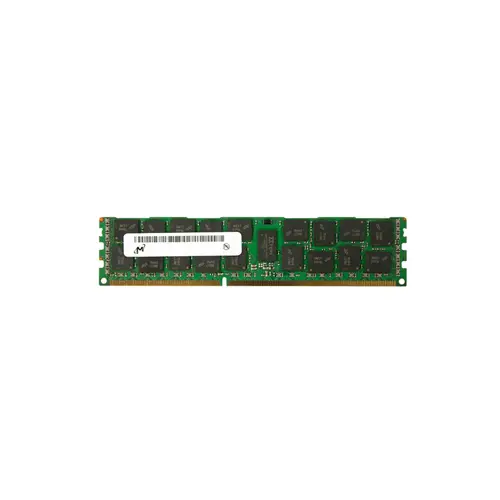
Engineered for mission-critical server environments, this Micron 4GB DDR3-1333 RDIMM directly tackles the challenges IT professionals face daily. Its ECC technology actively detects and corrects single-bit memory errors, a non-negotiable safeguard when a flipped bit in a virtualization cluster can cascade into silent data corruption and costly VM crashes. The registered signal buffer stabilizes the command interface between the CPU and memory, enabling you to populate all channels with confidence and avoid boot failures in dense database servers where every gigabyte counts. Furthermore, the dual-rank x4 organization leverages rank interleaving to boost effective bandwidth by overlapping data transfers, significantly accelerating in-memory analytics platforms like SAP HANA or large Redis caches where microsecond latency directly impacts transactional throughput. In both scale-out virtual server farms and latency-sensitive financial trading databases, this module delivers the data integrity, signal reliability, and throughput needed to keep your services online and responsive without constant hardware babysitting. Crucially, the standard 1.5V profile ensures legacy platform compatibility while adhering to RoHS compliance, simplifying your refresh cycle within existing data center infrastructure.
General Virtualization
This 4 GB DDR3-1333 RDIMM is suited for legacy hypervisor hosts running light to moderate VM densities. For basic virtualization, populate at least six identical modules per socket to enable balanced memory channels and avoid NUMA penalties. Aim for 24–48 GB total per host using six to twelve of these 4 GB DIMMs to comfortably run a dozen small VMs.
In-Memory Database
In-memory workloads demand capacity and reliability, so leverage the ECC and registered nature of these modules. Deploy a full set of 12 or 18 DIMMs per server to reach 48–72 GB, which can hold moderate datasets entirely in RAM. Given the low 4 GB density, this configuration is best for small-scale Redis or memcached clusters where cost-effective redundancy is prioritized over massive capacity.
High-Performance Computing
Registered ECC memory ensures signal integrity in multi-socket, compute-dense nodes typical of HPC. Populate all memory channels symmetrically—often 8 or 16 DIMMs per node—to maximize bandwidth for memory-bound simulations. While 4 GB sticks limit total capacity to 64–128 GB per node, this is still viable for embarrassingly parallel workloads that scale horizontally across many smaller nodes.
Strictly tested RDIMM for Dell PowerEdge R710, HP ProLiant DL360 G7, IBM System x3650 M3.
Q: Can I mix this MT36JSZF51272PZ-1G4F1AB with other memory modules of different brands or speeds?
A: Mixing this registered ECC memory with different brands or speeds is strongly discouraged. It risks instability and uncorrected errors. For server reliability, always use identical part numbers.
Q: Is this memory compatible with my system?
A: This DDR3-1333 ECC RDIMM is compatible with servers supporting registered DDR3 memory, such as Intel Xeon 5500/5600 or AMD Opteron 6000 platforms. Always check your system's qualified vendor list to confirm support.
Q: What is the recommended DIMM population order for optimal performance?
A: Population order depends on your server board. Typically, install identical DIMMs in matched channels, starting with the farthest slot from the CPU, to enable memory interleaving. Refer to your system’s manual for exact configuration.
Q: Does this module support overclocking or XMP profiles?
A: No, this is a JEDEC-compliant registered server module engineered for maximum stability and data integrity. It does not support overclocking or XMP profiles.