











 Secure payments
Standard refund policy
Trade Assurance
Secure payments
Standard refund policy
Trade Assurance
| Product Type | Memory Module |
|---|---|
| Memory Capacity | 4 GB |
| Memory Technology | DDR3 |
| Product Voltage | 1.5V |
| RAM Speed | 1333MHz |
| RAM Standard | DDR3-1333/PC3-10600 |
| Error Identifying | ECC |
| Signal Type | Registered |
| Column Access Strobe (CAS) | CL9 |
| Rank | Dual Rank x4 |
| Quantity of Pins | 240-pin |
| RAM Genre | RDIMM |
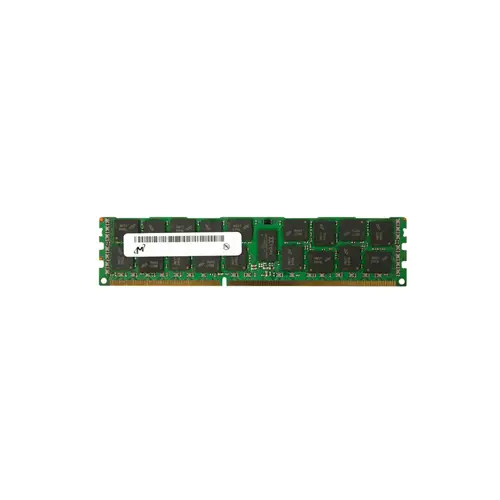
This Micron 4GB DDR3-1333 RDIMM is engineered for server platforms requiring data integrity, with its registered ECC design and dual-rank x4 configuration ensuring stable operation under heavy memory loads typical of virtualization and in-memory databases. The CL9 latency strikes a practical balance between responsiveness and power efficiency, making this 1.5V module a reliable choice for enterprise workloads that demand consistent uptime and error correction.
1. ECC end-to-end error correction detects and fixes single-bit data corruption silently, preserving transactional integrity for mission-critical databases and long-running analytics.
2. Registered DIMM buffering offloads the memory controller, stabilizing signal paths to support high-density memory populations crucial for large-scale virtualization hosts.
3. Dual-rank organization increases bank-level parallelism and saturates memory channels, delivering consistent low-latency throughput under heavy VM consolidation workloads.
4. This module’s capacity offers a cost-efficient foundation for mid-density server nodes, allowing flexible guest-memory allocation without over-provisioning budgets.
5. The mainstream DDR3 speed grade provides steady per-channel bandwidth, eliminating data fetch stalls in high-concurrency caching and content-serving deployments.
The MT36JSZF51272PZ-1G4G1HF is a server-grade Registered DIMM built for data centers where reliability and uptime are non-negotiable. Its ECC technology silently corrects single-bit memory errors caused by cosmic radiation or electrical noise, a critical safeguard when a flipped bit in a virtualized cluster could silently corrupt a hypervisor’s memory state and crash dozens of guest machines. The registered signal buffering on this 240-pin module separates data and command paths through an on-board register, stabilizing the electrical load so you can populate all memory channels without timing degradation—essential for large-scale virtualization hosts that demand 128 GB or more of stable, fully utilized RAM. Dual-rank x4 organization doubles the internal bank groups, enabling interleaved access that measurably improves bandwidth under concurrent workloads; when your in-memory database like Redis or SAP HANA processes millions of transactions per second, that extra throughput directly translates into lower query latency and higher operations per second. Running at 1333 MHz with CL9 latency, the 1.5 V module balances heat and power within dense server racks, reducing thermal throttling risks and fitting seamlessly into existing cooling envelopes—so your high availability cluster keeps humming through peak financial close or e-commerce flash sales without a moment of doubt.
General Virtualization
For dense virtual machine hosting, capacity must be balanced per core. A single 4 GB RDIMM is too small for modern hypervisors; populate at least six identical modules for 24 GB to run a modest ESXi or Hyper-V host. Ensure all channels are filled symmetrically to maintain NUMA alignment and registered ECC stability under mixed workloads.
In-Memory Database
In-memory databases like Redis or SAP HANA demand low latency and absolute data integrity. Use multiple 4 GB dual-rank x4 RDIMMs to leverage rank interleaving and reduce memory access gaps. For a small caching node, install at least 64 GB (16 modules) across all memory channels to keep the working set fully resident and avoid swap starvation.
High-Performance Computing (HPC)
HPC clusters require maximum throughput per node. Although 4 GB modules are low density, populate every available DIMM slot with identical DDR3-1333 registered ECC modules to achieve the highest aggregate bandwidth. Configure rank sparing or mirroring only if total capacity headroom allows; performance-optimized profiles should target a balanced DIMM-per-channel ratio to feed all cores continuously without throttling.
Rigorously tested, compatible with Dell PowerEdge R720, HPE ProLiant DL380p Gen8, Lenovo System x3650 M4.
Q: Can I mix this MT36JSZF51272PZ-1G4G1HF with other memory modules of different brands or speeds?
A: Mixing registered ECC modules from different vendors or with varying speeds is not recommended. It may cause signal integrity issues, instability, or force all DIMMs to the lowest common speed, compromising server reliability.
Q: Is this memory compatible with my system?
A: This is a DDR3-1333 Registered ECC RDIMM for servers. Compatibility depends on the motherboard chipset and processor. It requires a platform supporting registered DDR3 memory, such as Intel Xeon 5500/5600 series or AMD Opteron 4100/6100 series.
Q: What is the recommended DIMM population order for optimal performance?
A: Optimal population order is board-specific. Generally, balance memory across all memory channels, populate identical DIMMs per channel, and follow the slot numbering in your server motherboard's manual to maximize interleaving and throughput.
Q: Does this module support overclocking or XMP profiles?
A: No, this server-grade registered DDR3 module adheres strictly to JEDEC standards for deterministic reliability. It does not support overclocking or XMP profiles, as data integrity and stability under sustained load are paramount in server environments.
Q: What warranty and typical failure rate can I expect?
A: This module includes a one-year warranty. As an enterprise-class RDIMM, it delivers a very low annualized failure rate (AFR) typically below 0.5% under specified operating conditions, backed by rigorous post-production testing.