











 Secure payments
Standard refund policy
Trade Assurance
Secure payments
Standard refund policy
Trade Assurance
| Product Type | Memory Module |
|---|---|
| Compliance Standards | RoHS |
| Memory Capacity | 4 GB |
| Memory Technology | DDR3 |
| Product Voltage | 1.35V |
| RAM Speed | 1333MHz |
| RAM Standard | DDR3-1333/PC3-10600 |
| Error Identifying | ECC |
| Signal Type | Registered |
| Column Access Strobe (CAS) | CL9 |
| Rank | Dual Rank x8 |
| Quantity of Pins | 240-pin |
| RAM Genre | RDIMM |
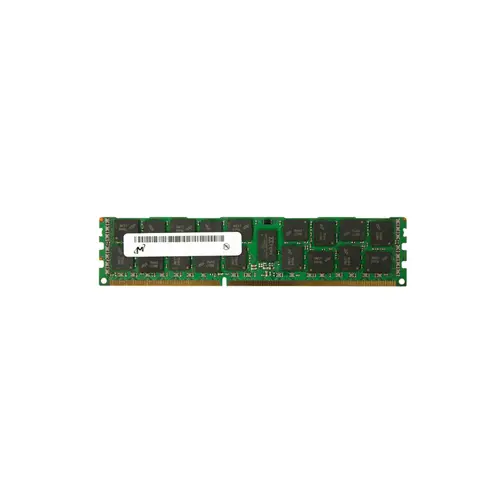
This 4GB DDR3-1333 Registered ECC RDIMM is engineered for entry-level servers and small-scale virtualization or database workloads where data integrity and 24/7 stability are critical. Its dual-rank x8 design at CL9 latency, combined with registered signaling and 1.35V low-voltage operation, delivers reliable error correction and balanced electrical loading for consistent performance in multi-DIMM memory configurations.
1. ECC protection silently corrects memory errors in real time, preserving data integrity for mission-critical databases and preventing costly server crashes.
2. Registered buffering decouples the memory bus from the CPU, enabling large memory footprints to run stably across all slots without signal degradation.
3. The module’s capacity per stick strikes a practical balance for hosting moderate virtual machines, optimizing density without wasting scarce DIMM slots.
4. Dual rank organization interleaves memory accesses to keep the channel fully utilized, improving transaction throughput for concurrent enterprise workloads.
5. Low-voltage operation cuts overall energy consumption and thermal output, directly reducing infrastructure costs in dense server deployments.
The Micron MT18KSF51272PDZ-1G4M1HF is a server-grade registered DIMM engineered for relentless reliability in enterprise data centers. Its ECC technology is your first line of defense against single-bit memory errors caused by background radiation—an invisible threat that can silently corrupt transactional databases or hypervisor state in a virtualized cluster. Without ECC, these errors accumulate into data loss or unexpected system crashes, but with this module, every bit flip is detected and corrected in real time, preserving the integrity of your critical workloads.
The registered architecture buffers command and address signals, enabling a server to simultaneously populate all memory channels with multiple DIMMs without electrical degradation. In a dense VMware or Hyper‑V host running dozens of virtual machines, this means you can scale to 192 GB or beyond across dual sockets while maintaining absolute signal stability, avoiding the memory training failures that plague unbuffered designs under high load. Operating at just 1.35 volts, the module further reduces thermal stress and energy consumption across a full rack of 2U servers, directly lowering power bills and cooling demands in a colocation facility. Finally, its dual‑rank configuration leverages bank interleaving so that an in‑memory database like Redis or SAP HANA sees consistently higher bandwidth and lower latency during concurrent read‑write operations, preventing the throughput bottlenecks that frustrate users during peak transaction windows.
Because this is a DDR3 Registered ECC module (RDIMM) with low voltage, capacity planning targets server‑class workloads.
General Virtualization
Populate memory channels symmetrically across both sockets to enable mirroring or sparing and maintain balanced bandwidth. A typical dual‑socket host should use 16 identical 4 GB modules (64 GB) or 24 modules (96 GB), covering dozens of light to medium VMs with full ECC protection.
In‑Memory Database
Maximize capacity and rank interleaving by filling all available DIMM slots with these dual‑rank RDIMMs. On a four‑socket platform supporting 16 slots per CPU, 64 modules deliver 256 GB and keep latency low under heavy cache pressure. Always install identical modules per channel to avoid performance penalties.
High‑Performance Computing
HPC nodes demand peak memory bandwidth more than raw capacity. Install equal numbers of modules in every channel—for instance, 16 modules (two per channel) on a dual‑processor board to reach 64 GB at full 1333 MT/s. The 1.35 V operation also helps control power budgets in dense clusters. Never mix different ranks or speeds within a channel.
This server memory has been rigorously tested and is compatible with Dell PowerEdge R720, HP DL380p Gen8, Lenovo x3650 M4.
Q: Can I mix this MT18KSF51272PDZ-1G4M1HF with other memory modules of different brands or speeds?
A: Mixing RDIMMs with different brands, speeds, or ranks is strongly discouraged. It may cause POST failures or silent data corruption due to mismatched timing and signal integrity requirements.
Q: Is this memory compatible with my system?
A: This DDR3-1333 Registered ECC RDIMM is designed for server platforms supporting Intel Xeon E5-2400/E5-2600 v1/v2 or AMD Opteron 6300 series processors. Verify your board supports 1.35V 4GB Dual Rank x8 modules.
Q: What is the recommended DIMM population order for optimal performance?
A: Populate identical RDIMMs per channel starting with the slot farthest from the CPU. For dual-processor systems, balance memory across both sockets and follow the motherboard's DIMM numbering to enable channel interleaving.
Q: Does this module support overclocking or XMP profiles?
A: No. This is a JEDEC-compliant server RDIMM. It does not support XMP or overclocking. Operating beyond rated 1333MHz or CL9 timings compromises signal integrity and server reliability.
Q: What warranty and typical failure rate can I expect?
A: This module is backed by a 1-year warranty. Annualized failure rates for Micron-manufactured RDIMMs are typically well below 0.5% under proper thermal and usage conditions.