











 Secure payments
Standard refund policy
Trade Assurance
Secure payments
Standard refund policy
Trade Assurance
| Model | MT18JSZF51272PXZ-1G6 |
|---|---|
| Product Type | Memory Module |
| Compliance Standards | RoHS |
| Memory Capacity | 4 GB |
| Memory Technology | DDR3 |
| Product Voltage | 1.5V |
| RAM Speed | 1600MHz |
| RAM Standard | DDR3-1600/PC3-12800 |
| Error Identifying | ECC |
| Signal Type | Registered |
| Column Access Strobe (CAS) | CL11 |
| Rank | Single Rank x4 |
| Quantity of Pins | 240-pin |
| RAM Genre | RDIMM |
This DDR3-1600 registered ECC memory module (RDIMM) is purpose-built for server platforms running virtualization, in-memory databases, and other mission-critical workloads that demand uncompromising data integrity. Its single-rank x4 organization and registered signal architecture minimize electrical loading on the memory bus, enabling stable, high-density deployments while ECC scrubbing corrects single-bit errors in real time.
1. Error correction code detects and corrects single-bit memory errors, safeguarding transactional data integrity in always-on enterprise databases.
2. Registered signal buffering stabilizes command and address lines, enabling reliable operation across densely populated server memory channels.
3. A moderate memory capacity suits lightweight virtualization hosts or dedicated appliances where power efficiency and cost per node are prioritized.
4. The 1600 MHz clock rate delivers sufficient bandwidth for concurrent request processing in mid-tier application servers.
5. Single Rank x4 organization reduces electrical loading on the memory bus, promoting higher signal integrity for consistent uptime in multi-DIMM configurations.
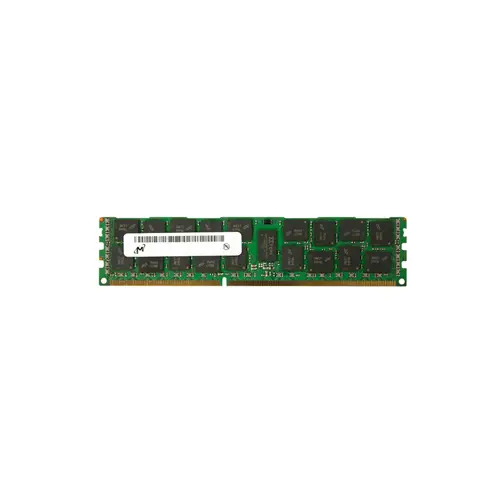
In the data center, where virtualization clusters and in-memory databases like Redis form the backbone of modern services, the Micron RDIMM MT18JSZF51272PXZ-1G6 is engineered for uncompromising reliability. Its ECC capability is your first line of defense against silent data corruption. A single bit flip can crash a hypervisor hosting dozens of virtual machines or poison a financial transaction in a database cache; ECC detects and corrects these errors instantly, preserving data integrity and preventing costly downtime. The Registered signal buffering stabilizes command and address lines, drastically reducing electrical load on the memory controller. This means you can fully populate all DIMM slots without sacrificing 1600MHz speed, enabling dense memory configurations for large-scale virtualization. Operating at 1600MHz with CL11 latency, this module delivers 12.8GB/s of bandwidth, keeping high-concurrency database queries and live VM migrations fast and bottleneck-free. Finally, its Single Rank x4 construction provides an optimal balance of capacity and signal integrity, allowing higher per-channel memory populations while maintaining rock-solid timing—a critical advantage when scaling hyperconverged infrastructure. For your business, that translates directly into higher uptime, faster workload responsiveness, and a lower total cost of ownership.
General Virtualization
For moderate-density virtualization, populate the server with a balanced configuration using at least four of these 4GB RDIMMs (16GB total) across multiple channels to maximize memory bandwidth. This provides enough capacity for a handful of virtual machines while ECC ensures data integrity. Scale to 8 or more modules for heavier consolidation.
In-Memory Database
In-memory databases demand both capacity and fault tolerance, so install a minimum of sixteen 4GB modules (64GB) evenly across all memory channels for optimal parallelism. ECC and registered buffering are essential here to prevent silent data corruption. Consider full populating the server to 128GB or beyond if working datasets are larger.
High-Performance Computing (HPC)
HPC workloads benefit from maximum memory bandwidth, so install six or eight modules in a triple-channel or quad-channel configuration (24–32GB) to saturate all channels. The registered ECC design supports stable, long-running simulations. For larger memory footprints, scale to multiple nodes rather than overloading a single server with these modules.
Rigorously tested for compatibility with servers including Dell PowerEdge R720, HP ProLiant DL380p Gen8, and similar DDR3 ECC RDIMM systems.
Q: Can I mix this MT18JSZF51272PXZ-1G6 with other memory modules of different brands or speeds?
A: Mixing RDIMMs with different brands or speeds is strongly discouraged. It can cause instability, boot failures, or silent data corruption. For server environments, always install identical modules validated for your platform.
Q: Is this memory compatible with my server system?
A: This DDR3-1600 Registered ECC module works with select Intel Xeon E5/E5 v2 and AMD Opteron platforms using the C602/C606 chipsets. Verify your server's qualified vendor list (QVL) for exact 4GB RDIMM support.
Q: What is the recommended DIMM population order for optimal performance?
A: Follow your server motherboard manual; typically populate identical DIMMs per channel, starting with the farthest slot from the CPU. Use balanced configurations across all memory channels for best throughput and ECC effectiveness.
Q: Does this module support overclocking or XMP profiles?
A: No. This is a JEDEC-compliant registered ECC DIMM built for data integrity, not overclocking. It runs at standard 1600MHz with CL11 timings and does not feature XMP profiles.
Q: What warranty and typical failure rate can I expect?
A: This module includes a 1-year warranty. Enterprise-grade RDIMMs like this have very low annualized failure rates (commonly under 0.5%) under proper thermal and electrical conditions.