

 Secure payments
Standard refund policy
Trade Assurance
Secure payments
Standard refund policy
Trade Assurance
| Product Type | Memory Module |
|---|---|
| Compliance Standards | RoHS |
| Memory Capacity | 4 GB |
| Memory Technology | DDR3 |
| Product Voltage | 1.5V |
| RAM Speed | 1066MHz |
| RAM Standard | DDR3-1066/PC3-8500 |
| Error Identifying | ECC |
| Signal Type | Registered |
| Column Access Strobe (CAS) | CL7 |
| Rank | Dual Rank x4 |
| Quantity of Pins | 240-pin |
| RAM Genre | RDIMM |
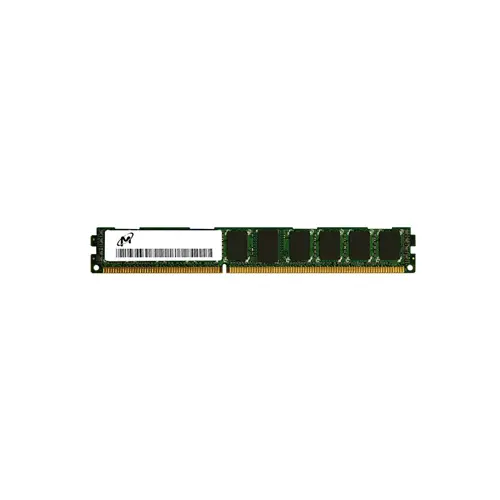
This RDIMM with ECC and registered signaling is engineered for server platforms running virtualization, memory databases, or mission-critical applications that demand uncompromising data integrity. The dual-rank x4 organization delivers an optimal balance of density and interleaving efficiency, while the CL7 latency ensures responsive memory access in highly consolidated, multi-DIMM deployments.
1. ECC detection and correction prevents silent data corruption, preserving transactional integrity for mission-critical databases and financial applications.
2. Registered signal buffering reduces electrical loading on the memory controller, enabling stable operation across fully populated multi-socket server platforms.
3. Dual Rank x4 organization interleaves access across internal banks, maximizing channel utilization and bandwidth for dense virtual machine consolidation.
4. A 4GB modular density supplies fine-grained capacity building blocks, allowing cost-efficient scaling in light-load containers and web farm nodes.
5. DDR3 technology ensures broad compatibility with a vast installed base of enterprise servers, simplifying lifecycle extensions and sparing logistics.
The MT36JSZF51272PZ-1G1F is a 4GB DDR3-1066 Registered DIMM purpose-built for server environments, where uptime and data accuracy are non-negotiable. Its four defining characteristics translate directly into real-world reliability for your infrastructure.
First, ECC technology actively detects and corrects single-bit memory errors, preventing silent data corruption that could poison a financial transaction log or slowly degrade a hypervisor’s state in a multi-tenant virtualized cluster. Second, the Registered signal architecture buffers command and address lines, enabling you to populate all 24 DIMM slots of a typical dual-socket server without signal degradation—critical when scaling memory capacity for dense VMware or KVM farms. Third, the Dual-Rank x4 organization interleaves two internal sets of memory arrays, boosting bandwidth during parallel read/write operations. In an in-memory database like Redis or SAP HANA, this parallelism reduces access latency and raises throughput under heavy concurrent queries. Finally, running at a standard 1.5V with a tight CAS latency of 7, the module delivers consistent, predictable response times without excessive power draw. For the IT manager, this means stable virtual machine failover, faster data set reloads, and assured integrity where every bit counts.
General Virtualization
For a virtualization host using these 4 GB RDIMMs, populate all memory channels symmetrically to reach a practical capacity; for example, 18 modules in a dual-socket server provide 72 GB, supporting many light VMs. The registered ECC architecture permits up to three DIMMs per channel without signal degradation, making this a reliable entry-level configuration.
In-Memory Database
In-memory databases require maximum capacity. Fill all DIMM slots with these dual-rank x4 RDIMMs—e.g., 18 modules for 72 GB on a dual-socket server—and distribute equally across channels for balanced interleaving. Because the 4 GB capacity is modest, consider clustering multiple nodes for larger datasets.
HPC
HPC workloads need high memory bandwidth. Populate each channel with identical 4 GB RDIMMs, such as two per channel on a triple-channel system (12 modules, 48 GB), to enable interleaved access and maximize throughput. The ECC and registered design ensures reliability for extended computation.
Rigorously tested and compatible with Dell PowerEdge R710, HP ProLiant DL380 G7, and IBM System x3650 M3.
Q: Can I mix this MT36JSZF51272PZ-1G1F with other server memory modules of different brands or speeds?
A: Mixing Registered ECC memory is not recommended. Different brands or speeds can cause signal integrity issues and system instability. Always use identical modules for validated performance and reliability.
Q: Is this memory compatible with my Intel or AMD server platform?
A: This DDR3 Registered ECC RDIMM requires a server motherboard with a compatible chipset, such as Intel C600 series or AMD SR56x0/SP5100, supporting 1066MHz registered memory. Please verify your system's memory QVL.
Q: What is the recommended DIMM population order for optimal performance in a server?
A: Follow your server board’s manual. Typically, populate identical RDIMMs starting with the farthest slot from the CPU per channel. Balance memory across channels to maximize bandwidth and interleaving.
Q: Does this module support overclocking or XMP profiles?
A: No. This is a server-grade Registered ECC module designed for absolute data integrity and stability. It operates strictly at JEDEC standard DDR3-1066 and does not support overclocking or XMP.
Q: What warranty and typical failure rate can I expect with this memory?
A: This module includes a 1-year warranty. Server RDIMMs are designed for high reliability with a typical AFR below 0.5% under specified conditions, ensuring long-term stability in 24/7 mission-critical environments.