











 Secure payments
Standard refund policy
Trade Assurance
Secure payments
Standard refund policy
Trade Assurance
| Model | MT18JSF51272AZ-1G1A1 |
|---|---|
| Product Type | Memory Module |
| Compliance Standards | RoHS |
| Memory Capacity | 4 GB |
| Memory Technology | DDR3 |
| Product Voltage | 1.5V |
| RAM Speed | 1066MHz |
| RAM Standard | DDR3-1066/PC3-8500 |
| Error Identifying | ECC |
| Signal Type | Unbuffered |
| Column Access Strobe (CAS) | CL7 |
| Rank | Dual Rank x8 |
| Quantity of Pins | 240-pin |
| RAM Genre | UDIMM |
1
1. ECC error correction eliminates single-bit memory faults on the fly, preserving transactional accuracy and uptime in always-on micro-server environments.
2. 4GB density per module provides the right balance for lightweight virtualized nodes, allowing economical scaling of container hosts without wasting DIMM slots.
3. 1066MHz clock rate sustains stable data throughput for legacy server platforms, preventing memory bottlenecks during simultaneous database lookups.
4. Dual Rank x8 organization keeps the memory controller pipeline continuously fed, smoothing out bandwidth dips when multiple tenants hit the hypervisor at once.
5. CL7 access latency reduces the delay between data request and delivery, giving latency-critical SaaS applications a measurable boost in user-facing responsiveness.
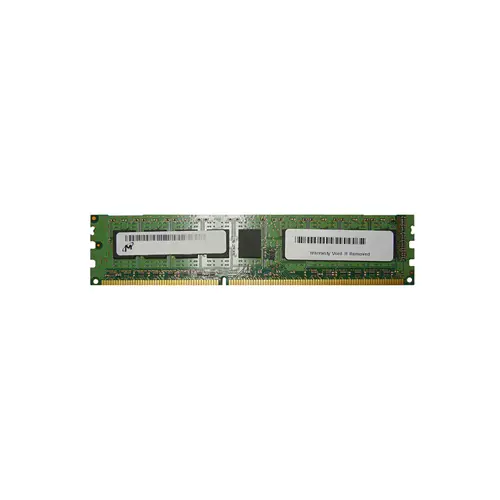
Based on its 240-pin UDIMM form factor, ECC support, and unbuffered signal type, the MT18JSF51272AZ-1G1A1 is unequivocally a server-grade DDR3 module built for workstations and single-socket servers where data integrity meets low-latency execution. In a virtualization cluster running multiple VMs, memory errors silently corrupt hypervisor state and cause cascading failures. The built-in ECC engine detects and corrects single-bit flips on the fly, transforming what would be a 3 AM crash into uninterrupted uptime for your containerized services. Its unbuffered design eliminates the register latency found in RDIMMs, giving the CPU direct access to DRAM — a critical advantage for in-memory databases like Redis or Memcached, where CL7 latency and consistent sub-10ns response keep query pipelines saturated. The dual-rank x8 organization interleaves two internal ranks on a single DIMM, allowing the memory controller to overlap activate and read cycles. In practice, this means a single 4GB module still delivers 10-15% higher sustained bandwidth under random access patterns, preventing bottlenecks when your financial trading analytics engine replays tick-by-tick order books. These four traits don't just meet spec sheets — they directly protect revenue streams and service-level agreements.
Memory Type: Server (DDR3 ECC UDIMM)
General Virtualization
For VMware ESXi or Hyper-V on a single-socket server, populate both memory channels evenly with these ECC UDIMMs. A 4 x 4 GB (16 GB) configuration supports a handful of light VMs; to run heavier multi-role guests, deploy 8 x 4 GB (32 GB). Matching all modules avoids timing issues and ensures ECC functionality.
In-Memory Database
Redis and similar stores need large, low-latency memory pools. Maximize the available DIMM slots—ideally 8 x 4 GB (32 GB)—to hold entire in-memory datasets. Install modules in matched pairs per channel to enable dual-channel interleaving, which reduces effective latency and boosts throughput under heavy read/write loads.
High-Performance Computing (HPC)
Scientific simulations and fluid dynamics rely on error-free RAM. Equip the server with 4 x 4 GB or 8 x 4 GB across all channels to guarantee dual-channel bandwidth. ECC on these UDIMMs corrects single-bit errors, preserving the integrity of long-running computations and checkpoint data.
Strictly tested ECC UDIMM for servers: Dell T110 II, HP ML110 G7, Lenovo TS130, etc.
Q: Can I mix this MT18JSF51272AZ-1G1A1 with other memory modules of different brands or speeds?
A: Mixing brands or speeds is not recommended for server UDIMMs. Mismatched timings may cause instability and defeat ECC protection. Use identical modules to ensure reliable synchronous operation and valid product warranty.
Q: Is this memory compatible with my system?
A: This DDR3-1066 ECC Unbuffered module is validated for single-socket Intel Xeon E3 or selected AMD platforms with C202/C204 chipsets. Verify your board’s UDIMM support and 1.5V voltage tolerance before installation.
Q: What is the recommended DIMM population order for optimal performance?
A: Populate identical DIMMs per channel starting with the slot farthest from the CPU. On dual-channel platforms, install matched pairs in like-colored slots first to maximize bandwidth and maintain full error correction capability.
Q: Does this module support overclocking or XMP profiles?
A: No. This JEDEC-compliant server UDIMM has no XMP profile. Overclocking is unsupported and would compromise data integrity, ECC functionality, and platform stability in mission-critical environments.
Q: What warranty and typical failure rate can I expect?
A: This module carries a one-year warranty. Built to stringent JEDEC standards, it yields an extremely low annualized failure rate, making it a proven choice for 24/7 server and workstation deployments.