











 Secure payments
Standard refund policy
Trade Assurance
Secure payments
Standard refund policy
Trade Assurance
| Product Type | Memory Module |
|---|---|
| Memory Capacity | 4 GB |
| Memory Technology | DDR3 |
| Product Voltage | 1.5V |
| RAM Speed | 1066MHz |
| RAM Standard | DDR3-1066/PC3-8500 |
| Error Identifying | ECC |
| Signal Type | Registered |
| Column Access Strobe (CAS) | CL7 |
| Rank | Dual Rank x4 |
| Quantity of Pins | 240-pin |
| RAM Genre | RDIMM |
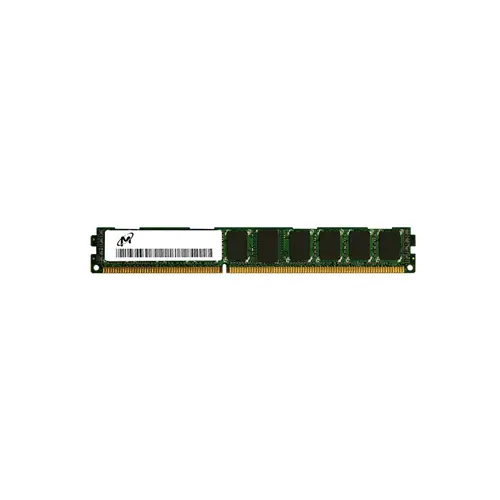
Designed for server platforms, this 4GB DDR3-1066 RDIMM with ECC ensures data integrity and reliability in memory-intensive workloads such as virtualization and in-memory databases. Its registered signal type and dual-rank x4 organization enhance signal stability and memory bank interleaving, while the low CL7 latency further optimizes response times in multi-DIMM configurations.
1. ECC protection automatically detects and corrects single-bit memory errors, safeguarding transactional data integrity in mission-critical server workloads.
2. Registered signal buffering reduces electrical load on the memory controller, enabling stable operation across fully populated server nodes where uptime is non-negotiable.
3. Dual Rank x4 organization maximizes interleaving efficiency, delivering higher sustained bandwidth for virtualized environments running dense container or VM fleets.
4. CL7 low column access latency accelerates cache-line fetches, reducing per-request turnaround in latency-sensitive database and financial trading applications.
5. DDR3-1066 speed grade offers a proven balance of throughput and power draw, ensuring reliable 24/7 operation in thermally constrained rack-server deployments.
The Micron MT36JSZF51272PDZ-1G1F1DD is a 4GB DDR3-1066 RDIMM, purpose-built for servers where uptime and data integrity are non-negotiable. Its four defining characteristics translate directly into operational resilience for demanding enterprise workloads. First, ECC error correction continuously detects and corrects single-bit memory errors, preventing silent data corruption that could crash a virtualization host or poison financial transactions in an in-memory database. In a cluster running a dozen virtual machines, a single uncorrected bit flip can cause cascading failures; this module makes such risks statistically irrelevant.
Second, the registered buffer stabilizes signal integrity across the memory bus, enabling platforms to populate all 18 DIMM slots per server without timing degradation. For virtualized environments where RAM is the primary constraint, this means confidently scaling to hundreds of gigabytes while maintaining consistent access latency. Third, the dual-rank x4 organization leverages interleaved command scheduling, delivering higher sustained bandwidth under concurrent access patterns. A Redis cluster processing millions of operations per second benefits directly from this parallelism, as it keeps the pipeline saturated even under mixed read/write pressure. Finally, the CL7 latency at 1066MHz strikes an optimal balance for enterprise DDR3 platforms—low enough to minimize cache miss penalties in database workloads, yet fully compliant with conservative server chipset timings that prioritize stability over aggressive overclocking. When your revenue depends on transaction accuracy and near-zero downtime, these design choices are not features on a datasheet; they are your safety net.
General Virtualization
For lightweight virtualization hosts running a few modest VMs, this 4 GB DDR3-1066 RDIMM can still serve in low-density consolidation. Populate six identical modules across a triple‑channel Nehalem/Westmere platform to build a 24 GB memory pool, keeping one DIMM per channel for reliable 1 DIMM Per Channel (DPC) operation. Avoid mixing with higher‑capacity or faster DIMMs, as the registered ECC will downclock to the slowest common denominator and unbalanced ranks may degrade interleave gains.
In‑Memory Database
In‑memory workloads demand both capacity and bandwidth, making this 4 GB module unsuitable for primary caching layers. At best, a pair of these modules could back a tiny test instance of Redis or Memcached with 8 GB total, using a dual‑channel configuration for modest throughput. For any production dataset beyond a few gigabytes, replace these with 8 GB or 16 GB RDIMMs to reach at least 64 GB while populating all memory channels symmetrically.
High‑Performance Computing
HPC nodes crave memory bandwidth; these CL7 1066 MT/s sticks are too slow for modern floating‑point‑intensive code. They can, however, equip a legacy cluster head node or a lightly‑loaded login node in a cost‑sensitive academic lab. Install them in matched pairs per channel, e.g., two DIMMs per channel on a dual‑socket Westmere system, to get 16 GB per socket and sustain dual‑rank parallelism, but always verify BIOS support for 2 DPC at 1066 MT/s without clock throttling.
Proven server memory, compatible with Dell PowerEdge R710, HP DL380 G7, and more.
Q: Can I mix this MT36JSZF51272PDZ-1G1F1DD with other memory modules of different brands or speeds?
A: Mixing is strongly discouraged. This is registered ECC server memory. Combining it with unbuffered or non-ECC modules can cause instability or prevent boot. Always use identical RDIMMs for reliable operation.
Q: Is this memory compatible with my system?
A: It fits servers supporting DDR3 Registered ECC RDIMMs on Intel Xeon 5500/5600 or AMD Opteron 4100/6100 platforms. Verify your board requires 240-pin, 1.5V PC3-8500 ECC memory and supports dual-rank x4 organization.
Q: What is the recommended DIMM population order for optimal performance?
A: Populate identical DIMMs per memory channel in matched pairs. For most servers, install in slots 1A and 1B first, then add pairs following your motherboard’s specific population guide to maintain balanced interleaving.
Q: Does this module support overclocking or XMP profiles?
A: No. This is enterprise-grade registered ECC memory strictly adhering to JEDEC DDR3-1066 specifications. Overclocking and XMP are disabled to ensure data integrity and platform stability in 24/7 server environments.
Q: What warranty and typical failure rate can I expect?
A: This module includes a 1-year warranty. As enterprise-class hardware, it is built for high reliability with an extremely low annualized failure rate, typically well below 0.5% under normal operating conditions.