











 Secure payments
Standard refund policy
Trade Assurance
Secure payments
Standard refund policy
Trade Assurance
| Product Type | Memory Module |
|---|---|
| Compliance Standards | RoHS |
| Memory Capacity | 4 GB |
| Memory Technology | DDR3 |
| Product Voltage | 1.35V |
| RAM Speed | 1333MHz |
| RAM Standard | DDR3-1333/PC3-10600 |
| Error Identifying | ECC |
| Signal Type | Registered |
| Column Access Strobe (CAS) | CL9 |
| Rank | Single Rank x4 |
| Quantity of Pins | 240-pin |
| RAM Genre | RDIMM |
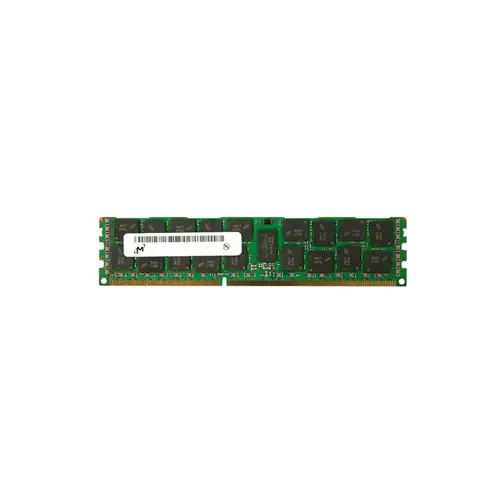
This 4GB DDR3L-1333 RDIMM with ECC and registered signaling is engineered for server platforms, delivering the data integrity and signal stability essential for virtualization, in-memory databases, and other mission-critical workloads. Its single-rank x4 organization reduces electrical loading per channel for reliable multi-DIMM configurations, while the 1.35V low-voltage operation and CL9 latency improve energy efficiency and response times in dense rack deployments.
1. ECC protection continuously scrubs memory for silent data corruption, ensuring transactional accuracy and uptime in virtualized financial and database clusters.
2. Registered signaling buffers the command and address bus, letting the server maintain electrical stability when all memory channels are populated to maximum capacity.
3. Low-voltage operation trims the thermal and power envelope per DIMM, directly lowering infrastructure cooling costs inside dense multi-node server racks.
4. Single-rank x4 organization minimizes electrical loading on the memory controller, giving IT architects the freedom to scale up DIMM-per-channel ratios without sacrificing reliability in heavily consolidated virtualization hosts.
5. The balanced clock speed delivers consistent bandwidth ideal for steady-state enterprise applications, where predictable response times matter more than burst throughput spikes.
Designed specifically for server environments, the Micron MT18KSF51272PZ-1G4M1 is a DDR3-1333 Registered DIMM with ECC, and its four defining characteristics directly address the real-world challenges IT professionals face in data centers. First, Error Correcting Code (ECC) is non-negotiable for data integrity. In a virtualized cluster running multiple VMs, a single undetected bit-flip caused by background radiation can silently corrupt a database record or crash a hypervisor, leading to hours of troubleshooting. ECC automatically detects and corrects these errors, ensuring computational accuracy over long uptime cycles. Second, the Registered signal buffer stabilizes high-density memory configurations. When you populate a server with multiple DIMMs per channel to support large in-memory databases like SAP HANA, the register reduces the electrical load on the memory controller, preventing signal degradation and enabling the system to run reliably under full load. Third, operating at 1.35V instead of the standard 1.5V significantly lowers power consumption and thermal output across a fleet of servers, directly reducing cooling costs and improving energy efficiency in a 24/7 facility. Finally, the single-rank x4 organization and CL9 latency strike a balance between bandwidth and access speed, optimizing throughput for transactional workloads where fast random access matters as much as raw transfer rate. Together, these features translate into fewer outages, consistent performance, and a lower total cost of ownership for mission-critical infrastructure.
General Virtualization
For a dual-socket virtualization host, populate each CPU’s memory channels symmetrically using eight of these 4GB RDIMMs (two per channel) to reach 64GB total. This configuration supports a moderate VM density, maintains NUMA balance, and relies on ECC to protect hypervisor stability. The 1.35V low-power design also reduces energy costs in dense deployments.
In-Memory Database
To maximize capacity for Redis or SAP HANA, fully load the server’s DIMM slots—up to 24 modules on a two-socket board—for a total of 96GB. This keeps hot datasets entirely in RAM and boosts query throughput. Although populating three slots per channel may drop the speed to 1066MHz, the added capacity outweighs the minor frequency loss while registered ECC ensures signal integrity.
High-Performance Computing (HPC)
Configure each memory channel with a single 4GB RDIMM (1DPC) to sustain the full 1333MT/s data rate and deliver peak bandwidth for simulation codes. For larger working sets, scale to two modules per channel across eight channels (64GB total in a dual-socket node), maintaining balanced access and ECC protection. This approach preserves latency-sensitive performance without sacrificing reliability.
This rigorously tested server memory is compatible with Dell PowerEdge R720, R620, HPE DL380p Gen8, and Lenovo RD630.
Q: Can I mix this MT18KSF51272PZ-1G4M1 with other memory modules of different brands or speeds?
A: Mixing is not recommended for RDIMMs. For reliable ECC operation, identical part numbers, ranks, and timings are critical. Different speeds will throttle to the lowest common SPD, potentially causing instability.
Q: Is this memory compatible with my system?
A: It is designed for servers using Intel Xeon E5-2400/2600 v1/v2 or AMD Opteron 6300 series platforms that support 1.35V DDR3-1333 ECC Registered 240-pin RDIMMs. Please verify your board's Qualified Vendor List.
Q: What is the recommended DIMM population order for optimal performance?
A: Populate identical DIMMs per channel, starting with the farthest slot from the CPU. For dual-processor boards, balance memory equally across both sockets. Always consult your server's specific population guide to maintain optimal channel interleaving.
Q: Does this module support overclocking or XMP profiles?
A: No. This is an enterprise-grade Registered ECC module designed strictly for JEDEC-compliant operation at DDR3-1333. Overclocking and XMP are not supported, as data integrity and system stability take priority over peak frequency.
Q: What warranty and typical failure rate can I expect?
A: This module includes a 1-year warranty. Enterprise DRAM typically maintains an Annualized Failure Rate (AFR) well below 0.5%, ensuring high reliability under continuous server workloads when operated within specified voltage and temperature ranges.