











 Secure payments
Standard refund policy
Trade Assurance
Secure payments
Standard refund policy
Trade Assurance
| Product Type | Memory Module |
|---|---|
| Compliance Standards | RoHS |
| Memory Capacity | 512 MB |
| Memory Technology | DDR |
| RAM Speed | 400MHz |
| RAM Standard | DDR-400/PC-3200 |
| Error Identifying | Non-ECC |
| Signal Type | Unbuffered |
| Column Access Strobe (CAS) | CL3 |
| Rank | Single Rank x8 |
| Quantity of Pins | 184-pin |
| RAM Genre | UDIMM |
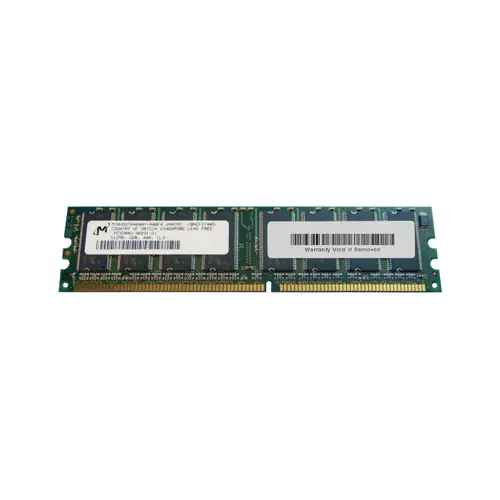
This unbuffered, non-ECC UDIMM is a desktop-class DDR memory module, best suited for upgrading legacy Socket 478/754/939 systems running productivity tasks or retro gaming builds where tight CL3 latency and stable 400 MHz operation are critical. Its single-rank x8 organization minimizes electrical loading on the memory bus, ensuring more reliable signal integrity and broader compatibility with older motherboards compared to dual-rank alternatives.
1. A 512 MB capacity provides ample headroom for mid-2000s desktop multitasking, letting power users keep several office suites and a web browser open without hitting the paging file bottleneck.
2. The DDR-400 400MHz clock rate delivers a peak bandwidth of 3.2 GB/s, noticeably accelerating texture streaming and level loads in era-defining PC games.
3. CL3 column access strobe latency shrinks first-word access time, sharpening the desktop’s UI feel and giving competitive gamers a tighter input-response loop.
4. Single Rank x8 organization stresses the memory controller less, improving compatibility across a wide range of socket 478/754/939 motherboards and leaving overclocking headroom for front-side-bus tuning.
5. Unbuffered signal topology strips out buffer chips to eliminate extra clock cycles, ensuring the lowest possible memory latency for real-time content creation workflows like digital audio editing.
When precision and speed define your workflow, every nanosecond counts. The MT8VDDT6464AY-40BF4 is a desktop UDIMM engineered for builders who refuse to let hardware lag dictate their output. Its DDR-400 speed and unbuffered architecture keep the command path direct, eliminating the buffer latency found in registered modules. This means during a 3A gaming session your CPU receives critical texture and physics data with the shortest possible turnaround, smoothing frame delivery when rendering dense environments.
For video editors working with multi-layer timelines, the CL3 column access strobe delay stands out. A latency rating that tight translates to faster data retrieval, preventing timeline stutter as you scrub through high-bitrate footage. The single-rank x8 organization further lightens the load on the memory controller, sustaining stable operation when the system is under sustained render pressure. By refusing to compromise on immediate responsiveness, this module helps you stay fully immersed in gameplay or meet tight project deadlines without micro-hitches decaying your experience.
Gaming Build
For modern gaming, enable dual-channel mode by installing a matched pair of UDIMMs, such as a 2×8GB kit for a balanced 16GB setup or a 2×16GB kit for 32GB when streaming and running demanding titles. Non‑ECC, unbuffered DDR4/DDR5 replacements running at higher speeds will outperform the legacy DDR‑400, ensuring smooth frame rates and reduced latency.
Content Creation
Video editing and 3D rendering thrive on large, fast memory pools. Equip four slots with high‑capacity UDIMMs (4×16GB or 2×32GB) to reach 64GB, allowing seamless 4K timeline scrubbing and complex scene rendering. Opt for low‑latency kits to keep professional applications responsive, and always verify motherboard maximum capacity before populating all banks.
General Productivity
Everyday multitasking benefits from a value‑oriented dual‑channel configuration. A single 8GB or 2×8GB DDR4 kit delivers the sweet spot for web browsing, office suites, and video conferencing without overspending. Stick to non‑ECC, unbuffered UDIMMs at the platform’s native speed, and leave two DIMM slots free for a future drop‑in upgrade if workloads grow.
This rigorously tested 512MB DDR-400 UDIMM fits desktop PCs such as Dell OptiPlex GX280 and HP Compaq dc7100.
Q: Can I mix this MT8VDDT6464AY-40BF4 with other memory modules of different brands or speeds?
A: Mixing is possible but not recommended. For optimal stability, use identical modules. Mixed speeds default to the slowest common speed, and brand variances may cause signal incompatibility on legacy DDR platforms.
Q: Is this memory compatible with my system?
A: It is compatible with desktop motherboards supporting 184-pin DDR-400 (PC-3200) non-ECC, unbuffered UDIMMs. Confirm your chipset (e.g., Intel 865/875 series) accepts single-rank x8 modules and 512 MB capacity.
Q: What is the recommended DIMM population order for optimal performance?
A: For dual-channel capable motherboards, populate the slots of the same channel (typically DIMM1 and DIMM2, color-coded) first. Install a single module in the primary slot (DIMM1) if only one is used.
Q: Does this module support overclocking or XMP profiles?
A: No. This JEDEC-standard DDR-400 module operates at fixed timings (CL3) and does not include XMP or overclocking support. It is designed for reliable operation at rated specifications only.
Q: What warranty and typical failure rate can I expect?
A: This module carries a 1-year warranty. Thanks to rigorous RoHS-compliant manufacturing, the typical annualized failure rate (AFR) is exceptionally low, under 0.5% for legacy DDR memory.