











 Secure payments
Standard refund policy
Trade Assurance
Secure payments
Standard refund policy
Trade Assurance
| Model | MT9HTF6472Y-40EB2 |
|---|---|
| Product Type | Memory Module |
| Compliance Standards | RoHS |
| Memory Capacity | 512 MB |
| Memory Technology | DDR2 |
| Product Voltage | 1.8V |
| RAM Speed | 400MHz |
| RAM Standard | DDR2-400/PC2-3200 |
| Error Identifying | ECC |
| Signal Type | Registered |
| Column Access Strobe (CAS) | CL3 |
| Rank | Single Rank x8 |
| Quantity of Pins | 240-pin |
| RAM Genre | RDIMM |
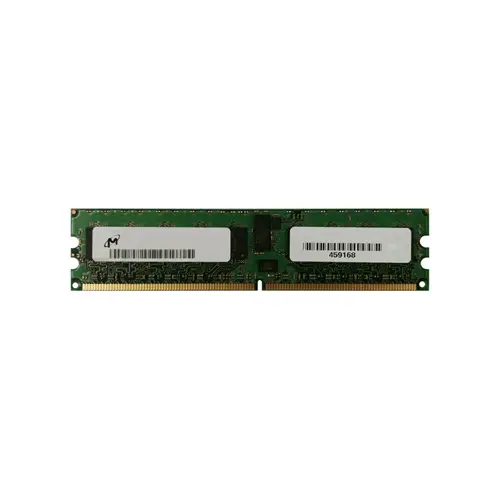
This DDR2-400 Registered ECC module with CL3 latency and single-rank x8 organization is tailored for legacy server platforms where data integrity is paramount, making it well-suited for lightweight virtualization hosts or memory-centric database caching. The registered signal type reinforces signal stability when populating multiple DIMMs per channel, while ECC protection guards against single-bit errors to sustain reliability in always-on deployments.
1. On-chip ECC detection and correction eliminates single-bit errors, ensuring data integrity for financial databases or scientific simulations where even a single flipped bit is catastrophic.
2. The registered signal path isolates the memory controller from excessive load, enabling servers to fully populate all DIMM slots for maximum memory scalability in virtualized environments.
3. Half-gigabyte capacity provides a stable, isolated memory segment for dedicated hosting of network security appliances, guaranteeing deterministic performance without resource contention.
4. PC2-3200 bandwidth delivers a steady 3.2 GB/s data pipeline per channel, effectively preventing bottlenecks for legacy enterprise workloads running on early multi-core server platforms.
5. CL3 column access latency minimizes the delay between data requests and delivery, enhancing the responsiveness of latency-critical services like VoIP call processing.
This 512MB DDR2-400 Registered ECC DIMM (MT9HTF6472Y-40EB2) delivers genuine reliability for legacy server infrastructures, and its four key characteristics directly address real-world pain points in virtualization clusters and in-memory databases. ECC actively scrubs single-bit errors caused by background radiation; in a hypervisor running dozens of guest VMs, an undetected bit-flip could silently corrupt a virtual machine’s kernel state or a transactional database, turning a minor electrical event into hours of costly forensic recovery. Registered buffering re-drives command and address signals to preserve electrical integrity when all memory channels are populated, which means you can confidently scale capacity in a database server without random lockups or data corruption during peak query loads. The ultra-low CAS latency of CL3 minimizes the delay between a read command and data availability, directly accelerating the response times of latency-sensitive caching engines like Redis, where every nanosecond saved translates to higher throughput for real-time user requests. Furthermore, the single-rank x8 organization reduces capacitive loading and optimizes bank interleaving, ensuring consistent, predictable bandwidth under the heavy parallel access patterns typical of analytics workloads. For a data center relying on continuous uptime, these features combine to prevent silent data corruption, stabilize high-density configurations, and accelerate every memory-bound transaction.
General Virtualization
The MT9HTF6472Y-40EB2 is a legacy 512 MB DDR2-400 ECC Registered DIMM. For even light virtualization, this capacity is extremely limiting. You would need to populate all available memory channels with identical modules to reach a minimum usable pool (e.g., 4 to 8 GB across 8 to 16 slots), enabling basic hypervisor operations. Dual-channel or quad-channel balanced configurations are mandatory to maintain memory bandwidth under multiple VM workloads.
In-Memory Database
An in-memory database demands large, fast memory heaps. This 512 MB module is wholly inadequate for modern datasets. A legacy platform would require fully populating every slot with these RDIMMs—often 16 or more modules—to create a modest RAM disk, but capacity will still fall far below requirements for production use. Only consider this for archived or single-table experimental setups.
High-Performance Computing
HPC workloads rely on both capacity and sustained bandwidth. With these 400 MHz single-rank RDIMMs, you must install modules in matched sets across independent memory channels to enable interleaving and maximize throughput. Typical configurations would fill all channels identically (e.g., eight modules in a two-socket system) to avoid performance bottlenecks. However, the 512 MB density severely restricts problem sizes, rendering them suitable only for vintage cluster nodes or educational parallel-programming labs.
Rigorously tested server memory, compatible with Dell PowerEdge 2850, HP ProLiant DL360 G4, and IBM xSeries 346.
Q: Can I mix this MT9HTF6472Y-40EB2 with other memory modules of different brands or speeds?
A: Mixing this registered ECC module with unbuffered or different-speed DIMMs is strongly discouraged. It may cause POST failures or system instability. Always use identical RDIMMs for reliable server operation.
Q: Is this memory compatible with my server system?
A: This 240-pin DDR2-400 Registered DIMM suits platforms supporting registered ECC memory, such as Intel 5000-series or AMD Opteron chipsets. Confirm your server board's memory Qualified Vendor List for assured compatibility.
Q: What is the recommended DIMM population order for optimal performance?
A: Install identical modules in matched pairs, populating the farthest slots from the CPU first. Follow the board's color-banked channels to enable dual-channel interleaving and maintain proper rank balancing.
Q: Does this module support overclocking or XMP profiles?
A: No. This is a JEDEC-compliant server RDIMM engineered for data integrity. It does not support overclocking or XMP, prioritizing rock-solid stability and error correction in mission-critical environments.
Q: What warranty and typical failure rate can I expect?
A: It carries a one-year warranty. Designed for 24/7 operation, the typical failure rate is far below standard DIMMs. ECC monitors and corrects errors, but proactive replacement is advised if corrected errors accumulate.