











 Secure payments
Standard refund policy
Trade Assurance
Secure payments
Standard refund policy
Trade Assurance
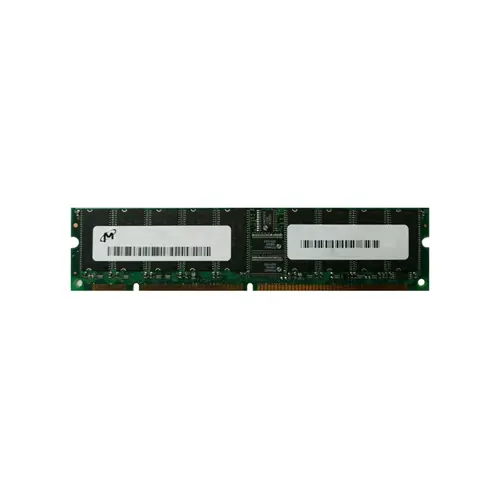
| Model | MT18LSDT6472G-133C2 |
|---|---|
| Product Type | Memory Module |
| Compliance Standards | RoHS |
| Memory Capacity | 512 MB |
| Product Voltage | 3.3V |
| RAM Speed | 133MHz |
| Error Identifying | ECC |
| Signal Type | Registered |
| Column Access Strobe (CAS) | CL3 |
| Quantity of Pins | 168-pin |
| RAM Genre | RDIMM |
This 512MB PC133 Registered ECC SDRAM module is a server-grade RDIMM purpose-built for legacy server platforms running memory-intensive workloads such as virtualization and in-memory databases, where data integrity and sustained availability are critical. Its registered signal buffering stabilizes high-density multi-DIMM configurations, while the combination of Error Correcting Code (ECC) and a low Column Access Strobe latency of CL3 at 133 MHz delivers reliable error correction and reduced access latency for transactional and integrity-sensitive applications.
1. On-the-fly error correction safeguards against data corruption, a non-negotiable requirement for mission-critical server applications such as financial ledgers and virtualization hosts.
2. Registered signaling strengthens command and address buses, allowing server boards to reliably populate all DIMM slots without signal degradation at scale.
3. A modest half-gigabyte per module enables fine-grained memory configurations, keeping cost and power per GB optimized for legacy multi-socket servers.
4. Synchronized operation at this frequency delivers deterministic memory latency, crucial for real-time transaction processing systems.
5. Low column access strobe latency shortens the delay to first word, accelerating small random reads typical of database index lookups.
In server-class infrastructure, the MT18LSDT6472G-133C2 stands apart because its Registered, ECC architecture directly addresses the hidden threats that routinely undermine aging but mission-critical platforms. The registered signal buffer is not just a technical footnote: when you populate a virtualization cluster with multiple high-capacity DIMMs to maximize VM density, it maintains clean command signaling across the bus, preventing the intermittent crashes that raw unbuffered modules would invite under heavy load. Meanwhile, on-die ECC scrubbing is your silent guardian in an in-memory database deployment such as a Redis cache or a legacy SAP instance, where a single undetected bit flip can corrupt transactional records or silently propagate errors through a financial report. The 133MHz clock paired with CL3 latency further ensures deterministic, low-latency access to hot datasets, so query responses stay consistent even as the chassis ages. Together, these traits translate directly into continuous uptime and data integrity for servers that cannot tolerate ambiguity.
General Virtualization
To achieve a usable capacity, populate every available DIMM slot—typically four or eight—with identical MT18LSDT6472G 512 MB registered ECC modules. This yields a total of 2 GB or 4 GB, sufficient for only a handful of lightweight virtual machines. Configure the hypervisor with strict memory overcommit limits and enable ballooning to maximize efficiency.
In-Memory Database
Install a full set of eight modules for the maximum 4 GB capacity, and organize identical sticks across memory banks for balanced access. Even this ceiling is inadequate for production datasets; use it exclusively for small-scale testing. Ensure ECC scrubbing is active and designate fast swap storage as an emergency spillover layer.
High-Performance Computing
Populate all slots symmetrically with four (or eight) modules to enable chipset-level interleaving and attain the highest possible bandwidth. A four-module 2 GB configuration at 133 MHz supports only legacy parallel workloads with compact working sets. Adjust BIOS settings for maximum bank interleaving to reduce stalls on this capacity-constrained platform.
Strictly tested server memory; compatible with Dell PowerEdge 4400, HP ProLiant DL380 G1, IBM xSeries 220.
Q: Can I mix this MT18LSDT6472G-133C2 with other memory modules of different brands or speeds?
A: Mixing is not recommended. For stable ECC Registered operation, all modules should match in speed, organization, and brand. Mixed speeds force the system to the lowest common specification, risking instability.
Q: Is this memory compatible with my system?
A: It is designed for legacy server platforms using Intel 440BX/GX or AMD equivalent chipsets that require 168-pin PC133 Registered ECC SDRAM. Verify your motherboard or server manual supports 3.3V RDIMMs.
Q: What is the recommended DIMM population order for optimal performance?
A: Populate banks starting from the slot closest to the CPU. Fill identical pairs or sets per bank to enable interleaving. Consult your server's technical guide, as some systems require specific slots to be filled first.
Q: Does this module support overclocking or XMP profiles?
A: No. This server-grade Registered ECC SDRAM adheres strictly to JEDEC PC133 standards. It does not feature XMP profiles nor support overclocking, prioritizing data integrity over flexible frequency adjustments.
Q: What warranty and typical failure rate can I expect?
A: This module includes a one-year warranty. Typical annualized failure rate (AFR) for such mature, low-density ECC RDIMMs is well under 0.5%, reflecting proven reliability in controlled server environments.