











 Secure payments
Standard refund policy
Trade Assurance
Secure payments
Standard refund policy
Trade Assurance
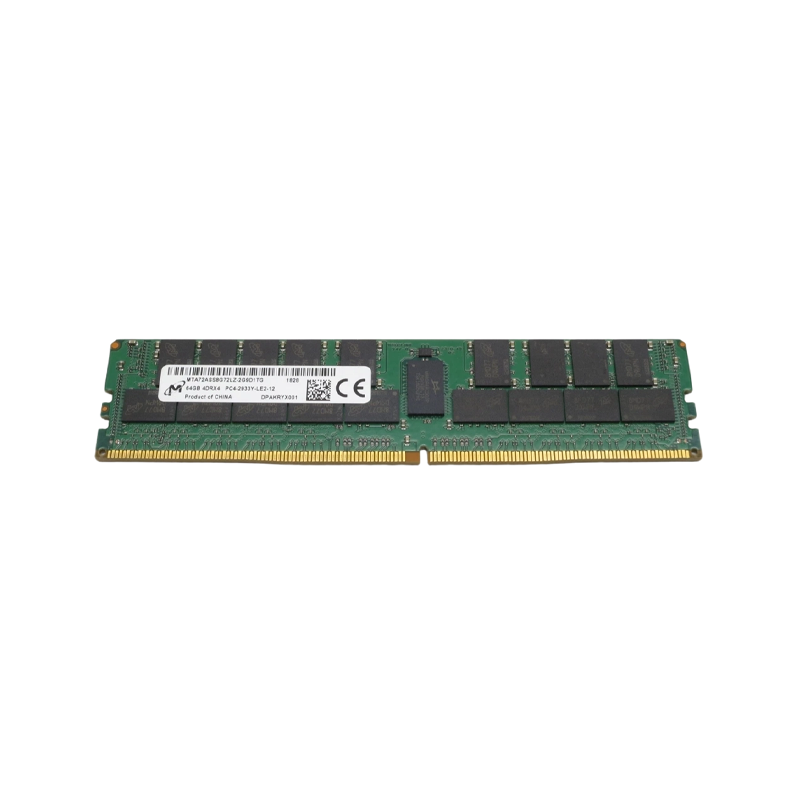
| Product Type | Memory Module |
|---|---|
| Memory Capacity | 64 GB |
| Memory Technology | DDR4 |
| Product Voltage | 1.2V |
| RAM Speed | 2933MHz |
| RAM Standard | DDR4-2933/PC4-23400 |
| Error Identifying | ECC |
| Signal Type | Registered |
| Column Access Strobe (CAS) | CL21 |
| Rank | Quad Rank x4 |
| Quantity of Pins | 288-pin |
| RAM Genre | RDIMM |
This server-grade RDIMM module is engineered for data-intensive enterprise platforms, particularly well-suited for virtualization hosts, in-memory databases, and mission-critical workloads that demand uncompromising data integrity. Its quad-rank x4 configuration maximizes memory density per channel while the registered signal type and ECC error correction ensure stable, reliable operation under heavy, sustained load at the native 2933MHz speed with a low CL21 latency.
1. Error Identifying: ECC
Single-bit error correction and multi-bit error detection safeguard financial transactions and virtualized workloads from silent data corruption, preserving uptime in mission-critical server environments.
2. Signal Type: Registered
By buffering command and address signals, registered technology stabilizes high-density memory arrays, allowing servers to populate all DIMM slots without compromising signal integrity under 24/7 operation.
3. Memory Capacity: 64 GB
Generous per-module capacity enables dense consolidation of virtual machines and in-memory databases, giving data centers the headroom to scale analytics without immediate hardware refreshes.
4. RAM Speed: 2933MHz
Elevated frequency accelerates data throughput for latency-sensitive enterprise applications, ensuring real-time query responses even as concurrent user loads spike.
5. Rank: Quad Rank x4
The Quad Rank x4 organization multiplies bank-level parallelism, keeping memory channels deeply pipelined so that multi-threaded server tasks sustain peak bandwidth under heavy I/O blending.
The MTA72ASS8G72LZ-2G9DATI is a server-class 64GB DDR4-2933 RDIMM engineered for mission-critical platforms where uptime and data accuracy are non-negotiable. Its ECC technology actively detects and corrects single-bit errors in real time, which directly prevents silent data corruption from flipping a critical bit inside an in-memory database like SAP HANA—an undetected error that could otherwise corrupt financial records or trigger a costly system halt. The registered interface buffers command and address signals, allowing you to fully populate all channels with high-density Quad Rank modules without signal degradation; in a dense virtualization cluster running dozens of VMs per host, this means unshakable platform stability and the confidence to scale memory without random boot failures. With 64GB per stick, you can deliver the massive total capacity that memory-hungry hypervisors and large database instances demand, avoiding the expense of migrating to exotic hardware just to gain more physical slots. Finally, the Quad Rank x4 organization leverages rank interleaving to amplify effective bandwidth, accelerating real-time analytics and query throughput so your reports arrive faster and your transactional databases maintain consistent low-latency responsiveness under peak load.
General Virtualization
For general virtualization hosts, 64GB RDIMMs allow dense memory configurations with fewer modules, preserving DIMM slots for future scaling. Populate in multiples of two or four per memory channel to maintain balanced interleaving and optimal throughput. Aim for symmetric configurations—such as six identical 64GB modules across two processors—to avoid NUMA performance penalties.
In-Memory Database
In-memory databases demand the highest capacity and reliability; 2933MHz ECC registered memory protects against data corruption during large sustained writes. Deploy the maximum number of 64GB RDIMMs your platform supports, preferably at one DIMM per channel (1DPC) for peak frequency, and configure memory mirroring or sparing if uptime is critical.
High-Performance Computing (HPC)
HPC workloads benefit from the balance of capacity and bandwidth these quad-rank x4 modules provide, as they offer more banks for concurrent access. Install modules evenly across all memory channels—typically six or eight per socket—to maximize aggregate memory bandwidth. Profile with your specific computational kernels to decide whether populating a second DIMM per channel is acceptable, as the slight frequency drop may be offset by the larger working set capacity.
Rigorously tested server memory, compatible with Dell PowerEdge R750, HPE ProLiant DL380 Gen10, Lenovo ThinkSystem SR650.
Q: Can I mix this MTA72ASS8G72LZ-2G9DATI with other memory modules of different brands or speeds?
A: Mixing RDIMMs of different brands, speeds, or ranks is not recommended. It can cause signal integrity issues and system instability. Always populate with identical Micron part numbers for validated, enterprise-grade reliability.
Q: Is this memory compatible with my system?
A: This DDR4-2933 registered ECC module is designed for server platforms such as Intel Xeon Scalable and AMD EPYC 7001/7002 series. Verify your motherboard supports Quad Rank x4 RDIMMs at 2933 MT/s before purchase.
Q: What is the recommended DIMM population order for optimal performance?
A: Follow your server board's population guide. Generally, balance Quad Rank DIMMs across all memory channels per CPU, populating the farthest slots in each channel first. Uneven loading may throttle speed to 2666 MT/s.
Q: Does this module support overclocking or XMP profiles?
A: No. As an enterprise registered ECC module, it adheres strictly to JEDEC DDR4-2933 specifications for maximum stability and error correction. Overclocking and XMP profiles are not supported nor intended for server-class reliability.
Q: What warranty and typical failure rate can I expect?
A: This Micron module is backed by a 1-year warranty. Enterprise RDIMMs exhibit extremely low AFR, typically below 0.1% under specified conditions, thanks to rigorous factory testing and high-quality component selection.