











 Secure payments
Standard refund policy
Trade Assurance
Secure payments
Standard refund policy
Trade Assurance
| Product Type | Memory Module |
|---|---|
| Memory Capacity | 64 GB |
| Memory Technology | DDR3 |
| Product Voltage | 1.5V |
| RAM Speed | 1600MHz |
| RAM Standard | DDR3-1600/PC3-12800 |
| Error Identifying | ECC |
| Signal Type | Registered |
| Column Access Strobe (CAS) | CL11 |
| Rank | Quad Rank x4 |
| Quantity of Pins | 276-pin |
| RAM Genre | CDIMM |
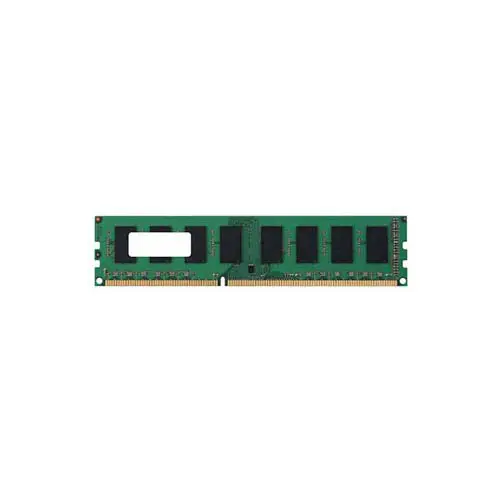
This 64 GB DDR3-1600 registered ECC module with a quad-rank x4 organization is engineered for enterprise server platforms running memory-intensive workloads such as virtualization, in-memory databases, and data analytics. The registered signal architecture ensures electrical stability across fully loaded memory channels, while ECC error correction and the generous 64 GB capacity per DIMM safeguard data integrity and maximize memory density in mission-critical environments.
1. ECC protection silently corrects single-bit errors in real time, safeguarding financial transactions and critical database operations from memory-induced data corruption.
2. Registered buffering decouples the memory controller from module loads, allowing fully populated server boards to maintain stable high-speed signaling even at maximum capacity.
3. 64 GB capacity per stick drives high VM density, letting a single dual-socket server comfortably run dozens of additional virtual desktops or microservices without swapping to disk.
4. Quad Rank x4 organization packs more DRAM chips into one module, optimizing slot usage for large-memory footprints while still operating within standard power envelopes via on-DIMM rank-switching.
5. 1600 MHz clock speed delivers 12.8 GB/s per channel bandwidth, accelerating in-memory analytics and real-time caching layers that depend on rapid random access.
In the modern data center, memory integrity and scalability are paramount. The Micron 64GB DDR3-1600 Registered ECC module (MTA80AHF8G72MDZ-1G6) addresses these demands head-on, purpose-built for servers running virtualization clusters and in-memory databases. Its ECC technology actively detects and corrects single-bit errors, silently preventing data corruption that could crash hypervisors or silently poison financial transactions in a Redis or SAP HANA instance. With a dense 64GB capacity and Registered buffer, you can populate a dual-socket system with up to a terabyte of reliable RAM without signal degradation, essential for consolidating dozens of virtual machines onto fewer physical hosts and lowering licensing overhead. The module’s Quad Rank x4 organization, managed by the register, ensures high-performance interleaving while allowing higher DIMM counts per channel—vital when accessing massive in-memory datasets under sustained workloads. Every calculation remains accurate, and your infrastructure stays online, turning memory into a trusted foundation.
General Virtualization
Start with two 64GB modules for a balanced 128GB base per host, then scale in matched pairs to populate all memory channels—eight modules (512GB) is typical for a dual-socket server with four channels per CPU. Be aware that quad-rank DIMMs often force a speed drop to 1066MHz when multiple channels are filled, so verify platform rules to balance capacity and performance.
In-Memory Database
Deploy four or eight 64GB RDIMMs per socket to reach 256–512GB, ensuring massive, reliable pools for applications like SAP HANA. Registered ECC and quad-rank density deliver the signal integrity and uptime essential for transactional workloads. Symmetrically populate channels with identical modules to maximize interleaved bandwidth and reduce NUMA latency.
High-Performance Computing (HPC)
For memory-bound simulations, equip each dual-socket node with at least six 64GB modules (384GB) to accommodate large working sets. Although quad-rank DIMMs may limit peak frequency, the capacity advantage typically outweighs the bandwidth trade-off in HPC jobs. Install equal module counts per CPU socket to maintain symmetric performance across MPI and OpenMP processes.
Rigorously tested and verified for server compatibility with Dell PowerEdge R720, HP ProLiant DL380p Gen8, Lenovo System x3650 M4, and similar DDR3 platforms.
Q: Can I mix this MTA80AHF8G72MDZ-1G6 with other memory modules of different brands or speeds?
A: Mixing is not recommended for server environments. Registered ECC modules must be identical in rank, timing, and speed to ensure signal integrity and prevent stability issues, especially with quad-rank LRDIMMs.
Q: Is this memory compatible with my Intel Xeon E5 or AMD Opteron system?
A: Compatibility depends on motherboard support for 64GB 4Rx4 DDR3-1600 LRDIMMs. Verify your platform's QVL and ensure it supports 276-pin CDIMM form factors with registered ECC at 1.5V.
Q: What is the recommended DIMM population order for optimal performance?
A: Adhere to your server board's population guide. Typically, load-reduced DIMMs like this 4Rx4 module populate farthest slots first per channel, balancing ranks across memory controllers for symmetric access.
Q: Does this module support overclocking or XMP profiles?
A: No. Server-class registered ECC memory operates strictly at JEDEC standard DDR3-1600 CL11 at 1.5V. Overclocking and XMP are not supported, as reliability and data integrity take precedence over speed tuning.
Q: What warranty and typical failure rate can I expect?
A: This module includes a 1-year limited warranty. Enterprise LRDIMMs exhibit an annualized failure rate (AFR) well under 1%, reflecting rigorous screening for 24/7 mission-critical operation.