











 Secure payments
Standard refund policy
Trade Assurance
Secure payments
Standard refund policy
Trade Assurance
| Product Type | Memory Module |
|---|---|
| Memory Capacity | 64 GB |
| Memory Technology | DDR4 |
| Product Voltage | 1.2V |
| RAM Speed | 2400MHz |
| RAM Standard | DDR4-2400/PC4-19200 |
| Error Identifying | ECC |
| Signal Type | Registered |
| Column Access Strobe (CAS) | CL17 |
| Rank | Quad Rank x4 |
| Quantity of Pins | 288-pin |
| RAM Genre | RDIMM |
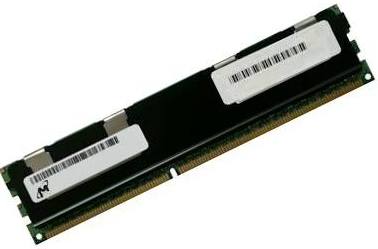
This 64GB DDR4-2400 Registered ECC RDIMM is purpose-built for server platforms handling memory-intensive workloads such as virtualization and in-memory databases, where its quad-rank x4 organization maximizes capacity per channel while maintaining signal integrity through registered logic. The combination of ECC error correction and a low CL17 latency ensures robust data reliability and consistent performance under sustained enterprise loads.
1. The 64 GB capacity per module maximizes memory density per channel, allowing virtualization hosts to run far more concurrent virtual machines without sacrificing performance.
2. ECC technology corrects single-bit errors in real time, preventing silent data corruption that could otherwise crash financial transactions or compromise database integrity.
3. Registered signal buffering stabilizes command and address lines under heavy load, ensuring reliable operation even when all DIMM slots are populated in a fully‑scaled server.
4. Quad Rank x4 organization aggregates multiple DRAM banks on a single stick, sustaining high bandwidth utilization and consistent low latency for memory‑intensive workloads like large in‑memory analytics.
5. The 2400 MT/s speed in a registered ECC environment strikes a deliberate balance between throughput and power efficiency, delivering steady performance for 24/7 operation without thermal throttling.
When you are running a dense virtualization cluster or an in-memory database like SAP HANA, every bit of data integrity and every clock cycle matters. The Micron MTA72ASS8G72LZ-2G3A1PI is a 64 GB DDR4-2400 Registered DIMM purpose-built to eliminate the risks that keep IT architects awake at night. Its ECC engine continuously detects and corrects single-bit errors, silently preventing cosmic-ray-induced data corruption from cascading into application crashes or database inconsistencies—a non-negotiable requirement for transactional workloads. Registered signal buffering means you can populate all memory channels without sacrificing command bus stability, enabling fully loaded servers to scale predictably under heavy virtualization. With a quad-rank x4 organization, this module delivers dense 64 GB capacity while efficiently interleaving banks to sustain bandwidth for concurrent virtual machines. In practice, that translates to more VMs per host with lower tail latency, and the ability to hold massive working sets entirely in DRAM for real-time analytics. This is not just memory; it is a reliability and consolidation anchor for your data center.
General Virtualization
A 64GB registered ECC module is ideal for dense virtualization hosts. In a dual-socket server with 16 memory slots, plan on installing eight of these 64GB RDIMMs (512GB total) to maintain balanced memory across all memory channels, which ensures both ample capacity for dozens of VMs and sufficient memory bandwidth. Avoid mixing quad-rank DIMMs at 2400MHz with lower-speed or dual-rank modules to prevent channel down-clocking.
In-Memory Database
Maximizing capacity is critical, so fully populate all channels with these 64GB quad-rank RDIMMs—for example, 24 modules in a 24-slot server to reach 1.5TB. Be aware that running four quad-rank DIMMs per channel will drop the speed to 1866MT/s on many platforms; evaluate if the massive capacity gain outweighs the minor latency increase for your dataset. Always enable memory mirroring or sparing only if redundancy is prioritized, as it halves usable capacity.
High Performance Computing (HPC)
For bandwidth-sensitive workloads, install one 64GB quad-rank DIMM per channel (one DIMM per channel, 1DPC) to sustain the full 2400MHz frequency and minimize rank contention. On a dual-socket system with eight channels, using eight modules provides 512GB at peak throughput—sufficient for large-scale simulation meshes while preserving low latency. If total memory must exceed 1TB per node, step to two DIMMs per channel but benchmark performance to confirm the speed trade-off remains acceptable for your parallel codes.
This server memory is rigorously tested and compatible with Dell PowerEdge R760, HPE ProLiant DL380 Gen10, Lenovo ThinkSystem SR650.
Q: Can I mix this MTA72ASS8G72LZ-2G3A1PI with other memory modules of different brands or speeds?
A: Mixing Registered ECC modules from different brands or speeds is not recommended. It may cause signal integrity issues and system instability. For reliable operation, use identical modules within the same server.
Q: Is this memory compatible with my server platform using Intel Xeon or AMD EPYC processors?
A: This 64GB DDR4-2400 RDIMM is compatible with Intel Xeon Scalable (Purley) and AMD EPYC 7001/7002 series platforms supporting 2400MT/s Registered ECC memory. Verify your server’s qualified vendor list.
Q: What is the recommended DIMM population order for optimal performance with this Quad Rank x4 RDIMM?
A: Follow the server motherboard’s population guide. Typically, populate identical DIMMs per channel starting from the farthest slot from the CPU, balancing channels to maximize interleaving and bandwidth.
Q: Does this module support overclocking or XMP profiles?
A: No. This is a JEDEC-compliant server-grade Registered ECC DIMM operating at standard DDR4-2400 (PC4-19200) with CL17. Overclocking and XMP are not supported to ensure enterprise data integrity.
Q: What warranty and typical failure rate can I expect?
A: It comes with a 1-year limited warranty. Enterprise DDR4 RDIMMs exhibit extremely low annualized failure rates (typically <0.5%) under specified operating conditions, ensuring high reliability for critical workloads.