











 Secure payments
Standard refund policy
Trade Assurance
Secure payments
Standard refund policy
Trade Assurance
| Product Type | Memory Module |
|---|---|
| Memory Capacity | 64 GB |
| Memory Technology | DDR4 |
| Product Voltage | 1.2V |
| RAM Speed | 2666MHz |
| RAM Standard | DDR4-2666/PC4-21300 |
| Error Identifying | ECC |
| Signal Type | Registered |
| Column Access Strobe (CAS) | CL19 |
| Rank | Quad Rank x4 |
| Quantity of Pins | 288-pin |
| RAM Genre | RDIMM |
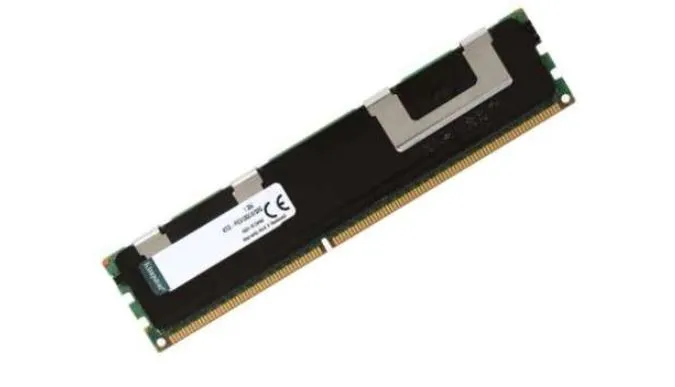
This 64GB DDR4-2666 Registered ECC RDIMM is engineered for enterprise server platforms, making it ideal for memory-intensive workloads such as virtualization, in-memory databases, and mission-critical applications where data integrity is paramount. Its Quad Rank x4 configuration maximizes capacity density per channel, while the Registered signal type and ECC ensure robust signal integrity and real-time error correction, delivering stable, reliable performance under sustained heavy load.
1. High-capacity module density empowers virtualization hosts to pack far more active VMs per node, reducing hardware sprawl and boosting consolidation ratios in enterprise data centers.
2. The ECC engine silently corrects single-bit memory faults in real time, preserving data integrity around the clock for mission-critical databases and financial transaction systems.
3. Registered signal buffering stabilizes command and address lines across heavily populated memory channels, allowing fully loaded server boards to operate without signal degradation under sustained load.
4. A quad-rank organization squeezes substantial DRAM density onto a single stick, ideal for applications like in-memory analytics that need both massive capacity and balanced channel loading.
5. The DDR4 mainstream data rate provides ample sustained bandwidth for concurrent stream processing, content delivery, and large-scale virtualization without incurring the power penalty of overclocked grades.
The Micron MTA72ASS8G72PSZ-2S6G1QI is a server-grade 64 GB DDR4-2666 RDIMM built to eliminate the most feared pain points in enterprise computing. Its four standout features—ECC error correction, registered buffering, quad-rank architecture, and a substantial single-module capacity—work in concert to protect your operations. In a dense virtualization cluster, a memory bit flip could silently corrupt a database or crash a critical VM. ECC detects and corrects single-bit errors on the fly, preserving data integrity without manual intervention. Meanwhile, the register re-drives address and command signals, allowing you to populate all memory channels with multiple high-capacity DIMMs and still run stably at 2666 MHz; this is non-negotiable when consolidating heavy workloads. For in-memory databases like SAP HANA or Redis, the quad-rank design leverages bank interleaving to sustain higher bandwidth and lower latency than standard dual-rank modules, giving your queries a measurable speed boost. The 64 GB capacity means fewer DIMM slots are consumed to reach your target memory, leaving room for future growth and reducing thermal load. A 1.2 V operating voltage further trims power bills in scale-out deployments. In real terms, this memory keeps your virtual machines live, your transactions accurate, and your analytics responsive—turning reliability into a competitive advantage.
General Virtualization
For dense server virtualization, this 64GB RDIMM is ideal. To maximize guest capacity on dual-socket platforms, populate at least two modules per memory channel (2DPC) for a balanced 256GB–512GB footprint, leveraging the registered ECC to maintain stability under mixed workloads. Avoid fully populating all channels with quad-rank DIMMs if peak throughput is critical, as speed may downgrade to 2400MT/s.
In-Memory Database
In-memory databases like Redis or SAP HANA demand both capacity and data integrity. Deploy six or eight of these modules in a single-socket server to reach 384–512GB, ensuring 1 DIMM per channel (1DPC) so the 2666MT/s speed is preserved. The ECC and registered design protect against bit-flips during large, persistent data sets, reducing costly application crashes.
High-Performance Computing (HPC)
HPC clusters require high memory bandwidth and reliability under sustained compute. Install one module per channel across all six or eight channels to unlock maximum 2666MT/s throughput while minimizing latency from the CL19 and quad-rank interleaving. For capacity-driven simulations, a 2DPC configuration with matched sets can double memory to over 1TB per node, but expect a slight frequency trade-off; the registered ECC ensures correct results on long-running parallel jobs.
Rigorously tested server RDIMM, compatible with Dell PowerEdge R740, HPE ProLiant DL380 Gen10, Lenovo ThinkSystem SR650, and more.
Q: Can I mix this MTA72ASS8G72PSZ-2S6G1QI with other memory modules of different brands or speeds?
A: Mixing is not recommended. Registered ECC modules require identical specifications to ensure signal integrity. Different speeds or ranks can cause stability issues and may force the memory controller to downclock unpredictably.
Q: Is this memory compatible with my server? Which Intel or AMD platforms are supported?
A: This 64GB DDR4-2666 RDIMM is designed for dual-socket servers using Intel Xeon Scalable (Skylake-SP onward) or AMD EPYC 7000/7002 series platforms with a 288-pin DDR4 slot and ECC Registered support.
Q: What is the recommended DIMM population order for optimal performance with this quad-rank module?
A: Populate identical modules per channel, starting farthest from the CPU. For quad-rank DIMMs, limit to one per channel initially; mixing ranks per channel can impact speed. Consult your server's memory population guide for balanced configurations.
Q: Does this memory module support overclocking or XMP profiles?
A: No. As a JEDEC-standard Registered ECC module, overclocking and XMP are not supported. It operates at the fixed SPD speed of DDR4-2666 with CL19 to guarantee data integrity in 24/7 server environments.
Q: What warranty and typical failure rate can I expect?
A: This module includes a 1-year warranty. Enterprise-class RDIMMs like this one typically have an annualized failure rate (AFR) well under 1% under normal server operating conditions, ensuring high reliability.