











 Secure payments
Standard refund policy
Trade Assurance
Secure payments
Standard refund policy
Trade Assurance
| Product Type | Memory Module |
|---|---|
| Memory Capacity | 64 GB |
| Memory Technology | DDR4 |
| Product Voltage | 1.2 V |
| RAM Speed | 2933 MHz |
| RAM Standard | DDR4-2933/PC4-23400 |
| Error Identifying | ECC |
| Signal Type | Registered |
| Column Access Strobe (CAS) | CL21 |
| Rank | Quad Rank x4 |
| Quantity of Pins | 288-pin |
| RAM Genre | RDIMM |
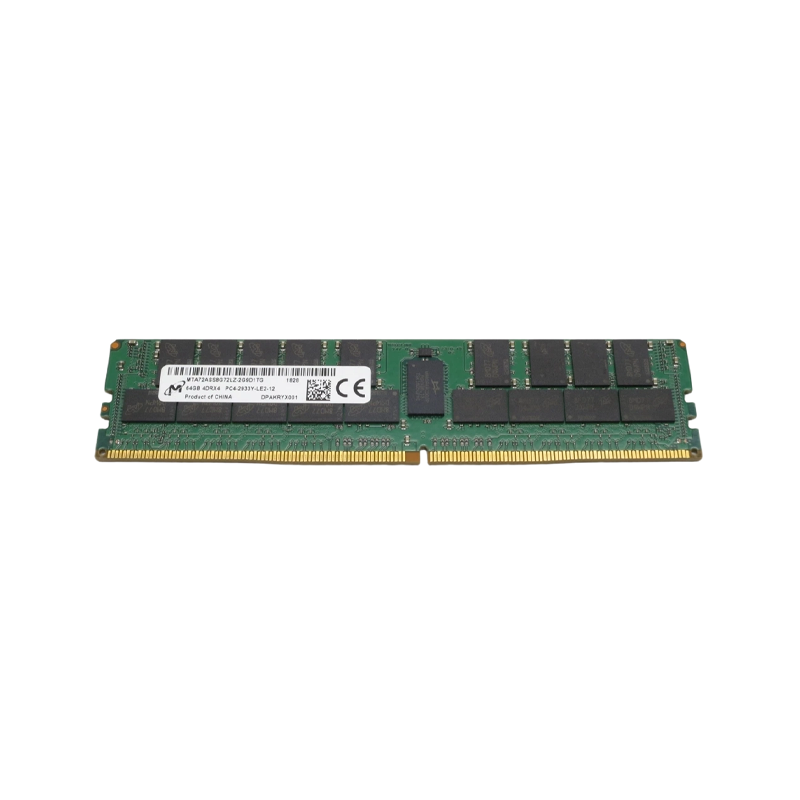
This 64GB DDR4-2933 Registered ECC RDIMM is purpose-built for server platforms running memory-intensive workloads such as virtualization, in-memory databases, and enterprise data analytics. Its Quad Rank x4 configuration maximizes capacity per channel while Registered signal buffering and ECC deliver the rock-solid signal integrity and data reliability required for 24/7 mission-critical operations.
1. Ample capacity per module maximizes memory density in server nodes, empowering virtualization platforms to host far more guest instances without incurring expensive NUMA node spills.
2. On-die error correction eliminates single-bit memory faults, a non-negotiable safeguard for transactional databases and real-time analytics where absolute data accuracy is paramount.
3. Registered clock drivers stabilize high-capacity configurations by buffering address and command lines, enabling reliable operation across fully populated memory channels in large-scale enterprise deployments.
4. Multi-rank organization keeps memory channels heavily saturated under concurrent access, directly boosting throughput for in-memory caching and massive dataset processing workloads.
5. Elevated interface speed accelerates CPU-to-memory data movement, shrinking latency windows in latency-sensitive applications like high-frequency trading and complex numerical simulation.
The Micron MTA72ASS8G72LZ-2G9 is a 64 GB DDR4‑2933 Registered ECC RDIMM engineered specifically to eliminate the reliability and performance bottlenecks that challenge virtualized clusters and in‑memory database platforms. Its 64 GB density lets you pack significantly more virtual machines onto each hypervisor, directly reducing hardware sprawl and software licensing overhead while keeping workloads securely isolated. Hardware‑level ECC silently corrects single‑bit errors caused by background radiation, shielding both the host and every guest VM from silent data corruption that could abruptly terminate a financial transaction or bring down an entire containerized service. The registered buffer restores command and address signal integrity when all memory channels are fully populated, maintaining rock‑solid stability even as dozens of VMs compete for resources during peak demand. Quad‑rank x4 architecture multiplies effective bandwidth through aggressive bank interleaving, which is critical for in‑memory databases like Redis and SAP HANA where microsecond‑level latency directly determines query throughput and real‑time insight. Operating at a low 1.2 V, the module also contributes to overall energy efficiency. Together, these attributes deliver uncompromising uptime, bulletproof data fidelity, and consistently fast application response for your most demanding enterprise workloads.
Capacity Planning for 64GB DDR4-2933 ECC RDIMM
This registered DIMM (quad-rank x4, CL21) is engineered for servers; its electrical loading makes per‑channel population crucial for targeting the 2933 MT/s speed.
General Virtualization
Populate one module per memory channel for balanced capacity and speed—an 8‑channel server reaches 512GB. Avoid a second DIMM per channel, as quad‑rank loading would force the memory controller to downclock.
In‑Memory Database
Deploy one module per channel for optimal latency. When extreme capacity is required, installing two quad‑rank DIMMs per channel is acceptable but reduces speed to 2666 or 2400 MT/s—a trade‑off justified by larger in‑memory datasets.
High Performance Computing
Fill all channels with a single module—no second DIMM per channel—to sustain maximum bandwidth. A dual‑socket server with 16 channels provides 1TB at peak throughput, essential for simulations. Symmetric population across sockets is mandatory for NUMA harmony.
For best results, always use identical modules in all slots and check the server manufacturer’s memory population guidelines for quad-rank support.
Rigorously tested. Compatible with Dell PowerEdge R750, HPE ProLiant DL380 Gen10 Plus, Lenovo ThinkSystem SR650 V2, and more.
Q: Can I mix this MTA72ASS8G72LZ-2G9 with other memory modules of different brands or speeds?
A: Mixing RDIMMs is not recommended. This 64GB quad-rank module requires matched ranks and timings. Mixing brands or speeds may cause boot failures or signal integrity issues on server platforms.
Q: Is this memory compatible with my system?
A: It is compatible with servers using Intel Xeon Scalable or AMD EPYC platforms that support DDR4-2933 ECC Registered DIMMs. Verify your board supports quad-rank x4 288-pin modules and 64GB capacity.
Q: What is the recommended DIMM population order for optimal performance?
A: Populate identical quad-rank DIMMs per memory channel starting with the farthest slot from the CPU. For quad-rank configurations, limit to two DIMMs per channel to maintain 2933 MT/s speed.
Q: Does this module support overclocking or XMP profiles?
A: No. This is a server-grade ECC Registered DIMM with fixed JEDEC-standard DDR4-2933 timings. Overclocking and XMP are not supported to ensure data integrity and 24/7 stability.
Q: What warranty and typical failure rate can I expect?
A: This module includes a one-year warranty. Enterprise RDIMMs exhibit very low failure rates, with an annualized return rate typically below 0.5% under proper thermal and environmental conditions.