











 Secure payments
Standard refund policy
Trade Assurance
Secure payments
Standard refund policy
Trade Assurance
| Product Type | Memory Module |
|---|---|
| Memory Capacity | 64 GB |
| Memory Technology | DDR4 |
| RAM Speed | 3200 MHz |
| RAM Standard | DDR4-3200/PC4-25600 |
| Error Identifying | ECC |
| Signal Type | Registered |
| Column Access Strobe (CAS) | CL22 |
| Rank | Dual Rank x4 |
| Quantity of Pins | 288-pin |
| RAM Genre | DIMM |
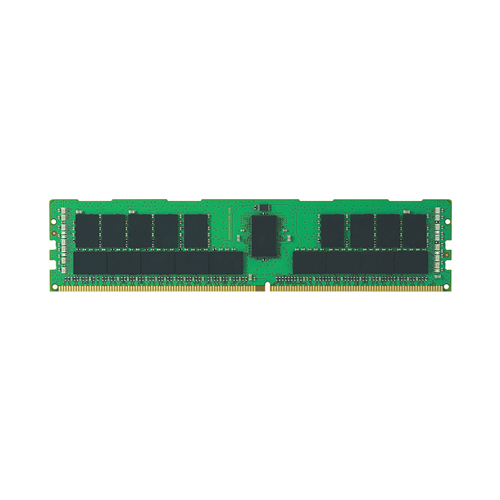
This 64GB DDR4-3200 Registered ECC DIMM is purpose-built for server platforms, excelling in memory-intensive workloads such as virtualization and in-memory databases where data integrity is non-negotiable. The dual-rank x4 configuration, coupled with registered buffering, stabilizes high-capacity memory channels and combines with ECC to deliver robust error correction and enhanced bandwidth for reliable enterprise operation.
1. A 64 GB capacity per module dramatically increases memory density per server node, allowing far more virtual machines or containers to be packed onto a single physical host without compromising performance.
2. ECC protection silently corrects single-bit memory errors in real time, preserving data integrity for transactional databases and financial workloads where even a single flipped bit is unacceptable.
3. Registered signal buffering stabilizes high-capacity memory configurations by reducing electrical load on the memory controller, which is essential when populating all DIMM slots in multi-socket servers.
4. The dual-rank x4 organization keeps the memory bus highly utilized through interleaving, sustaining peak bandwidth for analytics and in-memory caches under heavy concurrent access.
5. DDR4-3200 speed delivers a substantial 25.6 GB/s of peak bandwidth per channel, accelerating virtualization overhead and large dataset transfers in software-defined infrastructure.
Based on the 288-pin DIMM form factor, ECC error correction, and Registered signal type, the MTA36ASF8G72PZ-3G2T is unmistakably a server-grade DDR4 RDIMM built for data centers and enterprise workloads. Its four defining characteristics directly address the pain points of IT architects who refuse to trade reliability for performance.
In a dense virtualization cluster, the Registered buffer stabilizes command and address signals across fully loaded memory channels, enabling a dual-socket host to support dozens of additional virtual machines without signal degradation. Every bit of those VMs is safeguarded by ECC, which detects and corrects single-bit memory errors in real time. This isn’t a theoretical feature—it prevents silent data corruption that could trigger database rollbacks, poison financial calculations, or crash a hypervisor after months of uptime. The 64GB capacity per module also means you can scale to terabyte-class footprints, keeping massive VM working sets in memory rather than swapping to storage. Then there is the 3200 MT/s speed and dual-rank x4 organization. In an in-memory database like SAP HANA or Redis, the increased bandwidth and rank interleaving cut query latency dramatically, allowing real-time analytics to process millions of transactions without stalling. This module turns raw specs into a strategic advantage: maximizing density, ensuring data integrity, and accelerating the throughput your business depends on.
General Virtualization
For a hypervisor hosting multiple VMs, a balanced population is key. Populate all memory channels with identical 64GB Registered ECC DIMMs to maximize total capacity while maintaining memory bandwidth. Aim for 256GB to 512GB total using one DIMM per channel (1DPC) to sustain high consolidation ratios without compromising latency.
In-Memory Database
Latency-sensitive databases like Redis or SAP HANA demand both capacity and data integrity. Deploy six or eight of these 64GB modules, fully populating the memory channels to achieve up to 512GB of ECC-protected RAM. The Dual Rank x4 organization delivers strong interleaving, crucial for processing large in-memory datasets reliably under constant write pressure.
High-Performance Computing
HPC workloads scale with memory bandwidth as much as core count. Install exactly one DIMM per channel across all available channels—typically 8 modules for a 512GB configuration—to avoid dropping to lower speeds. This registered dual-rank layout provides the aggregate throughput required for tightly coupled simulations and large matrix operations, where every GB/s counts.
Rigorously tested for compatibility with Dell PowerEdge R760, HPE ProLiant DL380 Gen11, Lenovo ThinkSystem SR650 V3.
Q: Can I mix this MTA36ASF8G72PZ-3G2T with other memory modules of different brands or speeds?
A: Mixing is not recommended. Registered ECC DIMMs require identical ranks, timings, and speed for stable operation. Even slight mismatches may cause POST failures or silent data corruption in server environments.
Q: Is this memory compatible with my Intel Xeon Scalable or AMD EPYC server platform?
A: Yes, it is compatible with most Intel Xeon Scalable (Purley/Whitley) and AMD EPYC (7002/7003/9004 series) platforms that support DDR4-3200 Registered ECC DIMMs. Check your server vendor’s qualified memory list.
Q: What is the recommended DIMM population order for optimal performance?
A: Populate in sets of 8 identical DIMMs per memory channel, starting from the farthest slots from the CPU. Follow your server’s population guide for balanced interleaving and full memory bandwidth.
Q: Does this module support overclocking or XMP profiles?
A: No. As an enterprise Registered ECC module, it adheres strictly to JEDEC DDR4-3200 standards. XMP and overclocking are disabled to ensure data integrity and 24/7 stability.
Q: What warranty and typical failure rate can I expect?
A: This module includes a 1-year warranty. With robust ECC and testing, annualized failure rate (AFR) is typically below 0.5% in controlled server environments, ensuring high reliability.