











 Secure payments
Standard refund policy
Trade Assurance
Secure payments
Standard refund policy
Trade Assurance
| Product Type | Memory Module |
|---|---|
| Memory Capacity | 64 GB |
| Memory Technology | DDR4 |
| Product Voltage | 1.2 V |
| RAM Speed | 3200 MHz |
| RAM Standard | DDR4-3200/PC4-25600 |
| Error Identifying | ECC |
| Signal Type | Registered |
| Column Access Strobe (CAS) | CL22 |
| Rank | Dual Rank x4 |
| Quantity of Pins | 288-pin |
| RAM Genre | RDIMM |
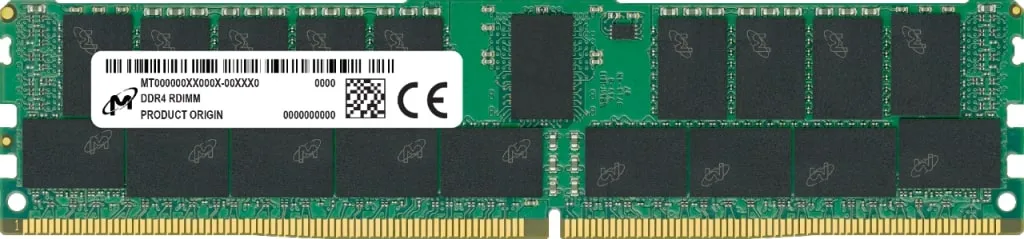
Designed for server platforms running memory-intensive workloads like virtualization and in-memory databases, this 64GB DDR4-3200 RDIMM leverages ECC and a registered signal type to ensure data integrity and signal stability under high-density configurations. Its dual-rank x4 organization enhances bank-level parallelism, boosting throughput in multi-DIMM deployments while maintaining reliable operation at a low 1.2V voltage with a CL22 latency.
1. The substantial capacity per module reduces the need for frequent physical swaps, allowing a single server to host more tenants and larger in-memory databases without sacrificing rack density.
2. The elevated data rate feeds modern multi-core server processors with ample throughput, accelerating real-time analytics and lowering query latency under heavy concurrent access.
3. On-the-fly error correction detects and fixes single-bit corruption, preserving the integrity of financial ledgers and scientific computations that cannot tolerate silent data errors.
4. Registered clock and command buffering stabilizes signal integrity across fully populated channels, making large-scale virtualized deployments reliably operable 24/7.
5. Dual rank x4 organization maximizes bank-level parallelism, sustaining consistent bandwidth when multiple virtual machines contend for memory simultaneously.
This Micron 64GB DDR4-3200 RDIMM is built for relentless server demands. Its four defining characteristics—ECC, registered buffering, dual‑rank x4 design, and massive module density—address real IT pain points directly. In a virtualized cluster hosting dozens of VMs, heavy memory loads destabilize signals and cause outages. The registered buffer cleans and re‑drives every data line, allowing you to populate all channels reliably, even with 16 DIMMs per node. Meanwhile, ECC silently detects and corrects single‑bit errors, shielding financial transactions and customer databases from silent in‑memory corruption that non‑ECC modules would ignore. For in‑memory databases like SAP HANA or Redis, the dual‑rank x4 organization enables rank interleaving, which accelerates bandwidth and slashes query latency under heavy concurrent access. The 64GB capacity per stick reduces the number of DIMMs needed for large memory footprints, preserving expansion slots and lowering total cost of ownership. This is not just a memory upgrade; it is the foundation for always‑on, data‑safe infrastructure where every microsecond of downtime matters.
General Virtualization
For a dual-socket virtualization host, install six to eight 64GB RDIMMs (384GB–512GB) spread evenly across all memory channels. This balances capacity per core and leverages the full DDR4-3200 bandwidth. Always add modules in matched sets that align with the channel count to maintain symmetric ECC interleaving and predictable VM performance.
In-Memory Database
Maximize capacity by fully populating every memory slot with these 64GB registered DIMMs — a 24-slot server can reach 1.5TB. The dual-rank x4 design provides the low latency essential for real-time analytics, while ECC corrects errors that could corrupt critical in-memory tables. Populate channels symmetrically to avoid NUMA penalties and ensure uniform access.
High-Performance Computing
Install one 64GB RDIMM per channel (1DPC) on each socket to sustain the rated 3200 MT/s; eight identical modules on an 8-channel platform deliver 512GB of high-bandwidth memory. This configuration prevents clock downshifts and maximizes throughput for simulation codes. When greater capacity is unavoidable, only adopt carefully validated 2DPC configurations using identical, dual-rank modules to preserve signal integrity.
Rigorously tested server memory, compatible with Dell R750, R650, HPE DL380 Gen10, Lenovo SR650 V2, and more.
Q: Can I mix this MTA36ASF8G72PZ-3G2F1 with other memory modules of different brands or speeds?
A: Mixing RDIMM brands or speeds is not recommended, as mismatched ranks, timings, or ECC/registered logic can cause system instability and boot failures in server environments. For reliable operation, use identical Micron modules.
Q: Is this memory compatible with my system? (Intel or AMD server platform)
A: This 64GB DDR4-3200 RDIMM is compatible with Intel Xeon Scalable (2nd gen and newer) and AMD EPYC 7002/7003 series platforms using C620 or SP3 chipsets. Verify your server's qualified vendor list for the specific MTA36ASF8G72PZ-3G2F1 module.
Q: What is the recommended DIMM population order for optimal performance?
A: Populate identical RDIMMs per memory channel, starting from the farthest slot (usually slot A1 for CPU1). For dual-rank x4 modules, follow the server's manual to balance channels and avoid mixing with different ranks or capacities.
Q: Does this module support overclocking or XMP profiles?
A: No. This is a server-class Registered ECC DIMM conforming to JEDEC DDR4-3200 CL22 standards (PC4-25600). Overclocking and XMP are not supported; the module operates at fixed native timings for data integrity and RAS features.
Q: What warranty and typical failure rate can I expect?
A: Micron provides a one-year limited warranty. In standard data center environments, this module's AFR (annualized failure rate) is exceptionally low, typically under 0.5%, due to rigorous component screening and built-in ECC error correction.