











 Secure payments
Standard refund policy
Trade Assurance
Secure payments
Standard refund policy
Trade Assurance
| Product Type | Memory Module |
|---|---|
| Memory Capacity | 64 GB |
| Memory Technology | DDR4 |
| Product Voltage | 1.2 V |
| RAM Speed | 3200 MHz |
| RAM Standard | DDR4-3200/PC4-25600 |
| Error Identifying | ECC |
| Signal Type | Registered |
| Column Access Strobe (CAS) | CL22 |
| Rank | Dual Rank x4 |
| Quantity of Pins | 288-pin |
| RAM Genre | RDIMM |
Designed as a server-class RDIMM, this 64GB DDR4-3200 module is ideally suited for memory-intensive enterprise workloads such as virtualization and in-memory databases where data integrity is paramount. Its dual-rank x4 configuration and registered signal type enhance signal stability under high-density population, while ECC actively corrects single-bit errors to maximize system uptime.
1. A capacious footprint supports higher virtual machine density per server, boosting consolidation ratios without compromising responsiveness under peak loads.
2. Error-correcting code protection silently neutralizes single-bit memory faults, safeguarding data integrity in transaction-heavy financial and database operations.
3. Registered signaling stabilizes command and address pathways, making it practical to populate densely scaled memory channels for large in-memory analytics.
4. Elevated data rate delivers the sustained bandwidth needed to feed multi-core processors, keeping throughput high during concurrent big data queries.
5. Dual-rank interleaving keeps memory banks efficiently overlapped, preserving consistent channel utilization when multiple enterprise workloads compete for I/O.
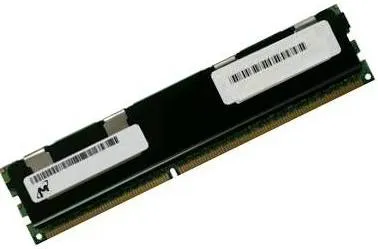
The MTA36ASF8G72PZ-3G2F1R is a server-grade DDR4 RDIMM, and its four defining engineering choices directly address the real-world pain points of data centers and enterprise IT. In a dense virtualization cluster running dozens of VMs, the 64 GB capacity per module means you can pack more working sets onto fewer DIMM slots, delaying costly node expansion. Its integrated ECC constantly corrects single-bit errors caused by cosmic radiation or electrical noise, preventing silent data corruption that could quietly poison a financial database or a customer-facing transaction log. Registered signal buffering then steps in to stabilize that massive capacity: it offloads the memory controller, allowing you to populate all channels at full 3200 MT/s without the signal integrity collapse that torments unbuffered designs. Meanwhile, the dual-rank x4 organization cleverly interleaves memory banks, unlocking higher sustained bandwidth for in-memory analytics platforms like SAP HANA or Redis clusters, where response latency under concurrent query loads matters far more than headline benchmarks. This is not just a stick of RAM; it is a reliability contract for mission-critical workloads that cannot afford a single undetected bit flip or a midday server reboot.
General Virtualization
For consolidated virtual machine hosts, populate all available memory channels with identical 64 GB RDIMMs—typically six or eight modules for a total of 384–512 GB. This balanced configuration maximizes memory bandwidth and minimizes NUMA latency, while the ECC and registered design ensure stability under dense, multi-tenant workloads.
In-Memory Database
Low-latency data stores like Redis or SAP HANA benefit from large capacity and reliable speed. Install at least four 64 GB modules (256 GB) across independent channels to sustain high throughput, and scale to 512 GB or more for sizable datasets. The 1.2 V operating voltage and CL22 timing help keep power and heat manageable in sustained OLTP environments.
High-Performance Computing
Fill every memory channel with dual‑rank x4 64 GB DIMMs to achieve peak 3200 MT/s aggregate bandwidth—ideal for fluid dynamics, weather modeling, or genome analysis. With platforms supporting up to 8 or 16 slots, a full complement delivers the capacity headroom and parallel access needed for large‑scale parallel jobs, while registered ECC protects against silent data corruption during long‑running simulations.
Rigorously tested for compatibility with Dell PowerEdge R760, R750, HPE ProLiant DL380 Gen11, Lenovo ThinkSystem SR650 V3, and Supermicro SYS-620P-TR.
Q: Can I mix this MTA36ASF8G72PZ-3G2F1R with other memory modules of different brands or speeds?
A: Mixing is strongly discouraged. For mission-critical server stability, always populate identical RDIMMs with the same brand, speed, rank, and timings. Mismatched modules risk memory errors and system instability.
Q: Is this memory compatible with my system?
A: This 64GB DDR4-3200 RDIMM is designed for servers using Intel Xeon Scalable or AMD EPYC platforms. Verify your server motherboard's QVL and support for ECC Registered 288-pin 1.2V modules.
Q: What is the recommended DIMM population order for optimal performance?
A: Follow your server board’s population guide exactly. Typically, populate symmetric slots per channel first (e.g., slots 1 per channel), balance across CPU memory controllers, and install identical DIMM pairs for dual-rank x4 modules.
Q: Does this module support overclocking or XMP profiles?
A: No. This is a JEDEC-compliant, ECC Registered server module built for 24/7 stability at standard DDR4-3200 speed. Overclocking and XMP are not supported and would compromise data integrity.
Q: What warranty and typical failure rate can I expect?
A: This Micron module includes a 1-year warranty. Enterprise-grade RDIMMs exhibit very low annualized failure rates, typically below 0.5% when operated within validated thermal and electrical specifications.