











 Secure payments
Standard refund policy
Trade Assurance
Secure payments
Standard refund policy
Trade Assurance
| Product Type | Memory Module |
|---|---|
| Memory Capacity | 64 GB |
| Memory Technology | DDR5 |
| Product Voltage | 1.1 V |
| RAM Speed | 4800 MHz |
| RAM Standard | DDR5-4800/PC5-38400 |
| Error Identifying | ECC |
| Signal Type | Registered |
| Quantity of Pins | 288-pin |
| RAM Genre | DIMM |
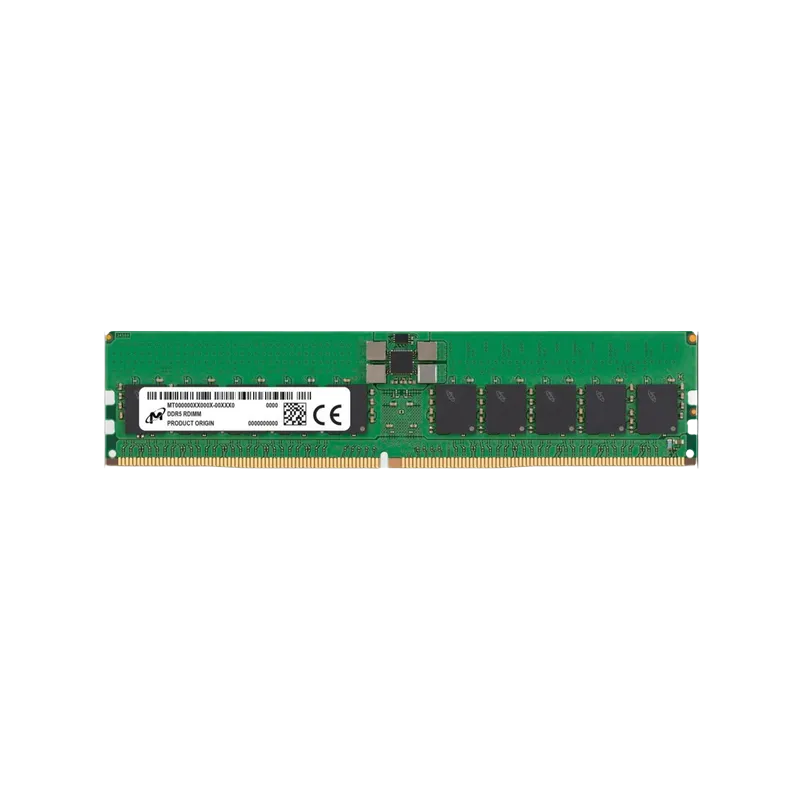
This 64GB DDR5-4800 registered DIMM with ECC is engineered for server platforms, providing the data integrity and reliability essential for virtualization, in-memory databases, and mission-critical enterprise workloads. The registered signal type stabilizes high-capacity memory configurations by reducing electrical loading on the memory controller, while integrated ECC actively corrects single-bit errors to prevent silent data corruption.
1. The 64 GB capacity per module allows denser memory configurations in server nodes, supporting larger virtualization workloads and more active containers without physical expansion.
2. DDR5 technology delivers higher effective bandwidth and improved power management over previous generations, enabling faster data processing in analytics and in-memory database environments.
3. ECC protection automatically detects and corrects single-bit memory errors, which is essential for financial transactions, scientific simulations, and any workload where silent data corruption is unacceptable.
4. Registered buffering re-drives address and command signals, stabilizing operation when populating multiple DIMMs per channel and maintaining signal integrity across fully loaded server platforms.
5. A 4800 MT/s transfer rate increases memory throughput, directly reducing latency in high-frequency trading applications and accelerating virtual machine migration in clustered environments.
When you are responsible for a virtualization cluster hosting dozens of mission-critical VMs, or an in-memory database where every microsecond of latency directly impacts revenue, the memory module seated in your server is not a commodity—it is a foundation of trust. The Micron MTC40F2046S1RC48BAS 64GB DDR5-4800 Registered ECC DIMM is engineered precisely for these realities, and its four defining characteristics translate directly into business resilience.
First, ECC error correction actively detects and corrects single-bit memory errors caused by cosmic radiation or electrical noise. In a dense multi-tenant hypervisor environment, a silent bit flip can corrupt a financial transaction or compromise hypervisor integrity; ECC eliminates that risk in real time, preserving data accuracy without performance penalty. Second, the registered signal type buffers command and address lines, enabling the server to populate all memory channels with 64GB modules without compromising signal integrity. This means you can confidently scale your VMware or Kubernetes nodes to terabyte-level footprints while maintaining rock‑solid stability under 24/7 load—no mysterious kernel panics during peak trading hours. Third, the full 64GB capacity per DIMM transforms memory density economics. Large in‑memory analytics platforms, such as SAP HANA or Redis clusters, can hold vastly larger datasets closer to the CPU, slashing storage I/O bottlenecks and accelerating insight generation. Fourth, the DDR5‑4800 speed and energy‑efficient 1.1V operation deliver substantially higher bandwidth per watt than previous generations, boosting throughput for concurrent virtual machines while aiding data center power‑budget goals. Every one of these attributes—integrity, scalability, density, and efficient speed—converges to ensure that your infrastructure does not just run, but runs with certainty and headroom when it matters most.
General Virtualization
For virtualized environments, populate at least one 64 GB RDIMM per memory channel to balance capacity and bandwidth. A dual-socket server with eight channels per CPU can reach 1 TB of RAM using sixteen modules, supporting dense VM consolidation without sacrificing DDR5-4800 throughput.
In-Memory Database
Maximize capacity by fully populating all DIMM slots with these 64 GB registered ECC modules, aiming for 2 TB or more on dual-socket platforms. Use modules in identical configurations across memory channels to maintain symmetric ranks, and consider rank multiplication for large in-memory datasets that demand low latency and high data integrity.
High-Performance Computing
Achieve peak memory bandwidth by installing one 64 GB DIMM per channel, keeping all channels populated identically to avoid performance penalties. For memory-capacity-bound HPC workloads, scale to two DIMMs per channel while verifying the platform can sustain 4800 MT/s speeds, ensuring registered ECC support for stable, error-free compute runs.
This 64GB DDR5 ECC RDIMM is rigorously tested, compatible with Dell PowerEdge R760, HPE ProLiant DL380 Gen11, and more.
Q: Can I mix this MTC40F2046S1RC48BAS with other memory modules of different brands or speeds?
A: Mixing is not recommended. Registered ECC modules require identical ranks, timings, and speeds for stability. Mismatched DIMMs may cause POST failures or disable ECC and memory interleaving.
Q: Is this memory compatible with my system?
A: Compatibility requires a DDR5 server platform supporting Registered ECC DIMMs, such as AMD EPYC 7003/9004 or Intel Xeon Scalable 4th Gen and later. Verify your motherboard's QVL list for validated configurations.
Q: What is the recommended DIMM population order for optimal performance?
A: Populate identical DIMMs per channel following the server board's silkscreen guide. Typically, fill all channels symmetrically—one DIMM per channel first, then second—to maximize memory bandwidth and interleaving.
Q: Does this module support overclocking or XMP profiles?
A: No. As an enterprise DDR5 Registered ECC DIMM, it adheres to JEDEC standards at 4800 MHz. Overclocking and XMP are not supported to guarantee signal integrity and data reliability in server environments.
Q: What warranty and typical failure rate can I expect?
A: This module includes a 1-year warranty. Enterprise-grade Registered ECC memory exhibits very low annualized failure rates, typically under 0.5%, thanks to rigorous screening and error correction capabilities.