











 Secure payments
Standard refund policy
Trade Assurance
Secure payments
Standard refund policy
Trade Assurance
| Product Type | Memory Module |
|---|---|
| Memory Capacity | 8 GB |
| Memory Technology | DDR3 |
| Product Voltage | 1.35V |
| RAM Speed | 1600MHz |
| RAM Standard | DDR3-1600/PC3-12800 |
| Error Identifying | ECC |
| Signal Type | Registered |
| Column Access Strobe (CAS) | CL11 |
| Rank | Dual Rank x8 |
| Quantity of Pins | 240-pin |
| RAM Genre | VLP RDIMM |
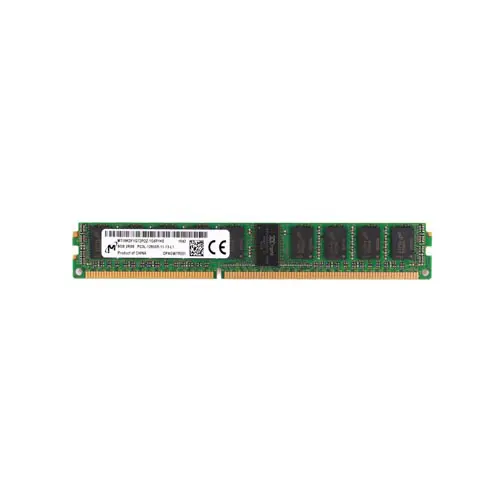
This 8GB DDR3L-1600 VLP RDIMM is a server-class memory module specifically engineered for virtualization platforms, in-memory databases, and enterprise workloads where data integrity is critical. Its registered ECC architecture and dual-rank x8 configuration work together to stabilize signal integrity under heavy load while exploiting rank interleaving for improved throughput, and the 1.35V very low-profile design reduces power consumption and enables dense packing in space-constrained rack servers.
1. ECC protection silently corrects single-bit errors, safeguarding data integrity essential for uninterrupted 24/7 server operations and financial transaction processing.
2. Registered clock drivers stabilize command and address signals, allowing fully populated memory channels without signal degradation in dense virtualization clusters.
3. Dual-rank interleaving maximizes bank-level parallelism, delivering sustained throughput for heavy database queries and simultaneous VM workloads.
4. The very low-profile form factor streamlines airflow within compact rack servers, reducing thermal buildup and improving overall system reliability in high-density deployments.
5. Low-voltage DDR3L operation cuts per-module energy consumption, directly lowering cooling costs and power bills in hyperscale data center environments.
Designed for mission-critical enterprise environments, the Micron MT18KDF1G72PDZ-1G6P1KE is an 8GB DDR3-1600 VLP RDIMM that directly addresses the pain points of IT infrastructure managers. Its ECC technology continuously detects and corrects single-bit memory errors, which in a dense virtualization cluster running dozens of VMs means a cosmic ray-induced bit flip will not silently corrupt a financial transaction log or collapse a customer-facing application, preserving data integrity around the clock. The registered signal buffer stabilizes the electrical load on the memory bus, allowing you to populate all 24 DIMM slots in a 2U server without signal degradation, a critical requirement when expanding memory capacity for growing database workloads under tight chassis constraints. Further, the dual-rank x8 organization interleaves memory banks to deliver higher sustained bandwidth and lower latency under concurrent access, directly accelerating in-memory databases like Redis or SAP HANA where microsecond response times determine real-time analytics outcomes. With its very low profile form factor and 1.35V operation, it also reduces power consumption and improves airflow in blade servers, lowering your total cost of ownership while maintaining full compatibility with dense rack deployments where every millimeter of space and every watt of power matters.
General Virtualization
For a DDR3-era hypervisor hosting multiple moderate VMs, populate all available channels per CPU to maximize bandwidth. Start with six or eight identical 8 GB VLP RDIMMs for a balanced 48–64 GB footprint, ensuring memory is evenly distributed across memory controllers to avoid NUMA bottlenecks while keeping slot headroom for future scale-out.
In-Memory Database
Low-latency, high-capacity demands require fully populating the server with these 8 GB dual-rank registered DIMMs. Aim for 128 GB or more by installing sixteen modules in a dual-socket platform, leveraging the 1.35 V efficiency to reduce thermal load during sustained heavy caching and indexing workloads, and always configure sparing ranks to maintain RAS features.
High-Performance Computing
Memory bandwidth per core is critical; deploy one 8 GB VLP RDIMM per channel across all memory channels to saturate the memory bus. A typical dual-socket node benefits from 64–128 GB using these low-profile, low-voltage DIMMs, which improve airflow in dense clusters and allow higher ambient temperatures, reducing cooling costs during long-running parallel jobs.
Rigorously tested DDR3L VLP RDIMM server memory, compatible with Dell R620, HP DL360p Gen8, Lenovo x3550 M4, and more.
Q: Can I mix this MT18KDF1G72PDZ-1G6P1KE with other memory modules of different brands or speeds?
A: Mixing is strongly discouraged. Due to ECC Registered signaling and stringent rank/timing requirements, different modules may cause instability. We recommend identical Micron DDR3L-1600 RDIMMs for guaranteed compatibility.
Q: Is this memory compatible with my Intel Xeon or AMD Opteron server platform?
A: It is designed for DDR3-based servers using Intel Xeon E5-2600 v1/v2 or AMD Opteron 6300 series CPUs. Verify your motherboard supports 240-pin, 1.35V DDR3 Registered ECC VLP RDIMMs.
Q: What is the recommended DIMM population order for optimal performance?
A: Populate identical DIMMs per channel starting with the farthest blue slot from the CPU. Follow your server vendor's guide to balance memory across channels and maintain dual-rank symmetry for best bandwidth.
Q: Does this module support overclocking or XMP profiles?
A: No. As an enterprise Registered ECC DIMM, it adheres to JEDEC DDR3-1600 standards at CL11. XMP and overclocking are not supported—stability and data integrity take precedence over speed.
Q: What warranty and typical failure rate can I expect?
A: This module includes a 1-year warranty. Annualized failure rate (AFR) is typically under 0.5% in compliant platforms, reflecting Micron's rigorous testing for enterprise reliability. Replacement is prompt upon valid claim.