











 Secure payments
Standard refund policy
Trade Assurance
Secure payments
Standard refund policy
Trade Assurance
| Product Type | Memory Module |
|---|---|
| Compliance Standards | RoHS,CE,WEEE |
| Memory Capacity | 8 GB |
| Memory Technology | DDR4 |
| Product Voltage | 1.2V |
| RAM Speed | 2400MHz |
| RAM Standard | DDR4-2400/PC4-19200 |
| Error Identifying | ECC |
| Signal Type | Registered |
| Column Access Strobe (CAS) | CL17 |
| Rank | Single Rank x8 |
| Quantity of Pins | 288-pin |
| RAM Genre | RDIMM |
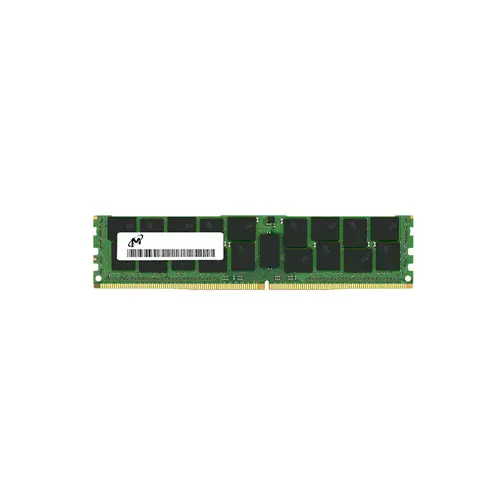
This Micron 8GB DDR4-2400 Registered ECC RDIMM (PC4-19200, CL17, single-rank x8) is engineered for server platforms requiring uncompromised data integrity, making it ideal for virtualization clusters and in-memory databases where silent data corruption cannot be tolerated. The registered signal architecture decouples the command/address bus from the DRAM chips to stabilize high-density memory configurations, while single-rank x8 organization minimizes electrical loading on the memory channel for better signal integrity in multi-DIMM deployments.
1. RDIMM architecture buffers critical control signals to maintain signal integrity across fully loaded server memory channels, ensuring uninterrupted operation in dense rack deployments.
2. ECC technology transparently corrects single-bit memory faults in real time, preventing silent data corruption that could compromise financial transactions or database integrity.
3. An 8 GB per module footprint provides a balanced capacity building block for virtualization hosts, enabling granular resource allocation across numerous lightweight containers or microservices.
4. The 2400 MHz clock speed translates into a peak transfer rate of 19.2 GB/s, sustaining high-throughput workloads such as in-memory caching and concurrent analytics queries without stalling.
5. Single Rank x8 organization lowers per-DIMM electrical loading and access latency, delivering predictable response times crucial for latency-sensitive enterprise applications under constant load.
Built for the relentless demands of server environments, the Micron MTA9ASF1G72PZ-2G3B1IK RDIMM is engineered to eliminate the hidden risks that can cripple enterprise operations. Its ECC technology is not a mere specification—it actively detects and corrects single-bit memory errors caused by background radiation, preventing silent data corruption that could crash a virtualized host or poison a financial transaction. In a dense virtualization cluster where dozens of VMs share physical resources, the registered signal buffer isolates the memory controller from electrical loading, enabling multiple DIMMs per channel to operate without instability; this translates directly to higher consolidation ratios and uninterrupted uptime for your business-critical applications. When paired with an in-memory database like Redis or SAP HANA, the DDR4-2400 speed and single-rank x8 organization deliver consistent, low-latency access to hot datasets, accelerating real-time analytics and query response times. The 1.2V power envelope further reduces thermal load inside rack servers, improving energy efficiency at scale. For IT infrastructure managers, these four pillars—error resilience, scalable stability, deterministic performance, and power thrift—mean you deploy with confidence, knowing your memory won’t become the bottleneck or the point of failure under continuous workload pressure.
Identified as server memory: an 8GB DDR4-2400 ECC Registered RDIMM. Below are capacity planning guidelines for typical server workloads.
General Virtualization
Start with four 8GB RDIMMs (32GB) per dual‑socket host, populating all memory channels to deliver balanced bandwidth. This configuration comfortably supports a dozen light VMs with ECC reliability. As VM density grows, add matched pairs to scale to 64GB or 96GB without replacing existing modules.
In‑Memory Database
Equip each socket with six to eight DIMMs (48–64GB) to keep demanding datasets fully in RAM. The registered ECC design ensures data integrity under constant high‑throughput writes, preventing silent corruption. Distribute modules evenly across channels to maintain low‑latency access for real‑time analytics.
High‑Performance Computing
For HPC nodes, install eight 8GB RDIMMs (64GB) to supply roughly 2–4GB per core in typical dual‑socket clusters. Registered ECC eliminates soft errors during multi‑day simulations, preserving result accuracy. Populate all channels to maximize memory bandwidth for parallel floating‑point workloads.
Rigorously tested 8GB DDR4 ECC RDIMM, compatible with Dell PowerEdge R750, HPE ProLiant DL380 Gen10 Plus, Lenovo ThinkSystem SR650 V2.
Q: Can I mix this MTA9ASF1G72PZ-2G3B1IK with other memory modules of different brands or speeds?
A: Mixing is not recommended for server environments. Even identical specs from different brands may cause instability. For guaranteed reliability, use identical Micron RDIMMs across all channels.
Q: Is this memory compatible with my server system?
A: This DDR4-2400 RDIMM is validated for Intel Xeon E5-2600 v4 and AMD EPYC 7001 series platforms. Verify that your motherboard supports Registered ECC memory and 1.2V 288-pin DIMMs.
Q: What is the recommended DIMM population order for optimal performance?
A: Install identical DIMMs into matching memory channels first, typically populating the blue slots before black ones per your server motherboard manual. Balance memory evenly across all populated CPUs for best throughput.
Q: Does this module support overclocking or XMP profiles?
A: No. As an enterprise-class Registered ECC DIMM, it runs strictly at JEDEC standard DDR4-2400 speed for data integrity and 24/7 stability. Overclocking and XMP are not supported and would void warranty.
Q: What warranty and typical failure rate can I expect?
A: This Micron module includes a 1-year warranty. Annualized failure rate (AFR) is below 0.44%. Designed with strict quality controls, it delivers extreme reliability for mission-critical server workloads.