











 Secure payments
Standard refund policy
Trade Assurance
Secure payments
Standard refund policy
Trade Assurance
| Product Type | Memory Module |
|---|---|
| Compliance Standards | RoHS |
| Memory Capacity | 8 GB |
| Memory Technology | DDR3 |
| Product Voltage | 1.35V |
| RAM Speed | 1333MHz |
| RAM Standard | DDR3-1333/PC3-10600 |
| Error Identifying | ECC |
| Signal Type | Registered |
| Column Access Strobe (CAS) | CL9 |
| Rank | Dual Rank x4 |
| Quantity of Pins | 240-pin |
| RAM Genre | RDIMM |
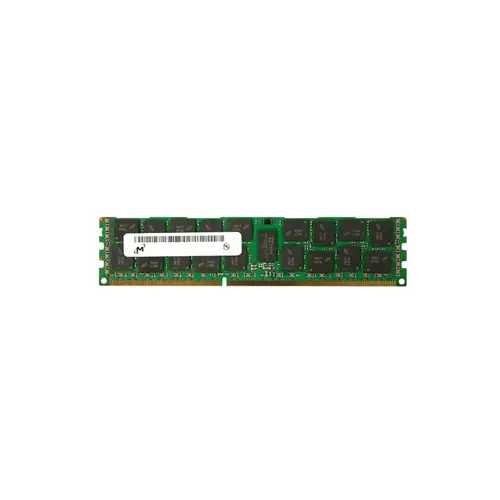
This 8GB DDR3-1333 registered ECC module (RDIMM) targets server platforms running virtualization or memory-centric databases, where its 1.35V low-power operation and registered signaling deliver robust data integrity and signal stability under fully populated memory configurations. The dual-rank x4 organization combined with CL9 latency optimizes bandwidth efficiency, making it well-suited for dense, mission-critical workloads that demand reliable, uninterrupted throughput.
1. ECC protection silently corrects single-bit memory errors, preventing data corruption in mission-critical database and virtualization workloads.
2. Registered signal buffering stabilizes high-capacity memory configurations, enabling reliable operation across fully populated server memory channels.
3. Dual Rank x4 organization boosts memory bank interleaving, sustaining high throughput for consolidated VMs under heavy I/O traffic.
4. 1.35V low-voltage design reduces server power consumption and thermal strain, cutting TCO in dense data center deployments.
5. 8 GB capacity per DIMM provides sufficient headroom for moderate virtualization nodes, balancing cost and memory density in scale-out architectures.
In enterprise computing, where uptime and data accuracy are non-negotiable, the Micron MT36KSF1G72PZ-1G4M1FF RDIMM is engineered to eliminate the silent killers of server performance. Its ECC technology continuously scans and corrects single-bit errors caused by cosmic radiation or electrical noise—an absolute necessity when a flipped bit in a financial database or virtual machine hypervisor could corrupt transactions or crash an entire host. For your virtualization cluster running dozens of VMs, the registered signal buffer stabilizes the command bus, allowing you to populate all memory channels with confidence even under heavy load, preventing the boot failures and random reboots that plague unbuffered designs in dense deployments. The dual-rank x4 organization pushes bandwidth further, delivering consistent low-latency throughput to in-memory databases like Redis or SAP HANA, where microsecond delays directly impact real-time analytics. Meanwhile, the 1.35V low-power operation reduces thermal stress across your rack, trimming cooling costs while maintaining 1333MHz speed. This isn’t just memory—it’s a safeguard for data integrity, a foundation for seamless scalability, and a direct contributor to your bottom line in high-stakes server environments.
General Virtualization
For virtualization hosts running many moderate VMs, balance capacity and memory bandwidth by populating all memory channels identically. Install one 8 GB DDR3-1333 ECC Registered RDIMM per channel—typically eight modules in a dual‑socket server with quad‑channel architecture—yielding 64 GB total at 1.35 V. This symmetric layout maximizes interleaving, keeps power draw low, and leaves room to scale by adding a second DIMM per channel later.
In-Memory Database
In‑memory databases demand maximum capacity and absolute data integrity. Populate every available DIMM slot with these 8 GB low‑voltage RDIMMs while maintaining balanced channels. For a dual‑socket server offering 12 slots per CPU, 24 modules deliver 192 GB of error‑protected memory, satisfying large Redis or SAP HANA footprints. Registered ECC and dual‑rank x4 organization provide the reliability and rank density essential for persistent, high‑availability data sets.
High-Performance Computing
HPC clusters prioritize sustained memory bandwidth under parallel I/O. Place exactly one dual‑rank 8 GB RDIMM per channel to avoid speed down‑binning and preserve the full 1333 MT/s rate. An eight‑module, 64 GB configuration supports simulation, modeling, or analytics nodes with balanced throughput across all channels. The 1.35 V operating voltage further reduces thermal load in dense compute racks, improving overall energy efficiency during long‑running jobs.
Rigorously tested server memory. Compatible with Dell PowerEdge R720, HP DL380p Gen8, Lenovo x3650 M4, and more.
Q: Can I mix this MT36KSF1G72PZ-1G4M1FF with other memory modules of different brands or speeds?
A: Mixing RDIMMs from different brands or speeds is strongly discouraged. It often causes system instability, reduced performance, or boot failure in servers. Always install identical modules to guarantee reliable, validated operation.
Q: Is this memory compatible with my system?
A: This 8GB DDR3-1333 ECC Registered DIMM is engineered for server platforms, such as Intel Xeon E5-2400/2600 v1/v2 or AMD Opteron 6300 series. Confirm your board supports 1.35V RDIMMs before ordering.
Q: What is the recommended DIMM population order for optimal performance?
A: For dual-socket servers, populate channels symmetrically, filling the farthest slot from each CPU first. Consult your motherboard guide for balanced loading; correct order maximizes bandwidth and ensures stable interleaving.
Q: Does this module support overclocking or XMP profiles?
A: No, this enterprise ECC Registered DIMM strictly follows JEDEC DDR3-1333 standards. Overclocking and XMP are not supported, as server memory prioritizes long-term data integrity and stability over performance tuning.
Q: What warranty and typical failure rate can I expect?
A: This module includes a 1-year warranty. As a rigorously screened server DIMM, typical Annualized Failure Rate (AFR) is below 0.5%, significantly more reliable than standard desktop memory under continuous operation.