











 Secure payments
Standard refund policy
Trade Assurance
Secure payments
Standard refund policy
Trade Assurance
| Product Type | Memory Module |
|---|---|
| Memory Capacity | 8 GB |
| Memory Technology | DDR4 |
| Product Voltage | 1.2V |
| RAM Speed | 2666MHz |
| RAM Standard | DDR4-2666/PC4-21300 |
| Error Identifying | ECC |
| Signal Type | Registered |
| Column Access Strobe (CAS) | CL19 |
| Rank | Single Rank x8 |
| Quantity of Pins | 288-pin |
| RAM Genre | RDIMM |
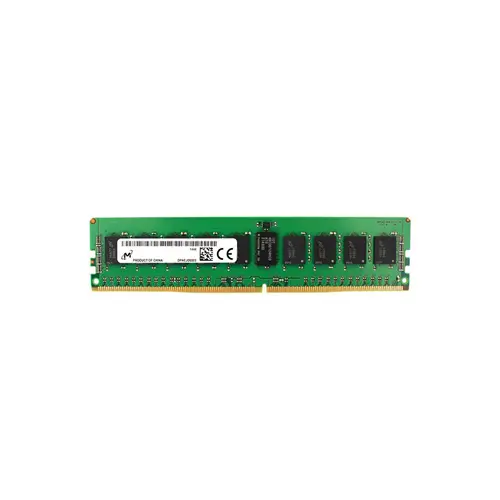
This RDIMM module is engineered for server platforms, delivering 8 GB of DDR4-2666 capacity with ECC and registered signaling to ensure data integrity and signal stability in dense, multi-DIMM configurations. Its single-rank x8 organization and CL19 latency make it an optimal choice for virtualization and in-memory database workloads where consistent, low-latency access and error resilience are critical.
1. Registered buffering decouples the memory bus from chip loading, enabling dense server farms to scale capacity reliably across many DIMMs per channel without signal degradation.
2. ECC protection silently corrects single-bit errors the instant they occur, preserving data integrity for transactional databases and virtualized workloads that cannot tolerate silent corruption.
3. Single Rank x8 organization keeps bus electrical loads low, helping fully populated server boards maintain stable command timing under continuous multi-tenant pressure.
4. The 2666 MT/s transfer rate delivers a balanced bandwidth envelope that comfortably feeds multi-core server CPUs running enterprise applications such as ERP and middleware.
5. 1.2-volt operation trims both power draw and thermal output per module, directly reducing cooling overhead and energy costs in high-density rack deployments.
Designed for the data center, the Micron MTA9ASF1G72PZ-2G6D1RG is a server-grade DDR4-2666 RDIMM whose four defining characteristics directly address the real-world demands of enterprise IT. Its ECC technology constantly detects and corrects single-bit memory errors. In a virtualization cluster hosting dozens of VMs, a flipped bit caused by background radiation can silently corrupt a financial transaction or crash a critical application; ECC eliminates that risk, meaning your business avoids unpredictable downtime and data integrity breaches that erode trust. The registered buffer stabilizes the command and address lines when populating multiple DIMMs per channel. For a high-density VMware or Kubernetes node, this signal integrity lets you scale to 512 GB or more without intermittent boot failures or performance degradation under load, so consolidation ratios grow safely. The single-rank x8 organization and 2666 MT/s throughput excel in memory-caching databases like Redis or SAP HANA, where interleaving across ranks delivers the low-latency, bandwidth-hungry access patterns that real-time analytics demand. Finally, the strict 1.2 V power envelope translates directly to a cooler-running rack; in a 42U cabinet packed with nodes, that cumulative power saving lowers both your opex and thermal throttling risk, keeping queries fast and consistent around the clock.
This is a server-class DDR4-2666 RDIMM with ECC and registered signaling, purpose-built for stability and multi-channel platforms. Use the following capacity planning guidance for typical workloads.
General Virtualization
Balance memory capacity and channel interleaving for consistent VM density. In a dual-socket server, populate at least one identical 8 GB RDIMM per memory channel to achieve optimal bandwidth. A configuration of 12 modules delivers 96 GB, sufficient for moderate virtualization hosts. For higher density, add a second DIMM per channel using the same part to reach 192 GB, while monitoring any speed adjustments.
In-Memory Database
Latency-sensitive databases require maximum channel utilization and large capacity. Fill all available memory channels with these 8 GB RDIMMs to enable full interleaving. If total capacity is insufficient, move to a two-DIMM-per-channel (2DPC) layout—for example, 24 modules providing 192 GB. Maintain uniform rank and timing across all slots to prevent performance inconsistencies, and validate the platform’s 2DPC speed support.
High-Performance Computing (HPC)
Prioritize memory bandwidth by installing one DIMM in every channel. A balanced configuration, such as 12 identical 8 GB modules across 6 channels per socket, yields 96 GB and peak throughput. Avoid empty channels to prevent bandwidth bottlenecks. The single-rank x8 design supports clean signal integrity at rated speed, which benefits floating-point and simulation workloads.
Rigorously tested, this server memory is validated for Dell PowerEdge R740, HPE DL380 Gen10, and Lenovo SR650.
Q: Can I mix this MTA9ASF1G72PZ-2G6D1RG with other memory modules of different brands or speeds?
A: We strongly advise against mixing brands or speeds in a registered ECC server environment. Mismatched modules can cause stability issues, signal integrity problems, and unbootable systems. Always populate with identical part numbers for validated reliability.
Q: Is this memory compatible with my system? I am using an Intel/AMD server platform.
A: This DDR4-2666 ECC RDIMM is compatible with platforms supporting registered DIMMs, such as Intel Xeon Scalable (Skylake-SP/ Cascade Lake) and AMD EPYC 7001/7002 series. Please verify your server board's QVL or memory support list to confirm.
Q: What is the recommended DIMM population order for optimal performance?
A: Follow your server motherboard's manual. Typically, populate identical DIMMs per channel, starting with slot 1, then slot 2, to balance memory channels and enable interleaving. Symmetric configurations maximize bandwidth and minimize access latency.
Q: Does this module support overclocking or XMP profiles?
A: No. This is a JEDEC-standard registered ECC module designed for enterprise reliability, not overclocking. XMP profiles are absent; the module runs at its specified 2666MHz with CL19 timings for rock-solid stability.
Q: What warranty and typical failure rate can I expect?
A: It is backed by a 1-year limited warranty. As a quality server-grade component, the typical annualized failure rate (AFR) is below 0.5% under normal operating conditions, ensuring excellent long-term dependability for mission-critical workloads.