











 Secure payments
Standard refund policy
Trade Assurance
Secure payments
Standard refund policy
Trade Assurance
| Product Type | Memory Module |
|---|---|
| Memory Capacity | 8 GB |
| Memory Technology | DDR3 |
| Product Voltage | 1.5V |
| RAM Speed | 1333MHz |
| RAM Standard | DDR3-1333/PC3-10600 |
| Error Identifying | ECC |
| Signal Type | Registered |
| Column Access Strobe (CAS) | CL9 |
| Rank | Dual Rank x4 |
| Quantity of Pins | 240-pin |
| RAM Genre | RDIMM |
This 8GB DDR3-1333 RDIMM with ECC and registered signaling is purpose-built for legacy enterprise servers and workstations, delivering critical data integrity for virtualization platforms and in-memory database applications. Its dual-rank x4 configuration enhances memory bandwidth utilization at the cost of moderate latency, while the CAS 9 timing ensures stable command-to-address response under fully buffered loads.
1. ECC protection silently corrects single-bit errors in real time, preventing silent data corruption in transactional databases and long-running virtualization workloads.
2. Registered signal buffering stabilizes command and address lines across heavily populated server boards, enabling reliable operation with multiple DIMMs per channel in dense rack configurations.
3. Dual Rank x4 organization leverages rank interleaving to keep the memory pipeline fully utilized, reducing latency under the concurrent access patterns typical of multi-tenant cloud environments.
4. PC3-10600 bandwidth delivers a sustained 10.6 GB/s throughput per module, ensuring smooth data flow for mid-tier application servers handling concurrent user requests without bottlenecking the memory controller.
5. CL9 response time shortens the gap between column access and data delivery, improving the responsiveness of cache-miss-heavy enterprise applications like in-memory analytics and high-frequency trading platforms.
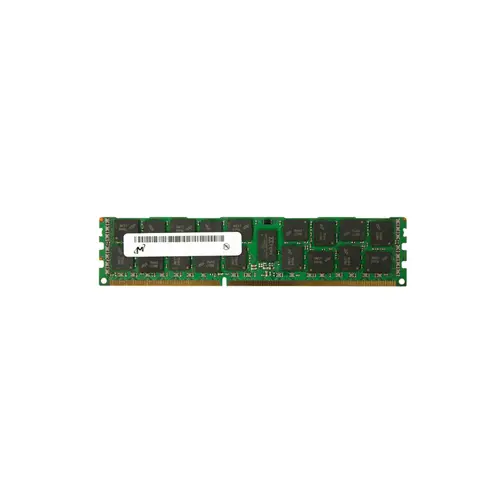
The Micron MT36JSZF1G72PZ-1G4DZES is a server-grade 8GB DDR3 RDIMM engineered to eliminate the most painful uncertainties in your data center. Its ECC constantly corrects single-bit flips caused by background radiation—a silent threat that, without correction, corrupts transactional records inside an in-memory database like SAP HANA or quietly crashes a virtual machine in a densely consolidated cluster. The registered buffer stabilizes high-density configurations; it re-drives address and command signals so you can populate all available channels without signal degradation, preventing the random lockups that plague unbuffered modules under full load and keeping your virtualization hosts running through peak provisioning. Dual-rank x4 organization enables rank interleaving, overlapping read and write cycles to boost effective bandwidth for Redis or Memcached instances where microsecond delays multiply into SLA misses. Finally, 1333 MHz operation at CAS 9 delivers deterministic low latency, ensuring financial trading applications and OLTP queries execute within predictable time windows. For a hypervisor node or a database engine, this module is not just capacity—it is your guarantee against silent data corruption, unscheduled downtime, and latency drift when revenue depends on consistent response.
General Virtualization
Populate each memory channel of a dual-socket server with one 8 GB DDR3-1333 ECC RDIMM, yielding a balanced 64 GB of registered memory. This configuration runs at the full 1333 MT/s with dual-rank x4 interleaving, comfortably hosting 20–30 lightweight VMs. Always use identical modules to guarantee reliable ECC operation.
In-Memory Database
In-memory databases need low latency; fill every channel with a single 8 GB RDIMM to sustain 1333 MHz with CL9 timings. For larger working sets, install two DIMMs per channel for 96 GB, but be aware that many DDR3 platforms force a down-clock to 1066 MHz at 2DPC. Use identical dual-rank x4 parts and configure huge pages to maximize bank-level parallelism.
High-Performance Computing (HPC)
HPC workloads demand maximum bandwidth; install exactly one 8 GB RDIMM per channel to avoid speed penalties. The dual-rank x4 organization already provides rank interleaving, so a dual-socket node with eight or twelve channels achieves 64–96 GB at full 1333 MT/s. Verify memory subsystem settings in BIOS and select a performance profile for optimal throughput.
Rigorously tested server memory, compatible with Dell PowerEdge R720, HP ProLiant DL380p Gen8, and similar ECC RDIMM systems.
Q: Can I mix this MT36JSZF1G72PZ-1G4DZES with other memory modules of different brands or speeds?
A: Mixing different brands or speeds of Registered ECC DDR3 is not advised. Mismatched modules can cause signal integrity issues, system instability, or failure to POST. Use identical part numbers for guaranteed compatibility.
Q: Is this memory compatible with my Intel Xeon or AMD Opteron server platform?
A: This DDR3-1333 ECC Registered DIMM is compatible with platforms supporting DDR3 RDIMMs, such as Intel Xeon E5-2400 series and AMD Opteron 6300. Always verify your server board's memory Qualified Vendor List (QVL).
Q: What is the recommended DIMM population order for optimal performance?
A: For dual-socket servers, populate identical DIMMs starting from slot A1, B1, across channels. Keep channel populations symmetric and match ranks. Refer to your system's manual for exact slot layout to maintain balanced interleaving.
Q: Does this module support overclocking or XMP profiles?
A: No. This is an enterprise-grade ECC Registered module operating at fixed JEDEC timings (CL9). Overclocking is not supported and would compromise data integrity, stability, and could void the warranty.
Q: What warranty and typical failure rate can I expect?
A: This memory carries a 1-year warranty. Typical annualized failure rate for such enterprise RDIMMs is below 0.5%. We recommend periodic diagnostic testing to maintain early fault detection in server environments.