











 Secure payments
Standard refund policy
Trade Assurance
Secure payments
Standard refund policy
Trade Assurance
| Model | MT36JSF1G72PZ-1G4K1H |
|---|---|
| Product Type | Memory Module |
| Compliance Standards | RoHS |
| Memory Capacity | 8 GB |
| Memory Technology | DDR3 |
| Product Voltage | 1.5V |
| RAM Speed | 1333MHz |
| RAM Standard | DDR3-1333/PC3-10600 |
| Error Identifying | ECC |
| Signal Type | Registered |
| Column Access Strobe (CAS) | CL9 |
| Rank | Dual Rank x4 |
| Quantity of Pins | 240-pin |
| RAM Genre | RDIMM |
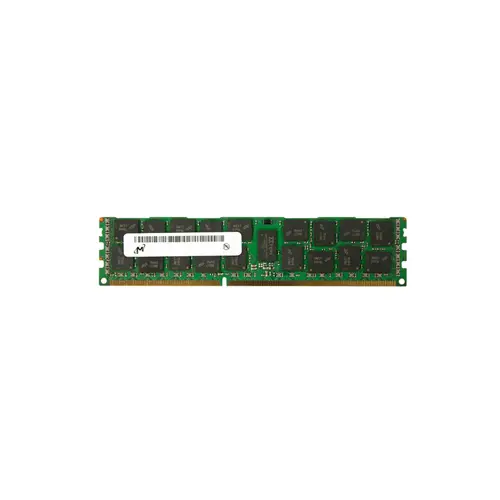
This Micron 8GB DDR3-1333 Registered DIMM, with ECC and a dual-rank x4 organization, is engineered for stability in legacy server platforms running virtualization or memory-intensive database workloads. Its registered signaling and 1.5V operating voltage ensure reliable signal integrity across multiple ranks, making it an ideal choice for preserving data consistency in always-on enterprise systems.
1. ECC actively detects and corrects single-bit memory errors, safeguarding data integrity in mission-critical server workloads where even silent corruption is unacceptable.
2. Registered signal buffering reduces the electrical load on the memory controller, enabling the deployment of higher-capacity configurations across more DIMM slots without sacrificing system stability.
3. The RDIMM form factor aligns with server-grade platforms, ensuring full compatibility with enterprise chipsets and delivering predictable, validated operation in always-on environments.
4. Dual Rank x4 organization interleaves accesses across two internal rank sets, keeping memory channels fully saturated and boosting bandwidth for virtualized clusters running dozens of VMs on a single node.
5. An 8 GB capacity per module serves as a dense building block, allowing servers to scale up total memory for large in-memory databases and high-density virtualization without exhausting available slot counts.
The Micron MT36JSF1G72PZ-1G4K1H is a server-grade DDR3 Registered DIMM, purpose-built for always-on enterprise infrastructure. Its four defining characteristics are not just specifications; they answer real operational pain points. ECC error correction directly prevents silent data corruption, a catastrophic risk for in-memory financial ledgers or database transactions where a single bit flip could alter account balances without a trace. The registered signal buffer re-drives command and address signals, stabilizing heavy loads when all channels are populated. For a dense virtualization cluster hosting dozens of VMs, this eliminates intermittent memory-related crashes and channel dropouts, ensuring live migration completes without incident. The dual-rank x4 organization interleaves internal banks to maximize sustained bandwidth, slashing query latency in Redis or SAP HANA instances under concurrent user spikes. Finally, the 8 GB capacity at 1333 MHz delivers a cost-effective yet reliable upgrade path for aging servers, sidestepping the instability of mixed-rank configurations. For IT teams tired of unexplained blue screens and database response jitter, this RDIMM translates complex reliability engineering into one consistent outcome: uncompromising uptime.
General Virtualization
For a typical hypervisor hosting multiple VMs, populate at least six to eight of these 8GB RDIMMs across memory channels to reach 48–64GB. Balancing capacity with channel interleaving improves throughput, so install identical modules evenly—three per processor in a dual‑socket server, for instance, to avoid bottlenecks.
In‑Memory Database
Low‑latency access is critical, so maximize total capacity while retaining the speed of DDR3-1333 CAS 9. Fully populate all channels with these registered ECC modules, aiming for 128GB or more across both sockets to keep entire datasets in RAM and benefit from Chipkill‑like reliability.
HPC
Memory bandwidth often limits performance, so use one DIMM per channel to run at the highest native 1333MHz speed. Deploy multiples of four modules per node for quad‑channel architectures, targeting 32–64GB per socket; the ECC and registered signaling ensure data integrity under sustained computational loads.
Rigorously tested server memory compatible with Dell PowerEdge R720, HP DL380p Gen8, IBM x3650 M4.
Q: Can I mix this MT36JSF1G72PZ-1G4K1H with other memory modules of different brands or speeds?
A: Mixing RDIMMs of different brands or speeds is not recommended. Mismatched modules may cause instability, forced downclocking, or POST failures in registered server environments. Always use identical part numbers for validated compatibility.
Q: Is this memory compatible with my system?
A: This 8GB DDR3-1333 ECC Registered DIMM fits servers using Intel Xeon E5-2400/E5-2600 v1/v2 or AMD Opteron 6300 series platforms. Verify your board supports 1.5V RDIMMs and 240-pin DDR3 slots before purchasing.
Q: What is the recommended DIMM population order for optimal performance?
A: Populate identical RDIMMs per memory channel, typically filling slots 1A, 2A, 1B, 2B first for dual-processor systems. Follow the server motherboard matrix to balance channels and achieve maximum throughput.
Q: Does this module support overclocking or XMP profiles?
A: No. This JEDEC-compliant ECC Registered module runs strictly at DDR3-1333 CL9 with no XMP or overclocking support. Server-class memory prioritizes stability and data integrity over high frequencies.
Q: What warranty and typical failure rate can I expect?
A: This module comes with a 1-year warranty. Enterprise RDIMMs have an annualized failure rate (AFR) well under 0.5% in controlled datacenter environments, ensuring high reliability for mission-critical workloads.