











 Secure payments
Standard refund policy
Trade Assurance
Secure payments
Standard refund policy
Trade Assurance
| Product Type | Memory Module |
|---|---|
| Compliance Standards | RoHS |
| Memory Capacity | 8 GB |
| Memory Technology | DDR3 |
| Product Voltage | 1.35V |
| RAM Speed | 1333MHz |
| RAM Standard | DDR3-1333/PC3-10600 |
| Error Identifying | ECC |
| Signal Type | Registered |
| Column Access Strobe (CAS) | CL9 |
| Rank | Single Rank x4 |
| Quantity of Pins | 240-pin |
| RAM Genre | VLP RDIMM |
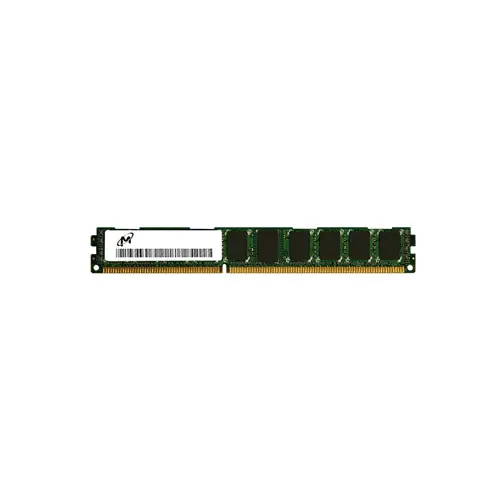
This VLP RDIMM is a server-grade DDR3L module optimized for dense, space-constrained deployments such as blade servers, where its 1.35V low-power design and single-rank x4 configuration enable higher memory capacity per channel with reduced electrical loading. The combination of ECC and registered signaling ensures data integrity and stability under heavy virtualized or memory-intensive workloads like in-memory databases.
1. Registered signal type decouples memory controller loading from the number of ranks, preserving signal cleanliness in heavily populated server channels where any instability means lost transactions.
2. ECC error detection and correction continuously scrubs bit errors, turning random soft faults into harmless events and protecting long-running virtualization and database instances from silent data corruption.
3. VLP RDIMM form factor minimizes module height to free up board spacing, directly improving airflow in 1U and blade servers and allowing higher density deployments without thermal throttling.
4. Ultra-low voltage operation cuts overall memory power draw, which compounds into significant energy savings across racks of servers while keeping DIMM temperatures well below reliability limits.
5. Substantial module capacity provides headroom for consolidating numerous virtual machines or containers per node, raising workload density and deferring costly hardware expansion in virtualized server fleets.
In the data center, where every computation carries business consequence, the Micron MT18KDF1G72PZ-1G4E1 VLP RDIMM is engineered to eliminate the subtle failures that erode reliability. This 8 GB DDR3-1333 registered module with ECC is purpose‑built for dense server environments where memory integrity and signal stability are non‑negotiable. Its ECC engine silently detects and corrects single‑bit errors, a critical safeguard when you are running a virtualized cluster hosting a dozen VMs on a single node. A cosmic ray flipping a bit in a shared memory page can cascade into a hung hypervisor; with error correction, that risk is neutralized before it becomes a service outage. In an in‑memory database like Redis serving real‑time analytics, the same ECC protection ensures that a corrupted key does not return faulty transaction records, preserving both data accuracy and customer trust.
The registered buffer on this RDIMM decouples the command‑address lane from the CPU, allowing your server to populate all 24 slots without signal degradation — a direct answer to scaling capacity for memory‑hungry workloads. When your virtual desktop infrastructure demands 192 GB of logical RAM, registered logic maintains clean timing across every rank, preventing the boot failures that plague unbuffered modules on fully‑loaded motherboards. The single‑rank x4 organization, despite its modest 8 GB density, delivers superior bandwidth per channel in configurations that interleave across multiple DIMMs. Operating at just 1.35 V, this very‑low‑profile module also draws less power per slot, lowering thermal load in a 1U node where every watt of saved heat means quieter fans, reduced cooling expenditure, and a longer service life for adjacent components. For database acceleration or hyperconverged storage, that electrical headroom translates directly into sustained compute throughput during peak query hours. This is not just memory; it is a bastion of uptime and data fidelity in your most consequential infrastructure.
This DDR3-1333 ECC Registered VLP RDIMM is built for server environments where reliability, low power, and dense configurations matter. Below are capacity planning recommendations for representative workloads.
General Virtualization
Populate memory channels symmetrically by installing one of these 8 GB modules per channel (e.g., six modules across a dual‑socket platform with three channels per CPU). This delivers 48 GB of balanced bandwidth for moderate VM densities. For heavier hypervisor loads, scale up to twelve or sixteen modules to reach 96–128 GB while preserving power efficiency thanks to the 1.35 V voltage.
In-Memory Database
Fill all available DIMM slots, often with two DIMMs per channel, to maximize protected capacity. Using these low‑profile 8 GB RDIMMs, a 24‑slot server provides 192 GB of resilient ECC memory that safeguards large datasets. The VLP form factor and low voltage help maintain thermal headroom in sustained, dense configurations.
High-Performance Computing
Equip each memory channel with a single module to sustain the full 1333 MT/s speed and avoid rank‑based timing penalties. A balanced setup, for instance 12 identical modules across two sockets, yields 96 GB of symmetric bandwidth, well suited for parallel jobs that reward consistent access latency across all cores.
Tested compatible with servers including Dell PowerEdge R720, HP DL380p Gen8, and Lenovo ThinkServer RD430.
Q: Can I mix this MT18KDF1G72PZ-1G4E1 with other memory modules of different brands or speeds?
A: Mixing this registered ECC RDIMM with modules of different brands or speeds is not recommended. Mismatched ranks or timings may cause signal integrity issues, system instability, or fail to POST in server environments.
Q: Is this memory compatible with my system?
A: It is compatible with servers using Intel Xeon E5-2600 v1/v2 or AMD Opteron 6300 series platforms that support DDR3 registered ECC memory. Verify your board supports 1.35V VLP RDIMMs and 240-pin slots.
Q: What is the recommended DIMM population order for optimal performance?
A: Follow your server’s memory population guide. Typically, populate identical DIMMs first in the blue slots (e.g., A1, B1, C1, D1) per memory channel to maintain balanced interleaving and maximize bandwidth.
Q: Does this module support overclocking or XMP profiles?
A: No. This is a server-grade registered DIMM adhering to JEDEC DDR3-1333 specifications. It does not support XMP or overclocking; it is engineered for stability and data integrity in mission-critical workloads.
Q: What warranty and typical failure rate can I expect?
A: This module comes with a one-year warranty. Manufactured by Micron, these enterprise RDIMMs exhibit an extremely low annualized failure rate (AFR) under 0.2%, ensuring reliable 24/7 operation in properly cooled enclosures.