











 Secure payments
Standard refund policy
Trade Assurance
Secure payments
Standard refund policy
Trade Assurance
| Product Type | Memory Module |
|---|---|
| Compliance Standards | RoHS |
| Memory Capacity | 8 GB |
| Memory Technology | DDR3 |
| Product Voltage | 1.35V |
| RAM Speed | 1333MHz |
| RAM Standard | DDR3-1333/PC3-10600 |
| Error Identifying | ECC |
| Signal Type | Registered |
| Column Access Strobe (CAS) | CL9 |
| Rank | Single Rank x4 |
| Quantity of Pins | 240-pin |
| RAM Genre | RDIMM |
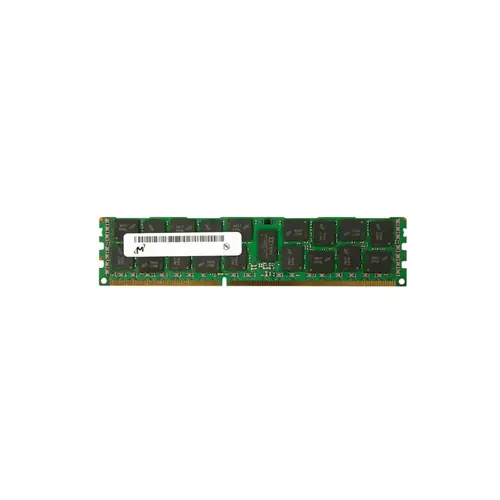
This 8GB DDR3-1333 RDIMM with ECC and registered signaling is a server-grade memory module purpose-built for virtualization platforms and in-memory database workloads where data integrity is critical. Its single-rank x4 organization minimizes electrical loading on the memory bus while the low 1.35V operating voltage and CL9 latency deliver a stable, power-efficient solution for dense multi-DIMM configurations.
1. ECC error correction continuously detects and corrects single-bit memory faults, safeguarding transactional databases and virtualization hosts from silent data corruption that leads to costly downtime.
2. Registered signal buffering reduces the electrical load on the server’s memory controller, enabling denser memory configurations and preserving signal integrity under sustained multi-DIMM workloads.
3. The DDR3 protocol and low 1.35V operating voltage combine to deliver a power-efficient memory foundation for legacy server fleets, lowering thermal stress and operational energy costs in always-on environments.
4. A capacity of 8 GB provides sufficient memory footprint per module for light virtualized clusters and moderate in-memory caching, optimizing consolidation ratios without overspending on unused resources.
5. The 1333 MHz clock rate offers consistent bandwidth and predictable access latencies, keeping latency-sensitive enterprise applications like online transaction processing running smoothly during peak loads.
The MT18KSF1G72PZ-1G4E1 is a server DDR3 RDIMM engineered for mission-critical enterprise workloads, and its four defining characteristics directly resolve real-world infrastructure pain points. In a virtualized cluster running dozens of VMs, a single cosmic-ray-induced bit flip can silently corrupt a hypervisor page or an active transaction log. The module’s ECC technology catches and corrects these errors in real time, meaning your VM fleet stays consistent and your service uptime remains protected. The registered signal buffer then ensures that command and address lines remain clean even when every DIMM slot is populated, allowing you to scale memory capacity for dense virtualization hosts without risking signal degradation or unexpected reboots. Operating at just 1.35 V, the module draws less power and radiates less heat per stick, which directly shrinks cooling demands and electricity bills across a rack full of always-on servers. Finally, the Single Rank x4 chip organization amplifies reliability: combined with ECC, it can correct multi-bit errors and survive an entire DRAM chip failure. For an in-memory database like SAP HANA or Redis, where transactional accuracy is non-negotiable, this fail-safe design means you never have to question the integrity of your critical data.
General Virtualization
For a typical dual-socket server, populate at least eight of these 8 GB RDIMMs (64 GB total) evenly across all memory channels to maximize bandwidth. Use a balanced configuration—one DIMM per channel—to ensure consistent performance for mixed virtual machine workloads. When density is a higher priority, deploy sixteen modules for 128 GB, allowing more headroom without sacrificing registered memory stability.
In-Memory Database
In-memory databases demand large, reliable capacity. Install twelve to eighteen modules (96–144 GB) across both processors, exploiting the ranked registered design to keep electrical loading manageable. Configure mirrored or spare-channel populations if the platform supports them, adding fault tolerance. This approach keeps the entire dataset in DRAM, drastically reducing latency for real-time analytics under ECC protection.
High-Performance Computing (HPC)
HPC clusters require sustained bandwidth and data integrity. Populate all memory channels with identical 8 GB RDIMMs—typically twelve or sixteen modules per node—to unlock maximum interleaving. The 1.35 V low-power operation reduces thermal output in dense racks, while ECC mitigates silent data corruption during long-running simulations. Avoid mixing ranks and speeds to maintain strict timing uniformity across workers.
Rigorously tested, this server memory is compatible with Dell PowerEdge R720/R620, HP ProLiant DL380p Gen8, and Lenovo System x3650 M4.
Q: Can I mix this MT18KSF1G72PZ-1G4E1 with other memory modules of different brands or speeds?
A: Mixing registered ECC modules of differing brands or speeds is strongly discouraged. It often leads to signal integrity issues and system instability. For reliable operation, use identical Micron-certified modules.
Q: Is this memory compatible with my Intel Xeon E5 or AMD Opteron server platform?
A: This 8GB DDR3-1333 RDIMM is compatible with platforms supporting 1.35V registered ECC memory. Please verify your server board's qualified vendor list (QVL) for this specific Micron part number to ensure full compatibility.
Q: What is the recommended DIMM population order for optimal performance with this RDIMM?
A: For dual-processor servers, balance memory across both CPUs. For single systems, populate identical DIMMs per channel starting with the furthest slot from the processor. Always consult your motherboard's population guide to maintain memory interleaving.
Q: Does this module support overclocking or XMP profiles?
A: No, this registered server memory does not support XMP or overclocking. It operates strictly at JEDEC standard DDR3-1333 CL9 timings with 1.35V, prioritizing data integrity and 24/7 stability over performance tuning.
Q: What warranty and typical failure rate can I expect for this Micron server memory?
A: This module comes with a 1-year warranty. As an original Micron RDIMM built with screened chips and strict burn-in testing, the annualized failure rate (AFR) is exceptionally low, typically below 0.5% in controlled environments.