











 Secure payments
Standard refund policy
Trade Assurance
Secure payments
Standard refund policy
Trade Assurance
| Product Type | Memory Module |
|---|---|
| Memory Capacity | 8 GB |
| Memory Technology | DDR3 |
| Product Voltage | 1.5V |
| RAM Speed | 1333MHz |
| RAM Standard | DDR3-1333/PC3-10600 |
| Error Identifying | ECC |
| Signal Type | Registered |
| Column Access Strobe (CAS) | CL9 |
| Rank | Dual Rank x4 |
| Quantity of Pins | 240-pin |
| RAM Genre | RDIMM |
This DDR3-1333 registered ECC RDIMM, with a dual-rank x4 organization and CL9 latency, is engineered for legacy server platforms that demand data integrity and stable operation under high memory loads, making it well-suited for virtualization hosts and memory-resident databases where error correction is critical. Its registered signal type buffers command and address lines to maintain signal integrity across multiple DIMMs, while the dual-rank configuration can improve memory throughput through interleaving in supported systems.
1. ECC error correction silently resolves single-bit memory faults, preserving the integrity of transactional data in always-on enterprise databases.
2. Registered buffering stabilizes high-capacity memory arrays, enabling expansive virtualization hosts to run reliably under constant multi-tenant demand.
3. An eight-gigabyte per-module capacity allows dense memory population, maximizing the number of simultaneous virtual machines per rack unit economically.
4. Dual-rank x4 organization sustains rank interleaving efficiency, ensuring predictable memory throughput for hypervisors handling mixed workloads.
5. 1333 MHz clocked operation delivers steady per-channel bandwidth, preventing data bottlenecks across consolidated storage and networking services.
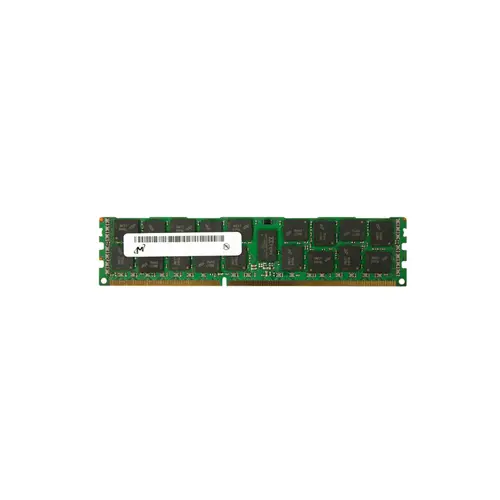
The Micron MT36JSF1G72PZ-1G4D1D is a server-grade 8GB DDR3-1333 RDIMM, engineered to resolve the exact vulnerabilities that keep data center architects up at night. Its ECC continuously corrects single-bit errors, preventing silent data corruption that could alter financial records or compromise long-running analytics inside an in-memory database like SAP HANA. The Registered buffer stabilizes high-capacity configurations, letting you populate dense virtualization clusters with dozens of VMs without signal integrity issues — no random crashes under heavy consolidation. Dual Rank x4 architecture leverages rank interleaving to overlap memory accesses and sustain higher bandwidth, directly accelerating transaction throughput in Redis or similar latency-sensitive data stores. Finally, the 1333MHz clock with CL9 timing delivers predictable, low-latency response under mixed workloads, so business-critical services never choke on memory bottlenecks. For 24/7 operations where data accuracy and service availability are non-negotiable, these four traits transform a simple memory module into a foundational layer of uptime and trust.
General Virtualization
For general virtualization hosts running multiple moderate VMs, populate six to eight identical 8 GB RDIMMs across triple‑channel memory controllers to achieve 48–64 GB total capacity. This configuration balances cost and density while Registered ECC protects against single‑bit errors in shared multi‑tenant environments. Stick to identical dual‑rank x4 modules per channel to avoid rank‑mixing penalties and maintain consistent 1333 MHz operation.
In‑Memory Database
In‑memory databases demand both capacity and resilience, making 8 GB RDIMMs a foundational building block. Fully populate all available DIMM slots—typically 18 or 24 per two‑socket server—to reach 144–192 GB or more, leveraging the low 1.5 V operating voltage to control thermals in dense configurations. Dual‑rank x4 organization and CL9 latency deliver the sustained bandwidth essential for real‑time analytics and high‑concurrency transaction processing.
High‑Performance Computing
HPC clusters benefit from balanced memory bandwidth, so install matching 8 GB RDIMMs in multiples of three per node to maximize triple‑channel throughput. A common 48 GB (6 × 8 GB) or 96 GB (12 × 8 GB) layout ensures uniform access patterns, while registered signals maintain signal integrity across many ranks. ECC protection is non‑negotiable for long‑running simulation jobs whose data integrity directly impacts scientific reproducibility.
Rigorously tested server RDIMM. Compatible with Dell PowerEdge R610, R710, HP ProLiant DL380 G7, and more.
Q: Can I mix this MT36JSF1G72PZ-1G4D1D with other memory modules of different brands or speeds?
A: Mixing RDIMMs of different brands or speeds is not recommended. The server will clock all modules to the slowest common speed, and mismatched ranks or timings may cause stability issues or prevent POST.
Q: Is this memory compatible with my Intel Xeon E5 or AMD Opteron server platform?
A: This DDR3-1333 Registered ECC module supports a wide range of Intel Xeon E5-2600/E5-2400 series and AMD Opteron 4300/6300 series platforms. Verify your board supports 1.5V RDIMMs and has 240-pin DDR3 slots.
Q: What is the recommended DIMM population order for optimal performance with this dual-rank x4 RDIMM?
A: For optimal performance, populate identical DIMMs per memory channel, starting with the farthest slot from the CPU. Typically blue or black slots first. Follow your server’s specific population guide for dual-rank x4 modules.
Q: Does this module support overclocking or XMP profiles?
A: No. This is a server-grade Registered ECC DIMM built for stability at JEDEC standard DDR3-1333 CL9. It does not support overclocking or XMP profiles, which are typically found on consumer desktop memory.
Q: What warranty and typical failure rate can I expect?
A: This module includes a 1-year warranty. Enterprise RDIMMs like this Micron unit are designed for high reliability with very low annualized failure rates—typically under 0.5% in properly cooled and managed server environments.