











 Secure payments
Standard refund policy
Trade Assurance
Secure payments
Standard refund policy
Trade Assurance
| Product Type | Memory Module |
|---|---|
| Compliance Standards | RoHS |
| Memory Capacity | 8 GB |
| Memory Technology | DDR3 |
| Product Voltage | 1.5V |
| RAM Speed | 1333MHz |
| RAM Standard | DDR3-1333/PC3-10600 |
| Error Identifying | ECC |
| Signal Type | Registered |
| Column Access Strobe (CAS) | CL9 |
| Rank | Dual Rank x4 |
| Quantity of Pins | 240-pin |
| RAM Genre | RDIMM |
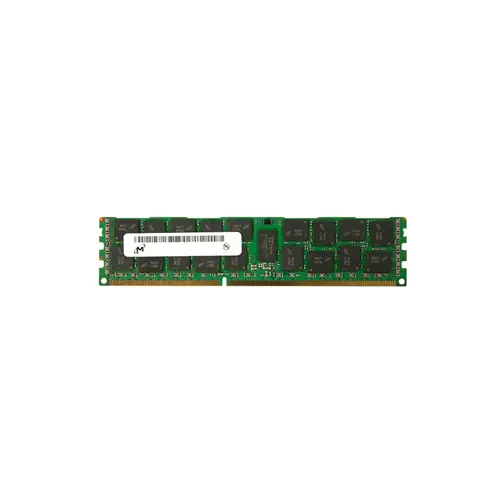
This registered ECC DDR3-1333 module, configured as a dual-rank x4 RDIMM with CL9 latency, is purpose-built for server platforms requiring uncompromising data integrity in virtualized environments and memory-intensive database workloads. Its registered signal architecture ensures stable operation under heavy load, while the dual-rank design maximizes memory density to boost throughput in multi-DIMM channel configurations.
1. ECC memory actively detects and corrects single-bit data errors, safeguarding transactional integrity for mission-critical databases and financial workloads.
2. Registered signal buffering stabilizes high-density server configurations, allowing multiple DIMMs per channel without signal degradation during heavy multi-tenant operations.
3. Dual Rank x4 organization maximizes interleaving and command pipelining, sustaining consistent memory throughput even when hypervisor hosts are running dozens of virtual machines.
4. The 8 GB capacity per module hits a sweet spot for mid-range virtualization nodes, enabling sufficient guest memory allocation without oversubscribing the memory bus.
5. A 1333 MHz clock speed delivers reliable DDR3 bandwidth that aligns with legacy enterprise platforms, ensuring balanced performance in scale-out storage and web serving tiers.
The part number MT36JSZF1G72PZ-1G4D1DD identifies an 8GB DDR3-1333 Registered DIMM with ECC, built using dual-rank x4 organization and operating at 1.5V. In server environments, these four characteristics directly answer the demands of mission-critical workloads. When you consolidate dozens of virtual machines onto a single host, ECC is non-negotiable—it silently corrects single-bit memory errors caused by cosmic radiation or electrical noise, preventing silent data corruption in your virtualized SQL databases or hypervisor state that could cascade into costly outages. The registered buffer on the RDIMM stabilizes command and address signals, allowing the platform to support large memory populations without timing degradation, so you can confidently scale to hundreds of gigabytes across multiple channels for in-memory analytics or large-scale virtualization. Meanwhile, the dual-rank x4 design interleaves accesses across two internal ranks, boosting effective bandwidth by keeping the memory pipeline fuller during random read operations—a tangible acceleration for online transaction processing where every microsecond counts. Finally, the DDR3-1333 speed at CL9 provides a balanced sweet spot of energy efficiency and throughput that keeps your data center power envelope in check while delivering the consistent low-latency performance that memory-hungry applications like Redis or Memcached need to respond instantly. This module is engineered not to just store data, but to safeguard, stabilize, and accelerate the services your business relies on.
Capacity Planning Guidance for DDR3-1333 ECC Registered RDIMMs
Based on the specifications — DDR3-1333, ECC, Registered (RDIMM), 1.5V, 240-pin, Dual Rank x4 — this 8 GB module is clearly server memory. It is designed for data integrity and stability in multi-slot platforms, not for desktop or laptop use. Below are capacity planning recommendations for typical server workloads.
General Virtualization
In a virtualization host, memory is the primary constraint before CPU. With 8 GB RDIMMs, populate at least six identical modules per CPU to enable balanced interleaving and maximize memory bandwidth. For a dual-socket server running 20–30 light to moderate VMs, aim for 96–128 GB total using 12–16 modules. This leaves headroom for memory overcommitment while respecting NUMA boundaries.
In-Memory Database
In-memory databases like Redis or SAP HANA demand large, contiguous, and error-free addressable space. Use the maximum supported DIMM slots per socket with registered ECC modules. A 256 GB configuration (32 x 8 GB) is a common entry point for midsize in-memory datasets. Given the 1333 MHz speed, prioritize capacity over frequency, but ensure all channels are populated identically to avoid performance cliffs under heavy read/write loads.
High-Performance Computing (HPC)
HPC workloads often require high memory bandwidth per core. While 1333 MHz is modest, you can offset this by populating all memory channels per processor with identical 8 GB RDIMMs — for instance, 12 modules per socket in a 6-channel system — to deliver 96 GB per node with optimal channel interleaving. Consider node-level memory limits per job to prevent swapping; under-subscribe memory slightly to keep data local to the CPU socket.
Tested for server compatibility: Dell PowerEdge R710, HP ProLiant DL380 G7, and more.
Q: Can I mix this MT36JSZF1G72PZ-1G4D1DD with other memory modules of different brands or speeds?
A: Mixing brands or speeds is strongly discouraged in server environments. This Registered DIMM requires uniform population. Dissimilar modules may cause signal integrity issues, instability, or POST failures.
Q: Is this memory compatible with my system?
A: This 8GB DDR3-1333 Registered ECC RDIMM is compatible with servers using Intel Xeon 5500/5600 series or AMD Opteron 4100/6100 platforms that support 1.5V, 240-pin DDR3 Registered memory. Always verify your motherboard's qualified vendor list.
Q: What is the recommended DIMM population order for optimal performance?
A: Populate identical DIMMs per channel, starting with the slot furthest from the CPU. For dual-rank x4 RDIMMs, follow your server's memory population guide, typically filling channel 1 (blue) slots first across all memory risers.
Q: Does this module support overclocking or XMP profiles?
A: No. As an enterprise-class Registered DIMM, this module is engineered for 24/7 stability at standard JEDEC DDR3-1333 timings. Overclocking and XMP are not supported, ensuring data integrity and reliability.
Q: What warranty and typical failure rate can I expect?
A: This memory includes a one-year warranty. Enterprise RDIMMs demonstrate an extremely low annualized failure rate, typically less than 0.5% AFR, backed by rigorous testing to ensure mission-critical reliability.