











 Secure payments
Standard refund policy
Trade Assurance
Secure payments
Standard refund policy
Trade Assurance
| Product Type | Memory Module |
|---|---|
| Compliance Standards | RoHS |
| Memory Capacity | 8 GB |
| Memory Technology | DDR3 |
| Product Voltage | 1.35V |
| RAM Speed | 1333MHz |
| RAM Standard | DDR3-1333/PC3-10600 |
| Error Identifying | ECC |
| Signal Type | Registered |
| Column Access Strobe (CAS) | CL9 |
| Rank | Dual Rank x4 |
| Quantity of Pins | 240-pin |
| RAM Genre | RDIMM |
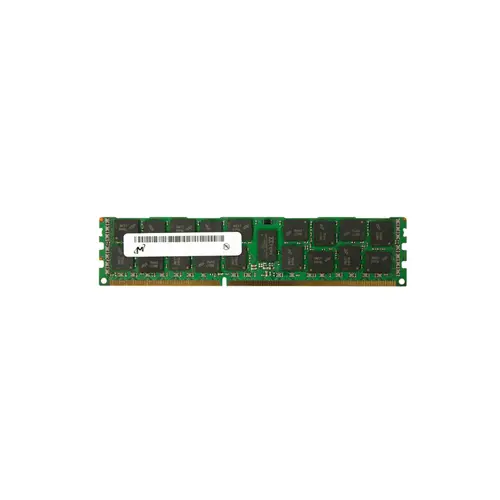
This server-grade DDR3 RDIMM is ideally suited for enterprise platforms running virtualization, in-memory databases, and other mission-critical workloads that demand uncompromising data integrity. Its combination of ECC error correction and registered signal buffering, along with a dual-rank x4 organization, ensures stable, high-reliability operation even in fully populated multi-DIMM server configurations.
1. ECC integrity shield instantly remedies single-bit errors, preserving transaction consistency crucial for financial databases and hypervisor reliability.
2. Buffered register logic boosts signal reach, supporting fully populated memory banks in rack servers for maximum virtual machine density.
3. Interleaved dual-rank organization amplifies command pipelining, increasing memory-level parallelism to accelerate large in-memory datasets.
4. Energy-efficient low-voltage design slashes overall power draw per DIMM, which directly reduces the cooling overhead in high-density data center aisles.
5. The per-channel bandwidth of 10.6 GB/s reliably feeds multi-core processors during concurrent user access, ideal for terminal services and mid-tier infrastructure.
Micron’s MT36KSF1G72PZ-1G4K server DDR3 RDIMM integrates ECC, registered buffering, dual-rank x4 architecture, and 1.35V low voltage to solve real-world data-center challenges. In a dense virtualization cluster, a silent bit-flip can snowball into multi-VM corruption and prolonged downtime; ECC instantly corrects single-bit errors, preserving data integrity and uptime. For memory-intensive databases like SAP HANA, fully loading DIMM slots challenges signal stability—the registered buffer cleans command/address signals, ensuring reliable operation at maximum capacity. The dual-rank x4 layout leverages interleaving to double command rate and accelerate data transfers, critical for real-time analytics that depend on rapid in-memory processing. Operating at 1.35V instead of 1.5V, it reduces energy consumption and heat, cutting cooling costs and power bills across a server farm without compromising 1333MT/s performance. For IT managers running always-available services, this means hardened data protection, consistent responsiveness under heavy workloads, and concrete OpEx savings.
General Virtualization
For modest virtualization hosts, a single 8GB RDIMM provides a minimal footprint, but dense VM consolidation demands far greater capacity. Populate at least six identical modules (48GB) across triple-channel architectures, or eight modules (64GB) for quad-channel platforms, to balance memory bandwidth and VM density. Always install in identical, manufacturer-matched sets to maintain ECC integrity and avoid performance penalties from unbalanced ranks.
In-Memory Database
In-memory databases require both large capacity and extreme data integrity, making ECC registered memory non-negotiable. This 8GB RDIMM can serve as a building block—deploy a minimum of eight modules (64GB) per socket for small datasets, and scale to fully populated banks of 16 or 24 modules for production caching layers. Keep all DIMMs within the same dual-rank x4 family to guarantee consistent CAS 9 latency under heavy transactional loads.
High-Performance Computing (HPC)
HPC workloads leverage memory bandwidth as much as capacity, so populate all memory channels symmetrically. A node running memory-bandwidth-bound simulations benefits from six or eight of these registered 8GB DIMMs (48–64GB total) per CPU, ensuring balanced interleaving. For larger shared-memory jobs, scale to 128GB or more by filling every slot with identical RDIMMs, which prevents NUMA imbalances and sustains error-correction performance during multi-day compute runs.
Server memory, rigorously tested. Validated for Dell PowerEdge R720, R620, HP DL380p Gen8, and IBM x3650 M4.
Q: Can I mix this MT36KSF1G72PZ-1G4K with other memory modules of different brands or speeds?
A: Mixing brands or speeds is strongly discouraged in servers. Registered ECC modules rely on matched timings and signal integrity. Dissimilar DIMMs may cause instability, correctable errors, or unexpected system halts in mission-critical environments.
Q: Is this memory compatible with my system?
A: This DDR3-1333 Registered ECC RDIMM suits servers using Intel Xeon E5-2600 v1/v2, Xeon 5600 series, or AMD Opteron 6300 platforms. Always consult your motherboard’s qualified vendor list to confirm compatibility and supported configurations.
Q: What is the recommended DIMM population order for optimal performance?
A: Follow your server board’s manual. Typically, populate identical DIMMs per channel, starting with slots designated for the first memory bank. This balances the interleaving across CPU memory controllers, maximizing bandwidth and ensuring reliable ECC operation.
Q: Does this module support overclocking or XMP profiles?
A: No. This Registered ECC module operates strictly at JEDEC-standard DDR3-1333 speeds with CL9 timings. Overclocking and XMP profiles are not supported, as enterprise memory prioritizes data integrity and 24/7 stability over frequency gains.
Q: What warranty and typical failure rate can I expect?
A: It carries a 1-year warranty. Built to rigorous enterprise standards, the module demonstrates an extremely low annualized failure rate, reflecting the inherent reliability demanded for continuous server operation and minimal hardware maintenance.