











 Secure payments
Standard refund policy
Trade Assurance
Secure payments
Standard refund policy
Trade Assurance
| Product Type | Memory Module |
|---|---|
| Memory Capacity | 8 GB |
| Memory Technology | DDR3 |
| Product Voltage | 1.35V |
| RAM Standard | DDR3-1333/PC3-10600 |
| Error Identifying | ECC |
| Signal Type | Registered |
| Column Access Strobe (CAS) | CL9 |
| Rank | Dual Rank x4 |
| Quantity of Pins | 240-pin |
| RAM Genre | RDIMM |
This DDR3L-1333 Registered ECC RDIMM is engineered for server platforms, delivering critical data integrity for virtualization and in-memory database workloads. Its dual-rank x4 organization and registered signal type enhance signal stability in high-density configurations, while 1.35V low-voltage operation reduces power consumption without sacrificing reliability.
1. Registered signal buffering stabilizes high-density server memory channels, allowing multiple modules to coexist without command integrity degradation and keeping the hypervisor responsive under sustained load.
2. ECC error correction detects and corrects single-bit memory faults in real time, which is essential for preventing silent data corruption in transactional databases and critical analytics.
3. Dual Rank x4 organization keeps the server’s memory interleaving optimized, maintaining peak bandwidth to each core during heavy virtualization and avoiding memory channel stalls.
4. The 1.35V low-voltage DDR3L operation trims datacenter power draw and thermal footprint, directly lowering cooling costs and improving energy efficiency per rack unit.
5. An 8 GB RDIMM capacity offers the optimal building block for dense virtualization hosts, striking a balance between guest density, memory overhead, and cost-effective scale-out.
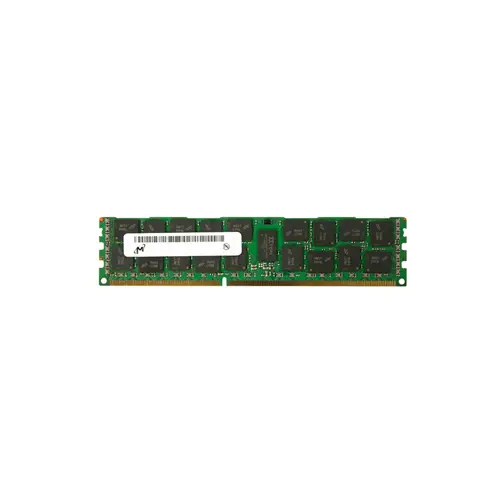
Engineered for the relentless demands of enterprise servers, the Micron MT36KSF1G72PZ-1G4K1FG is an 8GB DDR3-1333 Registered DIMM that transforms how your infrastructure handles critical workloads. Its four core attributes directly answer the pain points of data center operators. When you run a virtualization cluster hosting dozens of VMs, the Registered signal buffer stabilizes high-density memory configurations, preventing signal degradation as you populate all channels—meaning fewer unexplained host crashes during live migrations. The ECC protection silently corrects single-bit errors induced by cosmic radiation, a non-negotiable defense for a financial database where a flipped bit could corrupt a transaction. Meanwhile, the dual-rank x4 organization interleaves memory banks to boost bandwidth, so your in-memory analytics engine like Redis retrieves sorted sets noticeably faster under concurrent queries. Operating at 1.35V low voltage, it also reins in thermal buildup across a 24/7 rack, lowering cooling costs directly. This isn’t just a module; it’s a reliability contract for your virtualized platforms and latency-sensitive databases.
Based on the provided specifications—8GB DDR3-1333 ECC Registered RDIMM with 1.35V low voltage—this module is clearly server-class memory. The following capacity planning recommendations address typical data center workloads using this 8GB RDIMM.
General Virtualization
For general virtualization hosts, balance capacity and channel interleaving. Populate all memory channels identically with one or two 8GB RDIMMs per channel. In a dual-socket server with 4 channels per CPU, installing one DIMM per channel yields 64GB (8 x 8GB), which supports a moderate density of light to medium VMs. Scale to 128GB using two DIMMs per channel when hosting heavier workloads, always matching configurations across CPUs for uniform memory access.
In-Memory Database
In-memory databases demand maximum capacity and reliable data integrity, making ECC and registered buffering essential. Fill every available DIMM slot with these 8GB RDIMMs to reach the platform’s capacity ceiling (e.g., 192GB in a 24-slot system). If the dataset exceeds this limit, you must replace modules with higher-density RDIMMs; otherwise, configure all channels symmetrically to sustain the high throughput needed for fast in-memory transactions.
High-Performance Computing (HPC)
HPC performance heavily depends on memory bandwidth. Install a balanced set of 8GB RDIMMs across all memory channels—typically one or two DIMMs per channel—to enable full channel interleaving. For a dual-socket node with 8 total channels, 8 x 8GB (64GB) or 16 x 8GB (128GB) are common configurations that avoid throttling and provide the steady data feed required by compute-intensive simulations and modeling tasks.
Rigorously tested, compatible with Dell PowerEdge R620, R720, HP DL380p Gen8, Lenovo System x3650 M4.
Q: Can I mix this MT36KSF1G72PZ-1G4K1FG with other memory modules of different brands or speeds?
A: Mixing is not recommended for server environments. All modules should match in speed, rank, and ECC Registered type to maintain signal integrity and prevent system instability.
Q: Is this memory compatible with my Intel Xeon or AMD Opteron server platform?
A: Yes, this DDR3-1333 ECC Registered RDIMM is compatible with most dual-socket servers using Intel Xeon 5500/5600 series or AMD Opteron 6100 series chipsets. Verify your board's qualified vendor list.
Q: What is the recommended DIMM population order for optimal performance?
A: Populate identical DIMMs per memory channel, starting with slots farthest from the CPU. For dual-rank x4 RDIMMs, follow balanced configurations across channels to maximize bandwidth and interleaving.
Q: Does this module support overclocking or XMP profiles?
A: No, this is a server-grade module built to JEDEC standards for 24/7 reliability. Overclocking and XMP are not supported, as they would compromise ECC data integrity and platform stability.
Q: What warranty and typical failure rate can I expect?
A: This Micron module includes a 1-year warranty. It delivers extremely low failure rates, with an expected MTBF exceeding 2 million hours under specified operating conditions.