











 Secure payments
Standard refund policy
Trade Assurance
Secure payments
Standard refund policy
Trade Assurance
| Product Type | Memory Module |
|---|---|
| Compliance Standards | RoHS |
| Memory Capacity | 8 GB |
| Memory Technology | DDR3 |
| Product Voltage | 1.35V |
| RAM Speed | 1333MHz |
| RAM Standard | DDR3-1333/PC3-10600 |
| Error Identifying | ECC |
| Signal Type | Registered |
| Column Access Strobe (CAS) | CL9 |
| Rank | Dual Rank x4 |
| Quantity of Pins | 240-pin |
| RAM Genre | RDIMM |
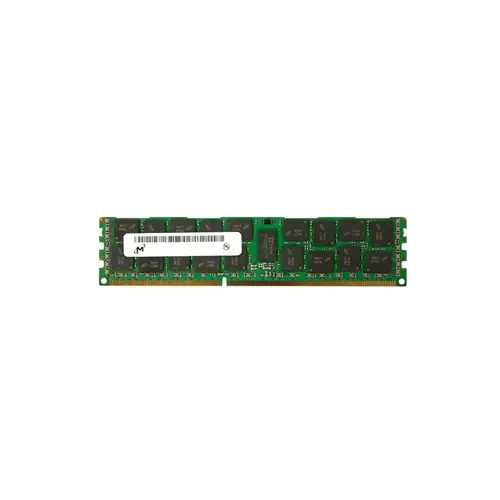
This 8GB DDR3L-1333 Registered ECC RDIMM is purpose-built for server platforms, delivering reliable performance in virtualized environments and memory-intensive workloads like in-memory databases by combining error correction with registered signal buffering. Its dual-rank x4 organization and low 1.35V operating voltage enhance memory channel stability and energy efficiency, ensuring sustained data integrity under demanding 24/7 operation.
1. ECC protection silently corrects single-bit errors, preventing data corruption in financial transaction databases and ensuring round-the-clock server reliability.
2. Registered signal buffering stabilizes command and address lines, enabling large memory populations across all channels without signal degradation in dense rack servers.
3. The memory capacity comfortably hosts multiple virtual machines and container workloads, letting small business servers pack more services into a single node without swapping.
4. Low-voltage operation slashes power consumption per DIMM, directly cutting cooling costs and improving energy efficiency metrics in large-scale data center deployments.
5. Dual Rank x4 organization interleaves accesses between two internal rank groups, boosting effective memory bandwidth and keeping the CPU pipeline fed under heavy multi-threaded workloads.
The MT36KSF1G72PZ-1G4K1LG is a server-grade DDR3 registered DIMM, purpose-built to eliminate the most common reliability and performance bottlenecks in data centers. Its ECC engine silently corrects single-bit memory errors that would otherwise corrupt hypervisor state or database tables—on a virtualized host running twenty VMware guests, one uncorrected bit-flip can cascade into multi-tenant outages and hours of forensic recovery. The registered architecture buffers the command and address bus, allowing you to fully populate all six channels with high-density modules while preserving signal integrity; this means an in-memory database like SAP HANA can scale to terabytes of stable, error-free RAM without intermittent glitches. The module’s 1.35V low-voltage operation cuts power consumption by up to 20% compared to 1.5V alternatives, reducing cooling and facility power overhead in dense server farms. A dual-rank x4 organization enables rank interleaving, delivering higher effective bandwidth and lower transaction latency for write-heavy Redis instances or OLAP queries.
General Virtualization
For generic virtualization hosts running multiple VMs, populate memory channels symmetrically to maximize throughput. Start with at least four 8 GB RDIMMs (32 GB total) per processor in a dual-socket server, utilizing quad-channel architecture to balance NUMA domains. Scale by adding identical registered DIMMs in multiples of the channel count, ensuring no memory interleaving gaps and predictable performance under mixed workloads.
In-Memory Database
In-memory databases demand both high capacity and uncompromising data integrity. Deploy at least eight 8 GB dual-rank x4 modules per socket to reach 64 GB, saturating all channels for low-latency access. The registered ECC design corrects single-bit errors and detects multi-bit faults, while 8 GB density per stick allows granular scaling. Favor 1.35 V modules to reduce thermal load in persistent high-utilization nodes.
High-Performance Computing (HPC)
HPC applications benefit from maximum aggregate memory bandwidth. Configure nodes with one 8 GB RDIMM per channel—often eight or twelve modules per processor—to fully saturate the memory controller. This yields 64–96 GB per socket using dual-rank x4 DIMMs, which offer superior bank-level parallelism for heavily threaded MPI jobs. The 1.35 V low-voltage operation and registered signaling improve energy efficiency in dense cluster deployments without sacrificing reliability.
Rigorously tested registered DDR3 memory, compatible with Dell R720, HP DL380p Gen8, IBM x3650 M4, Lenovo RD430, Cisco C220 M3.
Q: Can I mix this MT36KSF1G72PZ-1G4K1LG with other memory modules of different brands or speeds?
A: Mixing brands or speeds in a server environment is not recommended. Registered ECC modules require identical specifications to maintain signal integrity; mismatched DIMMs may cause stability issues or system failures.
Q: Is this memory compatible with my system?
A: This RDIMM is designed for servers supporting DDR3-1333 Registered ECC memory, such as platforms using Intel Xeon E5-2600 v1/v2 or AMD Opteron 6300 series. Verify your board supports 1.35V and 8GB dual-rank x4 modules.
Q: What is the recommended DIMM population order for optimal performance?
A: Follow your server’s manual; typically populate identical DIMMs per channel, starting with the slot farthest from the CPU. For dual-rank modules, balanced configurations maximize memory bandwidth and ensure reliable ECC operation.
Q: Does this module support overclocking or XMP profiles?
A: No. This is an enterprise-grade registered ECC DIMM operating at JEDEC standard DDR3-1333 with CAS 9. Overclocking and XMP are not supported, as the focus is on data integrity and 24/7 stability.
Q: What warranty and typical failure rate can I expect?
A: This module includes a one-year warranty. Manufactured to server-grade standards with rigorous testing, it exhibits a very low annualized failure rate (AFR) under normal operating conditions, ensuring high reliability.