











 Secure payments
Standard refund policy
Trade Assurance
Secure payments
Standard refund policy
Trade Assurance
| Product Type | Memory Module |
|---|---|
| Compliance Standards | RoHS |
| Memory Capacity | 8 GB |
| Memory Technology | DDR3 |
| Product Voltage | 1.35V |
| RAM Speed | 1333MHz |
| RAM Standard | DDR3-1333/PC3-10600 |
| Error Identifying | ECC |
| Signal Type | Registered |
| Column Access Strobe (CAS) | CL9 |
| Rank | Dual Rank x4 |
| Quantity of Pins | 240-pin |
| RAM Genre | RDIMM |
This 8GB DDR3-1333 RDIMM is ideally suited for legacy server platforms running virtualization or memory-intensive database workloads, where its 1.35V low-power design and ECC error correction safeguard data integrity in 24/7 operation. The dual-rank x4 organization with registered signaling enhances signal stability and memory bandwidth, while a CAS latency of 9 helps maintain responsive access under sustained multi-processor demands.
1. ECC error correction silently detects and corrects single-bit errors, preserving data integrity for financial transactions and database operations that cannot tolerate corruption.
2. Registered signaling buffers the command and address buses, allowing stable population of all DIMM slots across multi-socket servers without signal degradation under full load.
3. Dual Rank x4 organization interleaves memory banks across two ranks, keeping the channel saturated and significantly raising bandwidth for dense virtualization and container orchestration.
4. 1.35V operation cuts power consumption per DIMM, lowering energy costs and thermal output in rack-scale deployments where every watt magnifies cooling overhead.
5. The 1333MHz clock provides balanced throughput, efficiently handling concurrent read/write streams from multiple VMs while maintaining tight timing compatibility with enterprise chipsets.
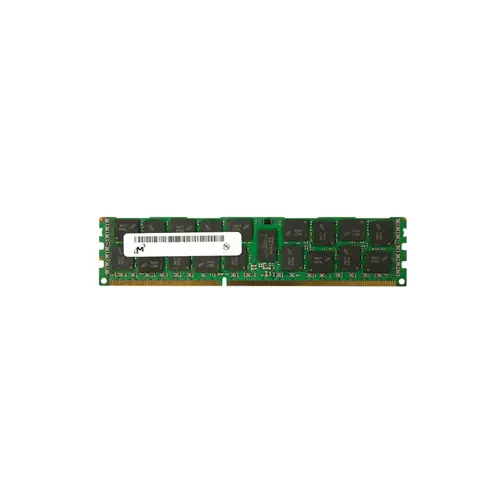
The Micron MT36KSF1G72PZ-1G4M1HE is an 8GB DDR3 RDIMM built for the relentless demands of server environments, where minor errors can cascade into critical failures. Its four defining features translate directly into operational resilience. First, ECC technology continuously detects and corrects single-bit memory errors—cosmic ray-induced bit flips that would otherwise silently corrupt data in a virtualization cluster, causing VM instability and unexplained downtime. For you, this means your multi-tenant hypervisor stays rock-solid without data integrity surprises. Second, the registered signal buffer stabilizes the command and address buses when populating multiple DIMMs per channel. In a dense virtualization host running dozens of VMs, you can confidently pack the server with 24 or more DIMMs to reach 192GB+ capacity, avoiding signal degradation that would crash unbuffered memory. Third, the low 1.35V operating voltage slashes power consumption and thermal output, directly lowering your data center electricity and cooling expenses across hundreds of nodes. Fourth, the dual-rank x4 organization doubles the internal bank groups, increasing command interleaving bandwidth. For an in-memory database like Redis or SAP HANA, this translates to faster transaction throughput and reduced latency under heavy concurrent reads, keeping real-time analytics snappy. Together, these attributes ensure your server infrastructure delivers uncompromising data accuracy, scalability, and performance efficiency—precisely what enterprise workloads demand.
General Virtualization
For a virtualization host running multiple VMs, populate at least six to eight identical 8 GB RDIMMs to reach 48–64 GB of total capacity. This ensures balanced memory access across all CPU memory channels and leaves headroom for memory overcommitment. Always install modules in matched sets per channel to maintain symmetric NUMA performance.
In-Memory Database
In-memory database workloads demand both capacity and low latency, so fill all available DIMM slots with these 8 GB RDIMMs to maximize total memory. Given the 1333 MHz speed and CL9 latency, it is best to keep the memory bus fully loaded with identical ranks to avoid performance penalties. Aim for a minimum of 128 GB across the server to hold large working sets entirely in RAM.
HPC (High Performance Computing)
HPC clusters benefit from predictable, error-free memory, making ECC Registered modules essential. Configure each node with a balanced population—typically four or eight modules per socket—to maintain full memory bandwidth for parallel computation. For MPI jobs, prioritize uniform speeds and dual-rank modules like these to achieve consistent per-core bandwidth across compute nodes.
This server memory is rigorously tested and compatible with Dell PowerEdge R720/R730, HPE ProLiant DL380p Gen8, and Lenovo ThinkServer RD640.
Q: Can I mix this MT36KSF1G72PZ-1G4M1HE with other memory modules of different brands or speeds?
A: Mixing RDIMMs with different brands, speeds, or ranks is not recommended. Inconsistent SPD timings or electrical loads can cause system instability. For reliable server operation, use identical part numbers in each channel.
Q: Is this memory compatible with my system?
A: This module is designed for DDR3-compatible Intel Xeon and AMD Opteron platforms that require 1.35V 8GB PC3-10600 registered ECC RDIMMs with 240-pin layout. Check your server board's qualified vendor list for exact support.
Q: What is the recommended DIMM population order for optimal performance?
A: For dual-socket servers, populate identical RDIMMs per channel, starting from the farthest slot from the processor in each memory channel. Balance capacity across CPU memory controllers and follow the motherboard's specific numbering guide.
Q: Does this module support overclocking or XMP profiles?
A: No. This is a JEDEC-standard DDR3-1333 registered server module operating at CAS 9. It does not support XMP or overclocking. Server memory prioritizes signal integrity and data reliability over frequency headroom.
Q: What warranty and typical failure rate can I expect?
A: This module is covered by a one-year warranty. Enterprise RDIMMs like this typically exhibit an annualized failure rate (AFR) below 0.5% under nominal conditions, backed by extensive component screening and rigorous burn-in testing.