











 Secure payments
Standard refund policy
Trade Assurance
Secure payments
Standard refund policy
Trade Assurance
| Product Type | Memory Module |
|---|---|
| Compliance Standards | RoHS |
| Memory Capacity | 8 GB |
| Memory Technology | DDR3 |
| Product Voltage | 1.35V |
| RAM Speed | 1333MHz |
| RAM Standard | DDR3-1333/PC3-10600 |
| Error Identifying | ECC |
| Signal Type | Registered |
| Column Access Strobe (CAS) | CL9 |
| Rank | Dual Rank x4 |
| Quantity of Pins | 240-pin |
| RAM Genre | RDIMM |
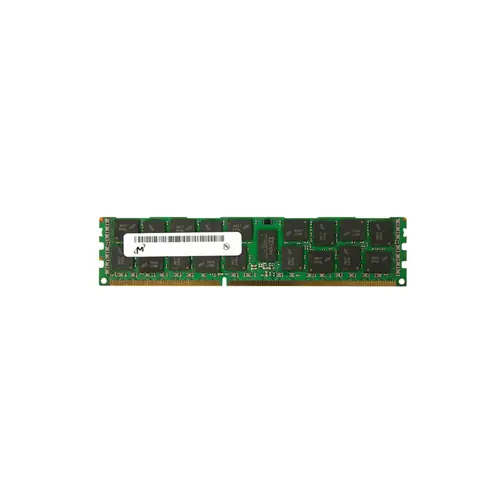
Designed specifically for server platforms, this 8GB DDR3-1333 RDIMM with ECC and registered signal buffering ensures data integrity and system stability under heavy virtualization or in-memory database workloads. Its dual-rank x4 organization combined with CL9 latency and 1.35V low power operation optimizes memory bandwidth while maintaining reliable error correction for mission-critical environments.
1. ECC protection actively corrects single-bit errors in real time, preserving data integrity for transactional databases and preventing silent corruption in always-on server environments.
2. Registered signal buffering decouples the memory bus from local load, enabling stable population of numerous DIMMs per channel to maximize virtual machine density without sacrificing reliability.
3. Dual-rank x4 organization interleaves internal banks to sustain higher throughput, effectively accelerating hypervisor memory overcommit and large-scale in-memory analytics.
4. Low-voltage operation cuts energy consumption and thermal output across dense rack deployments, directly reducing data center cooling demands and operational cost over the hardware lifecycle.
5. Mainstream DDR3 speed delivers balanced bandwidth that keeps multi-threaded enterprise workloads and concurrent client requests flowing smoothly, avoiding response-time degradation under peak loads.
The Micron MT36KSF1G72PZ-1G4M1HF is an 8GB DDR3L-1333 Registered ECC DIMM purpose-built for server reliability. Its four core attributes directly address the real-world pressures of enterprise computing. ECC error correction is your frontline defense in a virtualization cluster: a single-bit memory flip can silently corrupt a hypervisor and crash dozens of VMs, but ECC detects and corrects these errors immediately, safeguarding uptime and data trust. The registered signal buffer stabilizes high-density deployments, letting you populate all memory channels with multiple DIMMs for extreme capacity without signal degradation—essential when consolidating memory-hungry virtual machines on one host. In memory-resident databases like Redis or SAP HANA, the dual-rank x4 organization accelerates performance through rank interleaving, delivering higher bandwidth for real-time transactions and analytics on large in-memory datasets. Meanwhile, the 1.35V low-voltage operation meaningfully reduces power consumption and cooling load per module, a direct cost saving that multiplies across racks of servers running 24/7. This DIMM gives you uncompromised data integrity, stable scalability, faster database response, and leaner energy efficiency—exactly what you need to maximize VM density and minimize total cost of ownership.
Server Memory Capacity Planning Guide
This module is an 8 GB DDR3-1333 Registered ECC DIMM (1.35 V, dual-rank x4), purpose‑built for servers. The following recommendations address three common enterprise workloads.
General Virtualization
Populate at least four identical 8 GB RDIMMs (32 GB total) across all memory channels to enable balanced interleaving and reliable ECC operation for a modest cluster of VMs. For higher consolidation ratios, scale to eight modules (64 GB) while keeping the channel‑per‑CPU population identical—this prevents bottlenecks when moving or expanding virtual machines.
In‑Memory Database
Maximize capacity by filling every available slot with this 8 GB DIMM; a dual‑socket platform with 12 or 16 modules delivers 96–128 GB of fault‑tolerant memory. Configure the memory mode for performance (independent channel) rather than sparing, and rely on the dual‑rank x4 organization to sustain low latency under heavy, continuous write/read traffic.
High‑Performance Computing
Install one DIMM per channel on each processor (e.g., six modules per CPU in triple‑channel systems) to extract peak bandwidth for MPI or OpenMP workloads. The registered, dual‑rank design stabilises signal integrity on fully loaded buses, and using a uniform population across all nodes ensures repeatable, deterministic run times.
Rigorously tested server memory, compatible with Dell PowerEdge R720, HP DL380p Gen8, Lenovo x3650 M4.
Q: Can I mix this MT36KSF1G72PZ-1G4M1HF with other memory modules of different brands or speeds?
A: Mixing is not advised. Registered ECC modules require matched specifications. Combining different brands, speeds, or ranks may lead to signal instability, POST failures, or reduced system reliability.
Q: Is this memory compatible with my system?
A: This DDR3-1333 Registered ECC RDIMM targets servers with Intel Xeon E5/E7 or AMD Opteron 6300/8300 platforms. Confirm your board supports 1.35V dual-rank x4 ECC modules.
Q: What is the recommended DIMM population order for optimal performance?
A: Always consult your server's technical guide. Generally, populate identical DIMMs per channel starting from the first slot, balancing across memory controllers to maintain interleaving and full bandwidth.
Q: Does this module support overclocking or XMP profiles?
A: No. As a server-class Registered ECC module, it adheres strictly to JEDEC DDR3-1333 standards. Overclocking functions are disabled to guarantee 24/7 data integrity and stability.
Q: What warranty and typical failure rate can I expect?
A: This product includes a 1-year warranty. Engineered for enterprise environments, its typical annualized failure rate is well under 0.5%, ensuring dependable long-term operation.