











 Secure payments
Standard refund policy
Trade Assurance
Secure payments
Standard refund policy
Trade Assurance
| Product Type | Memory Module |
|---|---|
| Memory Capacity | 8 GB |
| Memory Technology | DDR3 |
| Product Voltage | 1.5V |
| RAM Speed | 1333MHz |
| RAM Standard | DDR3-1333/PC3-10600 |
| Error Identifying | ECC |
| Signal Type | Registered |
| Column Access Strobe (CAS) | CL9 |
| Rank | Dual Rank x4 |
| Quantity of Pins | 240-pin |
| RAM Genre | RDIMM |
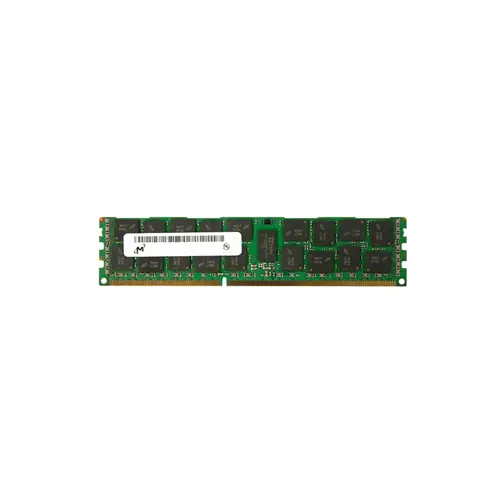
This 8GB DDR3-1333 registered ECC RDIMM, featuring a dual-rank x4 organization and CL9 latency, delivers the data integrity and signal stability required for virtualization platforms and in-memory databases. Its registered signaling ensures reliable operation in dense server memory configurations, safeguarding critical workloads against single-bit errors.
1. ECC error correction silently detects and corrects single-bit memory faults, preserving transactional data integrity in financial and mission-critical enterprise workloads.
2. Registered signal buffering stabilizes command and address lines across high-density server configurations, enabling reliable operation when all DIMM slots are populated.
3. 8GB capacity per module provides sufficient headroom to consolidate multiple virtual machines on a single host without triggering memory overcommitment penalties.
4. Dual Rank x4 organization interleaves accesses across internal banks, keeping server memory channels fully saturated for consistent bandwidth under parallel query loads.
5. 1333MHz operating speed balances ample throughput with modest power draw, optimizing total cost of ownership for legacy server fleets running steady-state business applications.
In a server environment where every calculation carries financial or operational weight, the MT36JSF1G72PZ-1G4 RDIMM is not simply a memory module; it is a safeguard for your data and a multiplier for your workload density. Consider a virtualized cluster hosting multiple business-critical VMs: a single undetected bit flip in memory—caused by background radiation—can corrupt financial records or crash a hypervisor without warning. The integrated ECC silently corrects these errors and logs them before they become outages, directly preserving service uptime and data integrity. When you populate a database server running an in-memory analytics platform, the combination of Registered signal buffering and Dual Rank x4 organization becomes decisive. Registered logic stabilizes high-capacity configurations, allowing you to scale to hundreds of gigabytes without signal degradation that would otherwise force costly system halts. Meanwhile, the dual-rank design interleaves memory banks to deliver higher sustained bandwidth under concurrent queries, accelerating real-time dashboards and transaction throughput. At 1333MHz with CL9 latency, it supplies responsive access for consolidated workloads while staying within the 1.5V power envelope that rack-level density demands. This means fewer unexpected crashes, consistent latency under mixed loads, and the confidence to run memory-intensive databases and virtualization hosts around the clock.
General Virtualization
For general virtualization with DDR3-1333 RDIMMs, populate at least six identical 8 GB modules across triple-channel memory controllers common in legacy servers, yielding 48 GB total. This balanced configuration provides sufficient headroom for moderate VM density without overcommitting memory, and ECC registered operation ensures stability for multi-tenant workloads.
In-Memory Database
Deploy twelve or more 8 GB RDIMMs to reach 96 GB+ per two-socket node, fully saturating all available DIMM slots. In-memory databases like Redis or Memcached demand high capacity and low latency, and the dual-rank x4 organization delivers faster row cycling under heavy read/write pressure. Registered buffering also maintains signal integrity at maximum population, reducing database latencies.
High-Performance Computing
Install a population of sixteen 8 GB modules (128 GB total) across four memory channels per CPU to maximize bandwidth for parallel workloads. Dual-rank DIMMs operate at the rated 1333 MT/s but still provide a slight throughput advantage for large adjacency-cell simulations. ECC is mandatory for run-time correctness in multi-day HPC jobs, and the 1.5 V VDD keeps thermal design manageable in dense clusters.
Rigorously tested server memory, compatible with Dell PowerEdge R720, HP ProLiant DL380p Gen8, and similar systems.
Q: Can I mix this MT36JSF1G72PZ-1G4 with other memory modules of different brands or speeds?
A: We do not recommend mixing this RDIMM with other brands or speeds. ECC Registered memory requires identical modules to maintain error correction and avoid system instability. Stick to the same MPN.
Q: Is this memory compatible with my system?
A: This module is designed for servers/workstations with DDR3 ECC Registered support, typically Intel Xeon 5600/5500 or AMD Opteron 6100 series platforms. Verify your motherboard QVL for compatibility.
Q: What is the recommended DIMM population order for optimal performance?
A: For optimal performance, follow your server board's memory population guide. Usually, populate identical RDIMMs in matching channels per CPU, starting with slot A1 for each memory channel.
Q: Does this module support overclocking or XMP profiles?
A: No. This server-class Registered ECC DDR3 module adheres to JEDEC standards and does not support overclocking or XMP. It prioritizes data integrity and stability over performance tuning.
Q: What warranty and typical failure rate can I expect?
A: This MT36JSF1G72PZ-1G4 module comes with a 1-year warranty. As an enterprise RDIMM, it is built for reliability and typically has a very low annualized failure rate (AFR) in compliant systems.