











 Secure payments
Standard refund policy
Trade Assurance
Secure payments
Standard refund policy
Trade Assurance
| Product Type | Memory Module |
|---|---|
| Compliance Standards | RoHS |
| Memory Capacity | 8 GB |
| Memory Technology | DDR3 |
| Product Voltage | 1.35V |
| RAM Speed | 1333MHz |
| RAM Standard | DDR3-1333/PC3-10600 |
| Error Identifying | ECC |
| Signal Type | Registered |
| Column Access Strobe (CAS) | CL9 |
| Rank | Dual Rank x4 |
| Quantity of Pins | 240-pin |
| RAM Genre | RDIMM |
This registered ECC DDR3-1333 module is engineered for server platforms requiring high data integrity, making it ideal for virtualization and in-memory database workloads. Its dual-rank x4 organization and low 1.35V operating voltage enhance memory bandwidth utilization and energy efficiency while maintaining reliable registered signal stability.
1. ECC memory detects and corrects single-bit errors on the fly, preserving data integrity for mission-critical workloads like financial transactions and virtualized database clusters.
2. Registered signal buffering stabilizes high-capacity server configurations by reducing command bus loading, ensuring consistent uptime during sustained multi-tenant operations.
3. Dual Rank x4 organization interleaves memory accesses to keep server memory channels fully utilized, boosting effective bandwidth for heavy virtualization and in-memory analytics.
4. Low-voltage operation at 1.35V reduces server power draw and thermal output, directly lowering cooling costs in dense rack deployments without sacrificing reliability.
5. A CL9 column access strobe latency shortens the delay between data request and delivery, improving responsiveness for latency-sensitive enterprise applications like high-frequency trading systems.
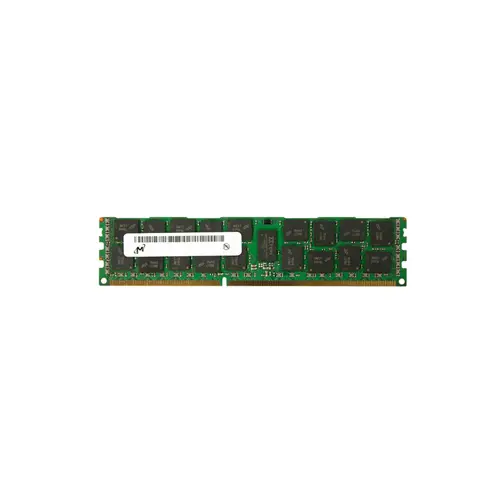
The Micron MT36KSF1G72PZ-1G4E1H is an 8GB DDR3 RDIMM, purpose-built for server environments where reliability under load defines your infrastructure’s success. Its four defining characteristics translate directly into operational resilience.
First, the integrated ECC engine continuously detects and corrects single-bit memory errors. In a virtualization cluster hosting dozens of VMs, an uncorrected bit-flip can silently corrupt guest data or crash hypervisors, leading to costly downtime. ECC ensures your consolidated workloads run with uncompromised data integrity. Second, the registered signal buffer stabilizes the command and address lines when multiple DIMMs populate the channel. For an in-memory database like Redis or Memcached demanding large memory footprints, this buffering eliminates signal degradation, allowing you to scale capacity without sacrificing stability under extreme query loads. Third, the dual-rank x4 organization enhances bank-level parallelism, substantially increasing sustainable bandwidth. That means faster transaction commits and lower latency spikes during peak user concurrency—critical when every microsecond in a trading platform or analytics engine counts. Finally, the 1.35V operating voltage trims power consumption per module by roughly 20% compared to standard 1.5V DDR3. Across a fully populated rack, that reduction compounds into tangible savings in electricity and cooling overhead, while also easing thermal stress and prolonging the lifespan of your memory controllers. This module doesn’t just meet a spec sheet; it directly safeguards uptime, performance, and TCO in the data center.
General Virtualization
For moderate consolidation, populate at least six of these 8 GB RDIMMs (48 GB total) across three memory channels per CPU to balance capacity and bandwidth. Favour a 2‑DIMM‑per‑channel configuration to maintain 1333 MHz speed, which avoids clock throttling under mixed read/write patterns. Monitor overcommitment ratios; an extra pair of modules brings the host to 64 GB and comfortably supports 20–25 light VMs.
In-Memory Database
In-memory workloads demand both capacity and error resilience. Deploy twelve modules (96 GB) in a balanced three‑channel, two‑DPC layout to provide headroom for large datasets while the 1.35 V low‑power design reduces thermal stress in dense 2U enclosures. For write‑heavy use, consider a mirrored channel setup across two identical memory risers to sustain throughput during DRAM failure.
High-Performance Computing
Maximise channels before capacity: install one 8 GB RDIMM per channel (three per CPU, 24 GB per socket) to striping data across all controllers for peak bandwidth. In memory‑bandwidth‑bound codes like CFD, populate all channels with identical Dual Rank x4 modules to exploit rank interleaving. Scale to 48 GB per node only if problem size demands it, keeping the 1.35 V power envelope lean for density‑optimised clusters.
Validated for Dell PowerEdge R720, HPE DL380p Gen8, Lenovo ThinkServer RD640. Rigorously tested.
Q: Can I mix this MT36KSF1G72PZ-1G4E1H with other memory modules of different brands or speeds?
A: Mixing registered ECC modules with different brands or speeds is not recommended. It can cause signal integrity issues and system instability. Use identical modules to ensure reliable operation in server environments.
Q: Is this memory compatible with my Intel Xeon or AMD Opteron server platform?
A: This 8GB DDR3-1333 RDIMM is compatible with dual-processor servers using Intel 5500/5600 series or AMD Opteron 4100/4200 chipsets that support 1.35V low-voltage registered ECC memory. Verify your board's qualification list.
Q: What is the recommended DIMM population order for optimal performance?
A: Follow your server motherboard manual. Typically, populate identical DIMMs per memory channel starting farthest from the CPU. For dual-rank x4 modules, balanced interleaving across all channels maximizes bandwidth and minimizes latency.
Q: Does this module support overclocking or XMP profiles?
A: No. This is an enterprise RDIMM designed for stability and data integrity. It operates strictly at JEDEC standard DDR3-1333 with no overclocking or XMP profiles. Server platforms prioritize error-free 24/7 operation over speed.
Q: What warranty and typical failure rate can I expect?
A: This module includes a one-year warranty. With ECC and robust burn-in testing, the annualized failure rate is exceptionally low, typically under 0.5%. Designed for demanding server workloads, it offers high long-term reliability.