











 Secure payments
Standard refund policy
Trade Assurance
Secure payments
Standard refund policy
Trade Assurance
| Model | MT36KDZS1G72PZ-1G4D1 |
|---|---|
| Product Type | Memory Module |
| Compliance Standards | RoHS |
| Memory Capacity | 8 GB |
| Memory Technology | DDR3 |
| Product Voltage | 1.35V |
| RAM Speed | 1333MHz |
| RAM Standard | DDR3-1333/PC3-10600 |
| Error Identifying | ECC |
| Signal Type | Registered |
| Column Access Strobe (CAS) | CL9 |
| Rank | Dual Rank x4 |
| Quantity of Pins | 240-pin |
| RAM Genre | VLP RDIMM |
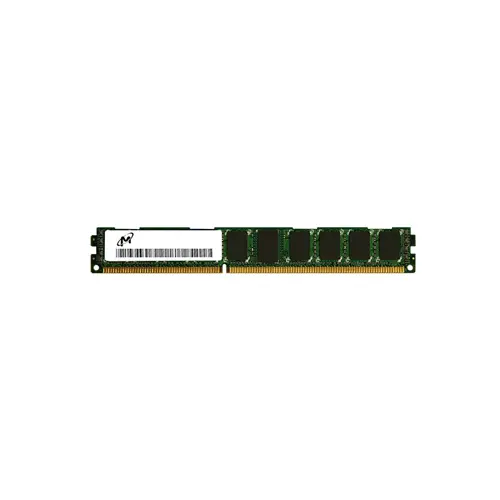
This Micron 8GB DDR3-1333 VLP RDIMM is engineered for dense server and virtualization environments where physical clearance is limited, leveraging low-power 1.35V operation and registered signaling to maintain stability in fully populated memory channels. Its dual-rank x4 configuration with ECC ensures high data integrity under sustained loads, making it an ideal choice for memory-database caching and virtual machine density where silent data corruption is unacceptable.
1. ECC detection and correction safeguards transactional data integrity, preventing silent memory errors that could corrupt critical enterprise workloads.
2. Registered buffering stabilizes command and address signals across high-density server boards, ensuring reliable operation even with fully populated DIMM slots.
3. Dual Rank x4 organization boosts memory interleaving efficiency, delivering sustained bandwidth necessary for heavy database and virtualized environments.
4. Very low profile form factor maximizes airflow in 1U and blade servers, preventing thermal throttling in space-constrained data center deployments.
5. Low 1.35V operation reduces per-DIMM power draw, directly cutting energy costs and cooling demands in large-scale server farms.
For server infrastructure, the MT36KDZS1G72PZ-1G4D1 is a DDR3 8GB VLP RDIMM engineered to solve the most persistent pain points of data center operators. Its ECC error correction directly safeguards financial transactions and patient records by detecting and correcting single-bit memory errors that would otherwise silently corrupt databases and crash virtual machines. Complementing this integrity, the registered signal buffer stabilizes command and address lines, allowing you to populate all 24 DIMM slots on a dual-socket board with confidence—critical when consolidating dozens of virtualized workloads onto a single host without signal degradation. Operating at a low 1.35V, the module slashes thermal output and power draw by approximately 20% compared to standard 1.5V DDR3, which cumulatively lowers cooling OPEX in a virtualization cluster hosting hundreds of modules. The very-low-profile PCB is not a luxury; in dense 1U blade servers running in-memory databases like Redis, standard-height DIMMs block airflow over the CPU heatsinks, causing throttling. The VLP design restores that airflow, letting your in-memory database deliver consistent sub-millisecond latency even under thermal stress, while Dual Rank x4 organization further boosts bandwidth for concurrent data access.
General Virtualization
For light to moderate VM density, populate one DIMM per channel with this 8GB module to reach 32-64GB total across 4–8 slots. Registered ECC ensures stability for multiple guest operating systems, while 1.35V low voltage reduces power draw in always-on hosts.
In-Memory Database
In-memory engines like Redis or SAP HANA demand large, reliable footprints. Start with at least eight modules (64GB) spread across all memory channels for peak bandwidth. Dual Rank x4 construction boosts command rate efficiency, and ECC safeguards in-memory data integrity during heavy transactional loads.
High-Performance Computing
HPC clusters prioritize memory bandwidth per core. Deploy 12–16 of these VLP RDIMMs in dual-socket servers to achieve 96–128GB capacities while maintaining balanced interleaving. The low-profile design improves airflow in dense racks, and registered signal buffering allows population of all DIMM slots without sacrificing 1333MT/s speed.
Strictly tested server memory compatible with Dell PowerEdge R710/R610, HP ProLiant DL380 G7, IBM x3650 M3.
Q: Can I mix this MT36KDZS1G72PZ-1G4D1 with other memory modules of different brands or speeds?
A: Mixing is not advised. To maintain ECC and signal integrity, all modules should be identical in speed, rank, voltage, and type. Using mismatched DIMMs may cause instability or unbootable systems.
Q: Is this memory compatible with my system?
A: This is a DDR3-1333 VLP Registered ECC RDIMM, compatible with servers based on Intel Xeon E5-2400/2600 v2 or AMD Opteron 6300 series platforms. Confirm your motherboard supports 1.35V RDIMMs and reference its QVL.
Q: What is the recommended DIMM population order for optimal performance?
A: Follow your server board’s manual. Generally, populate identical DIMMs per channel starting from the farthest slot from the CPU. For dual-rank modules, fill primary slots first to maintain balanced memory channels and avoid electrical loading issues.
Q: Does this module support overclocking or XMP profiles?
A: No. This is a server-grade Registered ECC DIMM designed for JEDEC DDR3-1333 compliance only. It does not support overclocking or XMP profiles, as stability and error-free operation take precedence in data-critical environments.
Q: What warranty and typical failure rate can I expect?
A: You receive a 1-year warranty. As an enterprise-class module, it offers high reliability with an annualized failure rate typically below 0.5%, backed by rigorous testing for 24/7 mission-critical operations.