











 Secure payments
Standard refund policy
Trade Assurance
Secure payments
Standard refund policy
Trade Assurance
| Product Type | Memory Module |
|---|---|
| Compliance Standards | RoHS |
| Memory Capacity | 8 GB |
| Memory Technology | DDR3 |
| Product Voltage | 1.5V |
| RAM Speed | 1333MHz |
| RAM Standard | DDR3-1333/PC3-10600 |
| Error Identifying | ECC |
| Signal Type | Registered |
| Column Access Strobe (CAS) | CL9 |
| Rank | Dual Rank x4 |
| Quantity of Pins | 240-pin |
| RAM Genre | RDIMM |
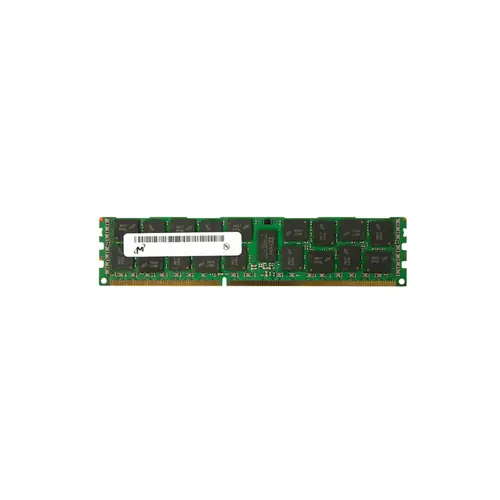
This DDR3-1333 registered ECC memory module, with its 8 GB capacity and dual-rank x4 organization, is engineered for server platforms handling virtualization or memory-intensive databases, where the registered signal type enhances signal integrity across multiple DIMMs. Its ECC capability provides single-bit error correction, safeguarding data integrity in always-on environments where operational reliability is paramount.
1. Registered signal buffering offloads the memory controller by using an internal register, enabling fully populated server boards with dozens of DIMM slots while preserving clean command signals for ironclad uptime.
2. ECC error correction constantly detects and fixes single-bit memory faults in the background, preserving data integrity for round-the-clock transactional databases and financial processing.
3. Dual Rank x4 organization leverages rank interleaving to overlap access cycles, maximizing effective bandwidth and sustaining high request rates under dense virtual machine consolidation.
4. An eight-gigabyte per module capacity offers the right density sweet spot for scaling affordable, high-capacity memory pools—easily reaching hundreds of gigabytes per chassis to host more tenants.
5. 1333 MHz operation provides a balanced throughput envelope per channel, efficiently handling simultaneous data streams from collocated workloads without bottlenecking the memory interconnect.
In a data center where every transaction matters, the MT36JSF1G72PZ-1G4M1FE registered DDR3 module serves as more than just memory—it is a safeguard for business continuity. As an 8 GB RDIMM with ECC, it actively corrects single-bit errors that cosmic radiation or electrical noise can trigger, preventing silent data corruption in virtualized clusters where a flipped bit in a hypervisor stack could cascade into host failures. The registered signal buffer stabilizes high-density configurations, letting you populate all channels without compromising signal integrity, which is essential when you run memory-hungry databases like SAP HANA or Redis in-memory caches that demand flawless 24/7 operation. Its dual-rank x4 organization maximizes bandwidth utilization by interleaving access across two internal ranks, so an OLTP database sees consistently lower latency under concurrent query loads. Backed by CL9 timings and 1333 MHz speed, this module delivers predictable, sustained throughput for applications where performance variance directly impacts revenue. Choosing this DRAM means trading speculative consumer speed for the absolute reliability and deterministic behavior that your virtual machines and critical databases fundamentally require.
General Virtualization
Deploy a minimum of six to eight of these 8 GB RDIMMs across all memory channels to achieve 48–64 GB of total capacity. This allows comfortably hosting 10–15 moderate VMs while taking advantage of registered ECC reliability for stable consolidation. Populate identical modules per channel to maintain balanced memory interleaving and avoid performance penalties.
In-Memory Database
Maximize capacity by fully populating every available DIMM slot—for a dual-socket server with 12 slots, that yields 96 GB. While 8 GB modules limit total scale, this configuration still supports mid-sized in-memory datasets and leverages ECC to prevent data corruption. Plan to replace with higher-capacity RDIMMs (16/32 GB) once workloads surpass 80 GB to maintain headroom.
High-Performance Computing (HPC)
Install one module per memory channel (e.g., six modules for a triple-channel platform) to maximize bandwidth through balanced channel loading. The dual-rank x4 organization enhances signal integrity under sustained throughput. For memory-bound HPC codes, consider over-provisioning to 12 identical modules if channels allow, ensuring uniform latency and minimizing NUMA penalties in multi-socket nodes.
Rigorously tested: compatible with Dell PowerEdge R720, HP ProLiant DL380p Gen8, and IBM System x3650 M4.
Q: Can I mix this MT36JSF1G72PZ-1G4M1FE with other memory modules of different brands or speeds?
A: Mixing is not recommended. This is a registered ECC RDIMM. For server stability, always install identical modules with the same Micron MPN, rank, and timings to avoid POST or data integrity issues.
Q: Is this memory compatible with my system?
A: It is compatible with servers supporting DDR3 registered ECC memory, such as platforms with Intel Xeon 5500/5600 series or AMD Opteron 4100/6100 series. Verify your motherboard supports 8GB dual-rank RDIMMs at 1333MHz.
Q: What is the recommended DIMM population order for optimal performance?
A: Follow your server motherboard manual. Typically, populate identical DIMMs in the farthest slot from the CPU per channel first (e.g., slots A1, B1, C1) to enable balanced multi-channel interleaving and maximum bandwidth.
Q: Does this module support overclocking or XMP profiles?
A: No. As a server-grade registered ECC DIMM, it strictly adheres to JEDEC DDR3-1333/PC3-10600 standards. Overclocking is not supported, ensuring 24/7 mission-critical stability and signal integrity.
Q: What warranty and typical failure rate can I expect?
A: This module includes a 1-year warranty. Built with Micron’s stringent quality process, the typical annualized failure rate (AFR) is exceptionally low, suitable for reliable enterprise workloads.