











 Secure payments
Standard refund policy
Trade Assurance
Secure payments
Standard refund policy
Trade Assurance
| Product Type | Memory Module |
|---|---|
| Compliance Standards | RoHS |
| Memory Capacity | 8 GB |
| Memory Technology | DDR3 |
| Product Voltage | 1.35V |
| RAM Speed | 1333MHz |
| RAM Standard | DDR3-1333/PC3-10600 |
| Error Identifying | ECC |
| Signal Type | Registered |
| Column Access Strobe (CAS) | CL9 |
| Rank | Dual Rank x4 |
| Quantity of Pins | 240-pin |
| RAM Genre | RDIMM |
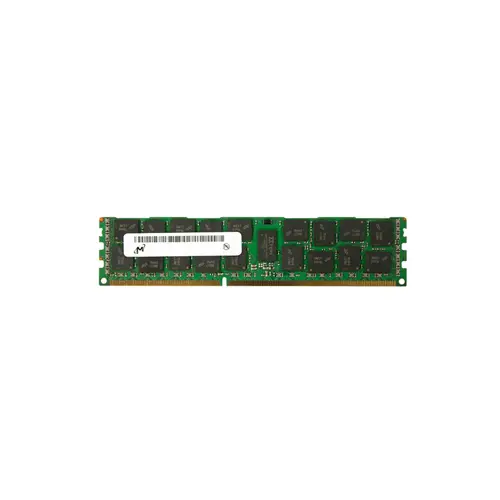
Designed as a server-grade module, this 8GB DDR3L-1333 Registered DIMM with ECC is ideally suited for virtualization hosts and in-memory databases where data integrity and system stability are critical. Its dual-rank x4 organization and registered signaling ensure reliable operation under heavy memory loads, while the 1.35V low-power design reduces thermal stress in dense rack environments.
1. ECC detection and correction prevents silent data corruption in financial transactions and database queries, ensuring uninterrupted uptime for mission-critical workloads.
2. Registered signal buffering stabilizes high-capacity memory arrays, enabling servers to populate all channels without signal degradation under dense virtualization.
3. 8 GB capacity per module delivers the sweet spot for mid-range virtualization hosts, packing enough headroom for multiple lightweight containers or virtual desktops.
4. Operating at just 1.35V trims overall rack power draw and cooling demands, directly lowering total cost of ownership in scaled-out data centers.
5. Dual Rank x4 organization interleaves internal banks to saturate the memory bus, boosting throughput for in-memory analytics and heavy concurrent access patterns.
The MT36KSF1G72PZ-1G4K1L is an 8 GB DDR3L RDIMM purpose-built for servers, where its four defining characteristics turn directly into operational safeguards. In a virtualized cluster running dozens of VMs, ECC detection and correction is your last line of defense: it catches single-bit memory errors caused by electrical noise or cosmic particles before those silent flips corrupt a hypervisor state and cascade into unplanned downtime. The registered buffer amplifies this reliability in high-density environments, letting you populate all DIMM slots while maintaining rock-solid signal integrity across large memory pools that database servers demand. Choosing this module’s 1.35 V low-voltage operation means the entire rack runs cooler and draws less power, trimming thermal stress and energy costs in a 24/7 data center without throttling the 1333 MHz speed. Finally, dual-rank x4 organization interleaves memory accesses to raise effective bandwidth right where it matters most: in-memory databases like Redis or SAP HANA see accelerated transactional throughput when every nanosecond counts. For your infrastructure, it translates to fewer outages, a lower total cost of ownership, and resilient performance when workloads spike.
General Virtualization
To support dozens of virtual machines, populate all memory channels with identical 8 GB RDIMMs. A dual-socket server with 12 slots per CPU should use at least one DIMM per channel (12 × 8 GB = 96 GB total) to maintain balanced bandwidth and avoid NUMA bottlenecks. This low-voltage 1.35 V module also helps reduce power costs in dense virtualized environments.
In-Memory Database
For in-memory databases, maximize capacity by installing two 8 GB DIMMs per channel where supported, achieving up to 192 GB with 24 modules. The dual-rank x4 organization of these RDIMMs enables effective rank interleaving, lowering latency for high-throughput transactions. Fill all channels symmetrically to ensure predictable memory access times.
High-Performance Computing (HPC)
HPC nodes require maximum bandwidth; configure one 8 GB RDIMM per channel per processor. For an 8-channel dual-processor system, 16 modules (128 GB) deliver uniform peak bandwidth while the 1.35 V operation reduces thermal load in large clusters. This balanced layout prevents channel underutilization during parallel I/O and computation phases.
Rigorously tested for guaranteed compatibility with Dell PowerEdge R720, HP ProLiant DL380p Gen8, Lenovo ThinkServer RD630.
Q: Can I mix this MT36KSF1G72PZ-1G4K1L with other memory modules of different brands or speeds?
A: Mixing brands or speeds is not recommended for RDIMMs. Mismatched modules can cause signal integrity issues and system instability. For best results, populate with identical Micron part number modules with the same rank, speed, and voltage.
Q: Is this memory compatible with my server system?
A: This 8GB DDR3-1333 Registered ECC module works with servers using Intel Xeon E5-2400/E5-2600 v1/v2 or AMD Opteron 6300 series platforms with 240-pin slots. Please verify your system board’s qualified vendor list for this specific Micron PN.
Q: What is the recommended DIMM population order for optimal performance?
A: Follow your server motherboard’s population guide to balance channels and maximize throughput. Typically, populate identical DIMMs starting with the blue slots per channel, distributing equal ranks across memory controllers for uniform memory access.
Q: Does this module support overclocking or XMP profiles?
A: No. This Registered ECC memory operates at JEDEC standard DDR3-1333 with fixed CL9 timings and 1.35V. Overclocking and XMP profiles are not supported, ensuring stability and data integrity in server environments.
Q: What warranty and typical failure rate can I expect?
A: This Micron module carries a 1-year warranty. Enterprise RDIMMs are built for high reliability with an extremely low annualized failure rate (AFR), typically under 0.2%, when operated within specified environmental conditions.