











 Secure payments
Standard refund policy
Trade Assurance
Secure payments
Standard refund policy
Trade Assurance
| Product Type | Memory Module |
|---|---|
| Compliance Standards | RoHS |
| Memory Capacity | 8 GB |
| Memory Technology | DDR3 |
| Product Voltage | 1.5V |
| RAM Speed | 1333MHz |
| RAM Standard | DDR3-1333/PC3-10600 |
| Error Identifying | ECC |
| Signal Type | Registered |
| Column Access Strobe (CAS) | CL9 |
| Rank | Dual Rank x4 |
| Quantity of Pins | 240-pin |
| RAM Genre | RDIMM |
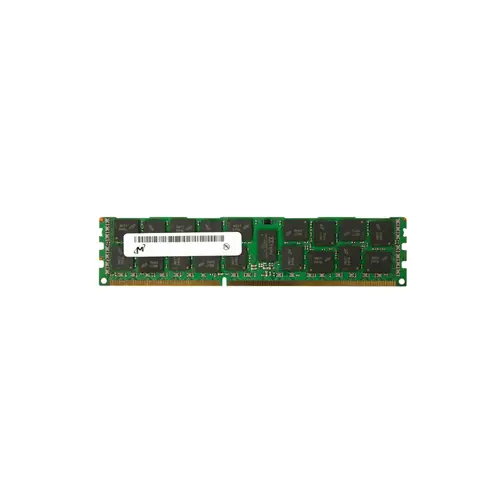
This 8GB DDR3-1333 Registered ECC RDIMM is engineered for server platforms running memory-intensive workloads like virtualization and in-memory databases, where data integrity under sustained load is critical. Its dual-rank x4 organization and ECC error correction combine with the registered signal buffering to deliver stable, low-latency CL9 performance across multiple DIMMs in enterprise-class systems.
1. ECC protection silently corrects single-bit memory errors before they cascade into application crashes or data corruption, a non-negotiable safeguard for transactional databases and mission-critical workloads.
2. Registered signaling buffers the command and address lines, stabilizing signal integrity across densely populated banks and enabling the large memory footprints that virtualization farms demand.
3. Dual Rank x4 organization leverages rank interleaving to hide refresh and precharge latencies, sustaining memory throughput even when multiple VMs compete for shared resources.
4. The 8 GB capacity per module strikes a density sweet spot, allowing system builders to populate all channels without exceeding budget while still provisioning ample headroom for containerized microservices.
5. DDR3-1333 speed provides a predictable and power-efficient bandwidth envelope, aligning with the steady-state throughput needs of file servers, caching layers, and mid-tier enterprise applications.
The module MT36JSZF1G72PZ-1G4D1BB is an 8 GB DDR3-1333 RDIMM built for servers, and its four defining engineering choices directly protect business-critical workloads. First, ECC continuously corrects single-bit memory errors triggered by background radiation, preventing silent data corruption. In a virtualized cluster running dozens of VMs on ESXi, that means a financial transaction or medical record never gets quietly altered inside a virtual machine. Second, the registered signal buffer stabilizes the command bus so you can populate all 24 DIMM slots without electrical loading that causes boot failures. This density is non-negotiable when your cluster must host hundreds of virtual desktops. Third, the dual‑rank x4 organization allows interleaved access, delivering higher effective bandwidth to an in‑memory database like SAP HANA; analytics queries finish faster because the memory controller can overlap row activations. Finally, 8 GB at 1.5 V offers a dense, standard‑voltage footprint that fits mainstream rack servers without unpredictable thermal spiking. Together, these characteristics turn a commodity upgrade into a foundation for always‑on data integrity, reliable scalability, and responsive in‑memory processing.
General Virtualization
For virtualized environments, memory capacity and balanced channel population are vital. Install at least one 8GB RDIMM per memory channel—a six-module (48GB) configuration suits entry-level consolidation, while twelve modules (96GB) allow heavier multi-VM workloads. Distributing identical DIMMs across both CPU sockets guarantees symmetric NUMA access and prevents bottlenecks.
In-Memory Database
In-memory databases require the largest reliable RAM footprint. Populate every DIMM slot with these 8GB Registered ECC modules—typical builds range from sixteen (128GB) to twenty-four (192GB) and beyond. ECC corrects errors automatically, which is critical for data integrity. Uniform channel population and dual-rank x4 organization sustain high throughput during sustained reads and writes.
HPC
HPC codes are often memory-bandwidth-bound. Install exactly one DIMM per channel to achieve maximum speed; eight modules (64GB) perfectly fit a dual-socket server with four channels per CPU. The dual-rank x4 design at CL9 provides a favorable blend of latency and capacity. Add a second DIMM per channel only if working sets exceed 64GB, noting possible frequency drops.
Server-grade DDR3 RDIMM, rigorously tested. Compatible with Dell PowerEdge R720, HP DL380p Gen8, Lenovo ThinkServer RD630.
Q: Can I mix this MT36JSZF1G72PZ-1G4D1BB with other memory modules of different brands or speeds?
A: Mixing different brands or speeds is not recommended for server environments. It may cause stability issues or POST failures. For optimal reliability, populate all channels with identical RDIMMs matching this module's specifications.
Q: Is this memory compatible with my system?
A: This module is a DDR3-1333 ECC Registered RDIMM. It is compatible with servers based on Intel Xeon 5500/5600 series, AMD Opteron 6100 series, or platforms that require 1.5V, 240-pin registered memory. Verify your motherboard's qualified vendor list.
Q: What is the recommended DIMM population order for optimal performance?
A: Follow your server motherboard's population guide. Generally, populate identical modules in matching slots per memory channel, starting with the farthest slots from the CPU, to enable multi-channel interleaving and maintain signal integrity with these dual-rank DIMMs.
Q: Does this module support overclocking or XMP profiles?
A: No. As an enterprise-grade ECC Registered DIMM, it adheres strictly to JEDEC standards for stability. Overclocking and XMP profiles are not supported, ensuring data integrity under 24/7 operation in server deployments.
Q: What warranty and typical failure rate can I expect?
A: This module includes a one-year warranty. It is manufactured to rigorous server-grade standards, resulting in a very low annualized failure rate, typically below 0.5%, backed by thorough pre-shipment testing for mission-critical reliability.