











 Secure payments
Standard refund policy
Trade Assurance
Secure payments
Standard refund policy
Trade Assurance
| Model | MT18KSF1G72AZ-1G4E1 |
|---|---|
| Product Type | Memory Module |
| Compliance Standards | RoHS |
| Memory Capacity | 8 GB |
| Memory Technology | DDR3 |
| Product Voltage | 1.35V |
| RAM Speed | 1333MHz |
| RAM Standard | DDR3-1333/PC3-10600 |
| Error Identifying | ECC |
| Signal Type | Unbuffered |
| Column Access Strobe (CAS) | CL9 |
| Rank | Dual Rank x8 |
| Quantity of Pins | 240-pin |
| RAM Genre | UDIMM |
Ideal for entry-level servers and workstations requiring data integrity, this DDR3L-1333 UDIMM leverages ECC error correction and a 1.35V low-voltage design to maintain 24/7 operational stability under memory-intensive tasks. Its dual-rank x8 organization improves interleaving efficiency for moderate virtualization and database workloads, while unbuffered signaling keeps latency low at a CAS latency of 9.
1. ECC error correction stops single-bit memory faults instantly, preserving transactional accuracy in database servers where silent data corruption can cause revenue-impacting anomalies.
2. An 8-gigabyte capacity per stick lets a small business server run multiple lightweight VMs simultaneously, forestalling memory exhaustion during peak collaboration hours.
3. The 1333 megahertz frequency sustains a steady 10.6 GB/s throughput, preventing lag in multi-user file-access scenarios like remote desktops and project shares.
4. Operating at just 1.35 volts cuts rack-level power draw and waste heat, which improves hardware longevity and keeps always-on microserver electricity bills in check.
5. Dual-rank x8 organization maximizes channel utilization by overlapping memory accesses, a direct enabler for fluent virtual machine response under consolidation-heavy workloads.
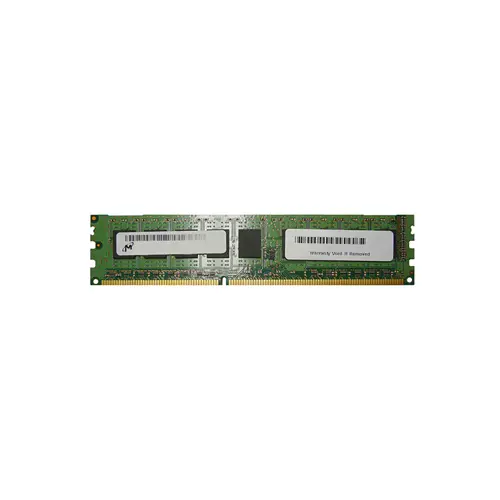
Designed specifically for entry-level servers and workstations, the Micron MT18KSF1G72AZ-1G4E1 is an 8 GB DDR3 UDIMM that brings enterprise-grade reliability to critical single-socket systems. Its ECC technology is the first line of defense against silent data corruption. In a virtualized environment running multiple VMs, a single-bit error in memory can cascade into a crashed hypervisor or corrupted virtual disk. ECC detects and corrects these errors in real time, keeping your virtual infrastructure stable. For a ZFS-based NAS or file server, ECC guards the integrity of every checksum and data block, preventing long-term storage rot that non-ECC desktop memory simply cannot detect.
Built at 1.35V, this low-voltage module significantly reduces thermal load and power consumption inside compact 1U chassis or small office servers that often run 24/7. It lowers electricity costs and eases cooling, directly extending component lifespan. The dual-rank x8 organization and 1333 MHz speed with CL9 latency improve memory interleaving, so when you run a memory-intensive database application, multiple read and write streams overlap seamlessly. This means faster query response and smoother multi-user access without the memory controller stalling. For the IT professional maintaining an always-on system, this memory translates into concrete uptime, data accuracy, and operational savings.
General Virtualization
For a typical single- or dual-socket server using DDR3 ECC UDIMMs, populate at least four 8 GB modules (32 GB total) to support a moderate VM density. Deploy the modules in matched pairs across memory channels to maintain balanced interleaving and maximize throughput. This configuration provides headroom for hypervisor overhead and multiple light to medium guests while keeping power draw low with 1.35 V operation.
In-Memory Database
Maximize capacity by filling all available DIMM slots—typically six or eight on such platforms—to reach 48–64 GB or more. ECC correction is critical for data integrity in memory-resident workloads, so use identical 8 GB dual‑rank UDIMMs. The lower latency of unbuffered modules benefits transaction processing, but ensure the CPU’s memory controller limits are not exceeded when populating all channels.
High-Performance Computing
Install modules in symmetric groups to exploit the server’s multi‑channel architecture; four 8 GB sticks in a quad‑channel board deliver 32 GB of bandwidth‑optimized memory. Dual‑rank x8 organization helps sustain throughput under heavy floating‑point or parallel I/O loads. Stick to low‑voltage 1.35 V parts to reduce thermal stress in dense compute nodes while relying on ECC to catch silent data corruption during long-running jobs.
Server memory rigorously tested. Compatible with Dell PowerEdge R210 II, T110 II, HP MicroServer Gen8, Lenovo ThinkServer TS140.
Q: Can I mix this MT18KSF1G72AZ-1G4E1 with other memory modules of different brands or speeds?
A: Mixing is not recommended. ECC UDIMMs require matched ranks and timings. Different speeds will downclock to the slowest module, potentially causing instability in server environments. Always use identical kits.
Q: Is this memory compatible with my system? (Intel/AMD server platforms)
A: It is compatible with DDR3 ECC UDIMM systems based on Intel Xeon E3/E5 series or AMD Ryzen/EPYC platforms that support unbuffered ECC modules. Verify your motherboard's QVL and support for 240-pin DDR3-1333.
Q: What is the recommended DIMM population order for optimal performance?
A: For dual-socket servers, populate identical DIMMs per channel starting with the slots farthest from the CPU. Follow your motherboard's guide for matching ranks; mixed positions can disable ECC or reduce memory bandwidth.
Q: Does this module support overclocking or XMP profiles?
A: No. Server-class ECC UDIMMs operate at fixed JEDEC standard profiles. Overclocking or XMP is not supported and could compromise data integrity. This module runs at native DDR3-1333 with 1.35V.
Q: What warranty and typical failure rate can I expect?
A: This product includes a one-year warranty. Server ECC UDIMMs undergo rigorous testing and exhibit very low annualized failure rates, typically under 0.5%, when operated within specified environmental and electrical parameters.