











 Secure payments
Standard refund policy
Trade Assurance
Secure payments
Standard refund policy
Trade Assurance
| Product Type | Memory Module |
|---|---|
| Compliance Standards | RoHS |
| Memory Capacity | 8 GB |
| Memory Technology | DDR3 |
| Product Voltage | 1.5V |
| RAM Speed | 1600MHz |
| RAM Standard | DDR3-1600/PC3-12800 |
| Error Identifying | ECC |
| Signal Type | Registered |
| Column Access Strobe (CAS) | CL11 |
| Rank | Single Rank x4 |
| Quantity of Pins | 240-pin |
| RAM Genre | RDIMM |
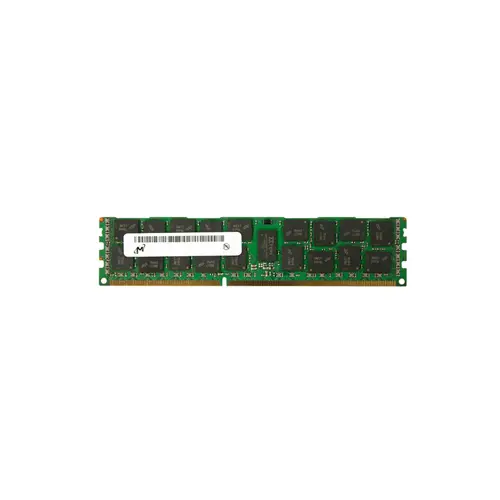
This DDR3-1600 Registered ECC module, with its 240-pin RDIMM form factor and single-rank x4 organization, is engineered for entry-level servers and workstations where data integrity and stability under moderate memory loads are critical. It is ideally suited for virtualization hosts or light in-memory databases, as the registered signal buffering and ECC protection reliably prevent single-bit errors in always-on environments while maintaining efficient 1600MT/s throughput.
1. ECC memory detects and corrects single-bit data corruption, preserving transactional integrity for always-on enterprise servers.
2. Registered command and address buffering enables high-capacity memory configurations, supporting greater VM density without compromising signal integrity.
3. The per-module capacity supports essential memory needs for moderate virtualization, keeping initial server investment efficient without wasting DIMM slots.
4. A single rank layout with narrow DRAM chips reduces bus loading, delivering the stable electrical environment required for 24/7 server workloads.
5. The memory speed aligns with the peak bandwidth requirements of legacy server processors, delivering responsive data throughput for caching and basic analytics.
The Micron MT18JSF1G72PZ-1G6D1F is a server-class DDR3 RDIMM purpose-built for data centers, and its four signature attributes directly address the real pain points of infrastructure managers. ECC proactively corrects single-bit errors caused by electrical noise or cosmic radiation. In an in-memory database such as SAP HANA, an uncorrected bit flip can silently corrupt a financial transaction; ECC turns that potential catastrophe into a seamlessly corrected event, safeguarding data fidelity. The registered buffer redrives command and address signals, dramatically increasing the number of modules a memory controller can handle. For a virtualization cluster, this means you can populate all channels without signal collapse, maximizing VM density and eliminating random crashes during live migrations. Its Single Rank x4 configuration presents a light electrical load, ensuring the DIMM maintains its full 1600MHz speed even in fully loaded servers. That directly prevents bandwidth throttling in Redis clusters where microsecond latency spikes erode user experience. Finally, the PC3-12800 bandwidth accelerates data throughput, keeping virtual workloads snappy and databases responsive. For you, this module translates to uncompromised data integrity, scalable capacity, and sustained velocity in environments where performance truly equals revenue.
General Virtualization
For virtualized environments running multiple VMs, these 8GB DDR3-1600 Registered ECC DIMMs ensure data integrity and stability. A baseline of 4 identical modules (32GB) supports moderate density, while 8 modules (64GB) allow more headroom. Always populate matching memory channels per CPU to maintain balanced NUMA performance.
In-Memory Database
In-memory databases like Redis or SAP HANA demand large, reliable capacity. Although a single 8GB RDIMM is modest, you can aggregate many for a substantial footprint. Plan to fill all available DIMM slots with identical 8GB sticks — for example, 12 modules yield 96GB — and leverage ECC to guard against silent data corruption in mission-critical datasets.
High-Performance Computing (HPC)
HPC workloads require high bandwidth and error resilience. Install one 8GB RDIMM per channel across all processor memory controllers to maximize bandwidth; a typical dual-socket node with 8 channels per CPU can start at 64GB (8 x 8GB). Use strictly matched speeds and ranks to prevent clock-down, ensuring peak throughput for simulation and modeling jobs.
Stringently tested RDIMM, proven compatible with Dell R720, HP DL380p Gen8, and IBM x3650 M4.
Q: Can I mix this MT18JSF1G72PZ-1G6D1F with other memory modules of different brands or speeds?
A: Mixing RDIMMs of different brands or speeds is not recommended. Registered ECC memory requires strict compatibility; mixing can cause POST failures or instability, especially in mission‑critical server environments.
Q: Is this memory compatible with my system?
A: This 8GB DDR3-1600 Registered ECC module is designed for servers using Intel Xeon E5‑series or AMD Opteron platforms with 240‑pin DDR3 RDIMM slots. Verify your motherboard’s Qualified Vendor List for compatibility.
Q: What is the recommended DIMM population order for optimal performance?
A: Populate identical RDIMMs in sets matching your CPU’s memory channels (e.g., one per channel first, then second). Follow your server’s slot numbering—often slots 1A, 2A, 1B, 2B—to enable full memory interleaving and avoid NUMA imbalances.
Q: Does this module support overclocking or XMP profiles?
A: No. This is a JEDEC‑compliant 1.5V server RDIMM with fixed CL11 timings. Overclocking and XMP are not supported; operating outside rated specifications can compromise ECC protection and system stability.
Q: What warranty and typical failure rate can I expect?
A: This module carries a 1‑year warranty. Actual failure rates are extremely low (typically <0.2% AFR) when operated within specified temperature and voltage parameters, reflecting the high reliability expected of enterprise server memory.