











 Secure payments
Standard refund policy
Trade Assurance
Secure payments
Standard refund policy
Trade Assurance
| Product Type | Memory Module |
|---|---|
| Compliance Standards | RoHS |
| Memory Capacity | 8 GB |
| Memory Technology | DDR3 |
| Product Voltage | 1.5V |
| RAM Speed | 1600MHz |
| RAM Standard | DDR3-1600/PC3-12800 |
| Error Identifying | ECC |
| Signal Type | Registered |
| Column Access Strobe (CAS) | CL11 |
| Rank | Single Rank x4 |
| Quantity of Pins | 240-pin |
| RAM Genre | RDIMM |
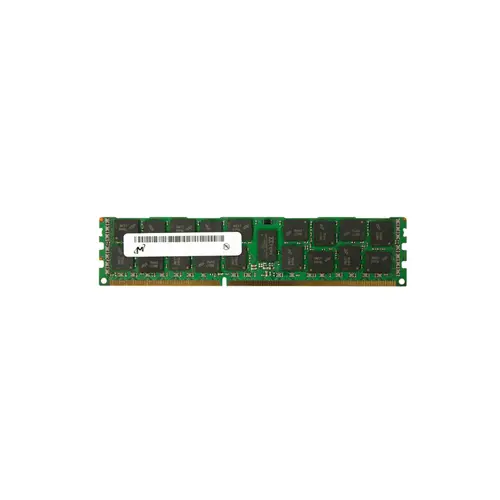
Designed for server platforms, this 8GB DDR3-1600 RDIMM combines ECC error correction with a registered signal architecture to ensure rock-solid data integrity for virtualization, in-memory databases, and mission-critical workloads. Its single-rank x4 configuration minimizes electrical loading on the memory bus, enabling higher density deployments and stable multi-DIMM operation in 24/7 data center environments.
1. Generous capacity per module allows dense server configurations, enabling businesses to run multiple virtualized workloads without memory bottlenecks.
2. High-frequency operation accelerates data exchange between CPU and memory, reducing latency for real-time database processing and in-memory caching.
3. Integrated error correction shields mission-critical data from bit flips, ensuring application consistency vital for financial services and cloud platforms.
4. Registered buffering isolates the memory controller from electrical loads, permitting massive memory expansions while maintaining rock-solid signal integrity in rack servers.
5. Single Rank x4 organization strikes an optimal balance between capacity and bus efficiency, preserving command scheduling precision for sustained compute accuracy.
When you’re running a dense virtualization cluster or an in-memory database where every transaction matters, the MT18JSF1G72PZ-1G6D1FF isn’t just a module—it’s your silent guardian against costly downtime. As an 8GB DDR3-1600 Registered ECC RDIMM, it directly addresses the pain points that keep IT managers awake at night.
ECC is your first line of defense. In a server farm processing financial transactions, a single-bit flip from background radiation can cascade into a corrupt database commit. This module detects and corrects those errors on the fly, preserving data integrity without crashing the application. That alone prevents the kind of silent data corruption that traditional desktop memory simply ignores.
The registered signal buffer is what lets you pack a virtualization host with all the RAM your VMs demand. Without it, the memory controller would buckle under heavy loads, forcing you to sacrifice density. For a VMware cluster running dozens of payloads, registered logic stabilizes the command bus, so you can fill every available slot and still enjoy rock-solid uptime during live migration storms.
That single-rank x4 organization and CL11 timing are tuned for real workloads, not just benchmarks. In an in-memory analytics platform like a Redis cluster, the rank interleaving and 1600MT/s bandwidth mean your hottest datasets stream into the CPU with consistent latency, eliminating the micro-stutters that throttle query throughput. The 1.5V specification also keeps thermals in check inside tightly packed 1U nodes, where every watt saved extends the life of your cooling budget and your hardware. This is memory engineered not for spec sheets, but for the server rooms where it actually lives.
The module is an 8GB DDR3-1600 Registered ECC RDIMM (single-rank x4), strictly for server deployments. Below are capacity planning recommendations for three common server workloads. Always use identical modules and verify platform Registered-ECC support.
General Virtualization
Populate memory channels evenly; start with 8 modules (64GB) spread across eight channels on a dual-socket server. This provides balanced bandwidth for 20–30 light VMs. For greater density, add a second DIMM per channel (128 GB total), though speed may drop to 1333 MHz.
In-Memory Database
Maximize capacity by filling every DIMM slot — a 24-slot server achieves 192 GB. Distribute modules symmetrically between CPUs to guarantee uniform memory access and low latency for large datasets.
High-Performance Computing (HPC)
Prioritize bandwidth: install one DIMM per channel (8 or 16 modules, 64–128 GB) to sustain the full 1600 MHz and enable channel interleaving. The single-rank design helps maintain peak throughput for parallel scientific workloads.
Proven compatible with Dell R720, R620, HP DL360p Gen8, Lenovo RD630 servers.
Q: Can I mix this MT18JSF1G72PZ-1G6D1FF with other memory modules of different brands or speeds?
A: Mixing RDIMM brands or speeds is not recommended. Mismatched timings, ranks, or voltage can cause instability and memory training failures in servers. Use identical modules for validated, reliable operation.
Q: Is this memory compatible with my server system?
A: This 8GB DDR3-1600 ECC Registered DIMM requires a server board supporting 1.5V RDIMM. It's compatible with platforms like Intel Xeon E5-2600 v1/v2 or AMD Opteron 6300 series. Verify your board supports registered x4-based modules.
Q: What is the recommended DIMM population order for optimal performance?
A: Follow your server's population guide, typically balancing channels per CPU. For optimal throughput, install identical DIMMs in sets of three or four to enable triple/quad-channel mode. Fill blue slots first on most two‑socket Intel boards.
Q: Does this module support overclocking or XMP profiles?
A: No. As a server-class Registered ECC module, it operates exclusively at JEDEC-standard DDR3-1600 (PC3-12800) with fixed CL11 latency. It does not support XMP or manual overclocking to ensure data integrity and 24/7 stability.
Q: What warranty and typical failure rate can I expect?
A: This genuine Micron module is covered by a 1‑year warranty. Enterprise RDIMMs exhibit an extremely low annualized failure rate, typically under 0.2%, due to rigorous testing and premium component binning.