











 Secure payments
Standard refund policy
Trade Assurance
Secure payments
Standard refund policy
Trade Assurance
| Product Type | Memory Module |
|---|---|
| Compliance Standards | RoHS |
| Memory Capacity | 8 GB |
| Memory Technology | DDR3 |
| Product Voltage | 1.5V |
| RAM Speed | 1600MHz |
| RAM Standard | DDR3-1600/PC3-12800 |
| Error Identifying | ECC |
| Signal Type | Registered |
| Column Access Strobe (CAS) | CL11 |
| Rank | Single Rank x4 |
| Quantity of Pins | 240-pin |
| RAM Genre | RDIMM |
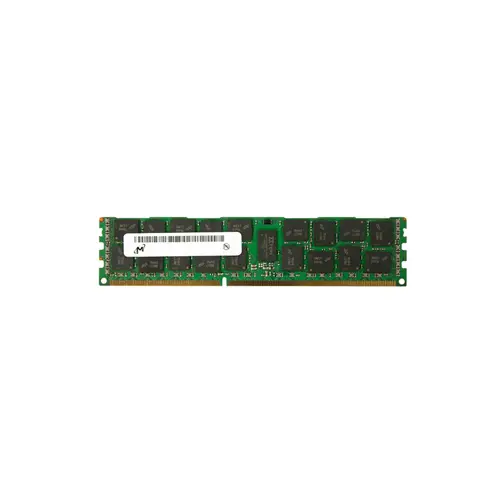
This Micron 8GB DDR3-1600 RDIMM with ECC and registered signaling is purpose-built for entry-level servers and small virtualization hosts, where data integrity and stable operation under moderate memory loads are critical. Its single-rank x4 configuration and 1.5V operation deliver reliable power efficiency, while the ECC engine actively corrects single-bit errors to prevent silent data corruption in memory-resident databases or light multi-tenant environments.
1. ECC protection silently detects and corrects single-bit memory errors, preventing silent data corruption in mission-critical enterprise databases and virtualized environments.
2. Registered signal buffering stabilizes high-density memory populations, enabling servers to scale up capacity without compromising command bus integrity under heavy load.
3. Generous capacity headroom allows more active virtual machines and larger in-memory datasets, reducing costly disk paging that degrades transaction response times.
4. High clocked throughput delivers the bandwidth needed to keep multiple processor cores fed, accelerating concurrent analytics queries and high-traffic web workloads.
5. A single rank of x4 organized DRAM reduces electrical loading on the channel, ensuring reliable signaling even when all server DIMM slots are fully populated.
The Micron MT18JSF1G72PZ-1G6E1 is an 8GB DDR3-1600 Registered DIMM (RDIMM) with ECC, purpose‑built for server workloads where downtime is simply not an option. In a dense virtualization cluster hosting dozens of VMs, ECC silently corrects single‑bit memory errors caused by background radiation or cosmic particles, preventing data corruption before it silently cascades into application crashes or filesystem inconsistencies. The registered buffer isolates the memory bus from the CPU, allowing the memory controller to drive multiple ranks across fully populated channels without signal degradation; this directly translates into scaling your hypervisor memory footprint safely past 256GB while maintaining rock‑solid stability. The single‑rank x4 organization balances bandwidth and thermal load, ensuring your in‑memory database like Redis or SAP HANA sees predictable low‑latency throughput at 1600MT/s without triggering DIMM throttling in dense 1U racks. For IT architects, that combination means fewer ECC‑induced performance penalties under heavy OLTP demand and confidence that mission‑critical services survive years of continuous operation without silent data decay.
General Virtualization
Populate each memory channel with two 8 GB RDIMMs, delivering 128 GB on a typical dual‑socket server. This symmetrical configuration provides ample headroom for numerous virtual machines while maintaining balanced performance. For entry‑level deployments, one DIMM per channel (64 GB total) preserves the full 1600 MT/s speed and reduces cost.
In-Memory Database
Maximise capacity by filling every DIMM slot. Using three 8 GB RDIMMs per channel on a dual‑socket platform yields 192 GB, enough to hold large datasets entirely in RAM. Expect a speed drop to 1333 MHz at 3 DPC, but the expanded capacity outweighs the bandwidth trade‑off for database workloads.
High-Performance Computing (HPC)
Prioritise bandwidth with a one‑DIMM‑per‑channel (1 DPC) setup—eight 8 GB modules give 64 GB at the rated 1600 MT/s, ensuring low latency for parallel jobs. If the simulation demands more memory, scale to 2 DPC (128 GB) and accept a slight frequency reduction while verifying application scaling.
Rigorously tested server memory, compatible with Dell PowerEdge R720/R620, HP DL380p Gen8, and Cisco UCS C220 M3.
Q: Can I mix this MT18JSF1G72PZ-1G6E1 with other memory modules of different brands or speeds?
A: Mixing in server environments is not recommended. The system will downclock all modules to the lowest common speed and may disable ECC functionality if unregistered DIMMs are present, risking stability.
Q: Is this memory compatible with my Intel or AMD server platform?
A: This DDR3-1600 Registered ECC RDIMM is compatible with servers using Intel Xeon E5-2600 v1/v2 or AMD Opteron 6300 series platforms. Verify your board supports 1.5V, 240-pin RDIMMs and single rank x4 organization.
Q: What is the recommended DIMM population order for optimal performance?
A: Follow your server motherboard manual. Typically, populate identical single-rank x4 RDIMMs in banks of three or four per memory channel for balanced interleaving and maximum throughput on multi-channel platforms.
Q: Does this module support overclocking or XMP profiles?
A: No. This is an enterprise-grade Registered ECC module operating strictly at JEDEC standard DDR3-1600 with CL11 timings. It does not support overclocking or XMP, as stability is prioritized over performance tuning.
Q: What warranty and typical failure rate can I expect?
A: This module is covered by a 1-year warranty. As a rigorously tested server-grade component with ECC, it exhibits an extremely low annualized failure rate (AFR) under normal operating conditions, typically below 0.5%.