











 Secure payments
Standard refund policy
Trade Assurance
Secure payments
Standard refund policy
Trade Assurance
| Product Type | Memory Module |
|---|---|
| Compliance Standards | RoHS |
| Memory Capacity | 8 GB |
| Memory Technology | DDR3 |
| Product Voltage | 1.5V |
| RAM Speed | 1600MHz |
| RAM Standard | DDR3-1600/PC3-12800 |
| Error Identifying | ECC |
| Signal Type | Registered |
| Column Access Strobe (CAS) | CL11 |
| Rank | Single Rank x4 |
| Quantity of Pins | 240-pin |
| RAM Genre | RDIMM |
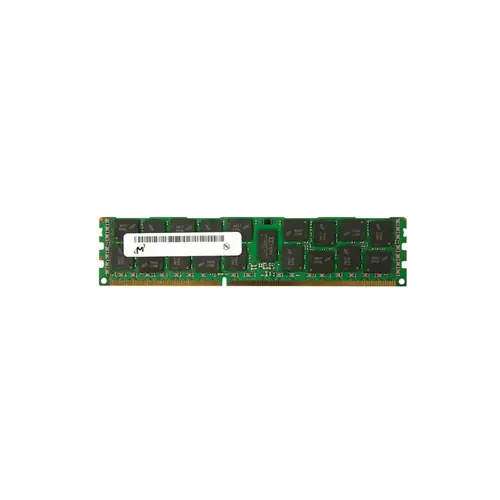
Designed for server-class platforms, this 8GB DDR3-1600 Registered ECC DIMM delivers critical data integrity and system stability for virtualization, in-memory databases, and other memory-intensive enterprise workloads. Its single-rank x4 organization and 1.5V operating voltage optimize signal integrity and power efficiency in dense multi-DIMM configurations, while the CL11 latency and Registered interface ensure reliable command/address handling under sustained load.
1. Eight-gigabyte capacity per module allows a single server node to host a larger number of lightweight virtual machines, improving consolidation ratios without immediate investment in new hardware.
2. ECC protection silently corrects single-bit errors in real time, safeguarding transactional databases and financial records from data corruption that would otherwise go undetected.
3. Registered signal buffering decouples the memory controller from the electrical load of the DRAM chips, enabling fully populated multi-channel configurations to run stably under 24/7 operation.
4. DDR3 technology preserves a validated upgrade path for aging server fleets, extending their useful life and lowering total cost of ownership through affordable capacity expansion.
5. Sixteen-hundred-megatransfers-per-second speed supplies steady throughput that keeps latency-sensitive enterprise applications, such as virtualization hypervisors and in-memory caches, fed with data without stalling.
In server environments, the Micron MT18JSF1G72PZ-1G6E1FI 8GB DDR3-1600 RDIMM is engineered to address critical challenges that directly impact uptime and application performance. Its ECC technology actively detects and corrects single-bit memory errors caused by background radiation, eliminating silent data corruption—an absolute necessity when a flipped bit in a financial database or virtualized cluster node could propagate into catastrophic transaction errors or entire VM crashes. The registered signal buffer stabilizes high-density configurations by reducing the electrical load on the memory controller, letting you populate multiple DIMMs per channel for large-scale VMware vSphere or Hyper-V deployments without sacrificing boot reliability or risking intermittent faults under sustained load. In memory-intensive workloads like an in-memory Redis or SAP HANA database, the single-rank x4 organization and 1600MHz speed deliver predictable low-latency access and consistent bandwidth, avoiding the rank-stagger penalty that degrades query throughput. This means your analytics jobs finish on time and your virtualized services remain consistently responsive, even as concurrent user demand spikes during peak business hours.
Server Memory Capacity Planning Guide
The specified module is an 8GB DDR3-1600 Registered ECC RDIMM, designed exclusively for server platforms. For effective capacity planning, always prioritize dual or multi-processor memory interleaving and adhere to the memory population rules of the target server board.
General Virtualization
For general virtualization hosts, 64GB to 128GB total RAM is a common baseline. Deploy eight to sixteen of these 8GB modules across all memory channels per processor to ensure balanced performance. This configuration provides ample headroom for consolidating dozens of moderate VMs while maintaining the ECC protection critical for multi-tenant stability.
In-Memory Database
In-memory databases demand the lowest latency and highest capacity. Populate all memory channels with these 8GB RDIMMs, aiming for 256GB or more to keep entire datasets resident in RAM. A fully populated system using three DIMMs per channel (3DPC) may require speed adjustments, so verify platform guidelines. The Registered ECC is non-negotiable for data integrity in transactional environments.
High Performance Computing (HPC)
HPC clusters benefit from high bandwidth, achieved by installing one identical 8GB RDIMM per channel (1DPC) at the rated 1600MT/s. For compute-bound nodes, 64GB to 128GB total is often sufficient, focusing on maximizing memory channels rather than raw capacity. Consistent single-rank x4 modules ensure uniform thermal and electrical characteristics under sustained full load.
Rigorously tested server memory, compatible with Dell PowerEdge R720/R620, HP DL380p Gen8, and similar DDR3 ECC RDIMM systems.
Q: Can I mix this MT18JSF1G72PZ-1G6E1FI with other memory modules of different brands or speeds?
A: Mixing different brands or speeds is not recommended for servers. It may cause instability or disable ECC functionality. We strongly advise using identical part numbers to ensure consistent timing, rank, and registered operation.
Q: Is this memory compatible with my system?
A: This DDR3 ECC Registered RDIMM suits Intel Xeon E5/E5 v2 or AMD Opteron 6300 series platforms. Always consult your server board’s qualified vendor list to confirm support for 8GB 2Rx4 PC3-12800 modules.
Q: What is the recommended DIMM population order for optimal performance?
A: Populate identical DIMMs per memory channel, typically starting with slots of the same color. For RDIMM configurations, follow your server manual’s balanced layout to maximize throughput and ensure correct ECC interleaving.
Q: Does this module support overclocking or XMP profiles?
A: No. This is an enterprise-grade RDIMM built to JEDEC standards for 24/7 stability. It does not support overclocking or XMP profiles, as data integrity and reliability are prioritized over extra frequency headroom.
Q: What warranty and typical failure rate can I expect?
A: This module carries a one-year warranty. Typical field failure rates are extremely low thanks to rigorous screening and Micron-quality manufacturing. Our testing guarantees reliable operation within specified server environments.