











 Secure payments
Standard refund policy
Trade Assurance
Secure payments
Standard refund policy
Trade Assurance
| Product Type | Memory Module |
|---|---|
| Compliance Standards | RoHS |
| Memory Capacity | 8 GB |
| Memory Technology | DDR3 |
| Product Voltage | 1.5V |
| RAM Speed | 1600MHz |
| RAM Standard | DDR3-1600/PC3-12800 |
| Error Identifying | ECC |
| Signal Type | Registered |
| Column Access Strobe (CAS) | CL11 |
| Rank | Dual Rank x4 |
| Quantity of Pins | 240-pin |
| RAM Genre | RDIMM |
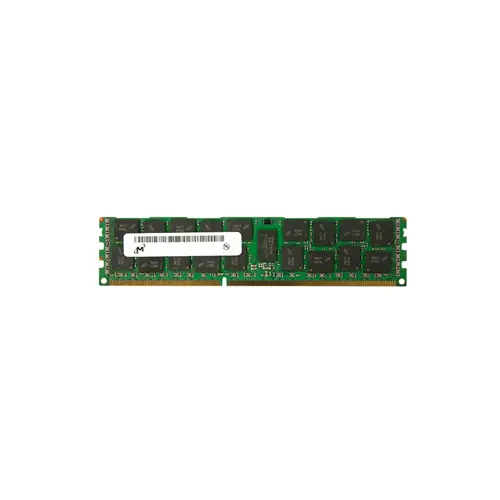
Optimized for server deployments, this 8GB DDR3-1600 Registered DIMM with ECC delivers uncompromised data integrity, making it ideal for virtualization hosts and memory-intensive enterprise workloads where silent data corruption cannot be tolerated. Its dual-rank x4 configuration enhances signal stability on densely populated boards while maintaining respectable bandwidth, and the CAS latency of 11 balances access speed with the command/address buffering inherent to RDIMM architectures.
1. Registered signal buffering stabilizes high-density memory configurations, enabling reliable operation across fully populated server banks in demanding virtualization clusters.
2. ECC error correction automatically detects and fixes single-bit memory faults, preserving transactional data integrity for financial or database workloads that cannot tolerate silent corruption.
3. Dual Rank x4 organization maximizes per-channel bandwidth utilization, reducing memory access contention when running simultaneous multi-tenant cloud instances.
4. An 8 GB capacity per module provides essential headroom for virtual machines, allowing consolidation of moderate-duty guests without immediate hardware expansion.
5. The 1600 MHz speed delivers predictable throughput for DDR3-era enterprise applications, balancing sufficient performance with the lower power envelope that dense data centers require.
The MT36JSF1G72PZ-1G6K1H is a server-grade DDR3 RDIMM engineered to eliminate the reliability and scaling bottlenecks that data-center operators fear. Its ECC corrects single-bit errors, a critical defense for virtualization clusters where bit flips silently corrupt data or crash VMs. Registered buffering stabilizes the command/address bus, allowing full channel population for dense hypervisor hosts without signal integrity issues. The dual-rank x4 organization leverages rank interleaving to increase effective bandwidth, accelerating memory-intensive in-memory database queries and analytics. Delivering 1600MHz speeds with a standard 1.5V supply, it provides brisk data throughput while maintaining energy efficiency for 24/7 data center workloads. Whether running a virtualized server farm or an in-memory database, this module’s fusion of integrity, stability, and speed keeps your operations uninterrupted and your data trustworthy.
Based on the provided specs—DDR3 8GB Registered ECC RDIMM at 1600MHz—this is unmistakably server-class memory. Capacity planning with 8GB modules must focus on population rules and workload-specific latency/capacity tradeoffs in dual- or quad-socket platforms.
General Virtualization
For modest consolidation (10–15 light VMs), populate at least six of these 8GB RDIMMs across three memory channels per socket to reach 48GB, preserving balanced channel interleaving. Avoid populating only one DIMM per channel, as that wastes the registered buffer’s ability to sustain command rates under frequent context switches. Scale to 96GB (12 × 8GB) for high-availability clusters where memory overcommit is risky.
In-Memory Database
In-memory datasets demand capacity far beyond a single 8GB module. Use multiples to fill all available slots per CPU while respecting rank limitations—these dual-rank x4 DIMMs can put substantial load on the memory controller. Aim for minimum 128GB (16 modules) in a two-socket system to hold indexes and hot tables entirely in RAM, configuring interleaving across all populated channels for lowest latency.
High Performance Computing
For bandwidth-sensitive HPC codes, populate one DIMM per channel on all available memory controllers to maximize throughput. A cluster node equipped with 12–16 of these PC3-12800 modules per socket delivers enough capacity for moderate problem sizes, but you must verify that CAS 11 latency and dual-rank loading do not force a frequency drop to 1333MHz under full population.
Rigorously tested server memory for Dell R720, HP DL380p Gen8, Lenovo x3650 M4.
Q: Can I mix this MT36JSF1G72PZ-1G6K1H with other memory modules of different brands or speeds?
A: Mixing registered modules of different brands or speeds is not recommended for server environments. It may cause signal integrity issues and system instability; always use identical modules for guaranteed compatibility.
Q: Is this memory compatible with my system?
A: This DDR3-1600 registered ECC RDIMM supports dual-processor Intel Xeon E5/E5-v2 or AMD Opteron 6300 series platforms. Please validate against your server board's Qualified Vendor List (QVL) for exact compatibility.
Q: What is the recommended DIMM population order for optimal performance?
A: For registered DIMMs, populate identical modules per channel starting with slot 1. Follow the platform's population guide (typically 1 DIMM per channel first) to maintain balanced memory interleaving and full ECC protection.
Q: Does this module support overclocking or XMP profiles?
A: No. This is a JEDEC-compliant registered server module operating at standard DDR3-1600 CL11. Overclocking and XMP are not supported; it is designed for 24/7 stability at 1.5V in enterprise environments.
Q: What warranty and typical failure rate can I expect?
A: This module includes a 1-year warranty. As an enterprise-grade RDIMM built with robust screening, the typical annualized failure rate (AFR) is well below 0.5% under normal operating conditions.